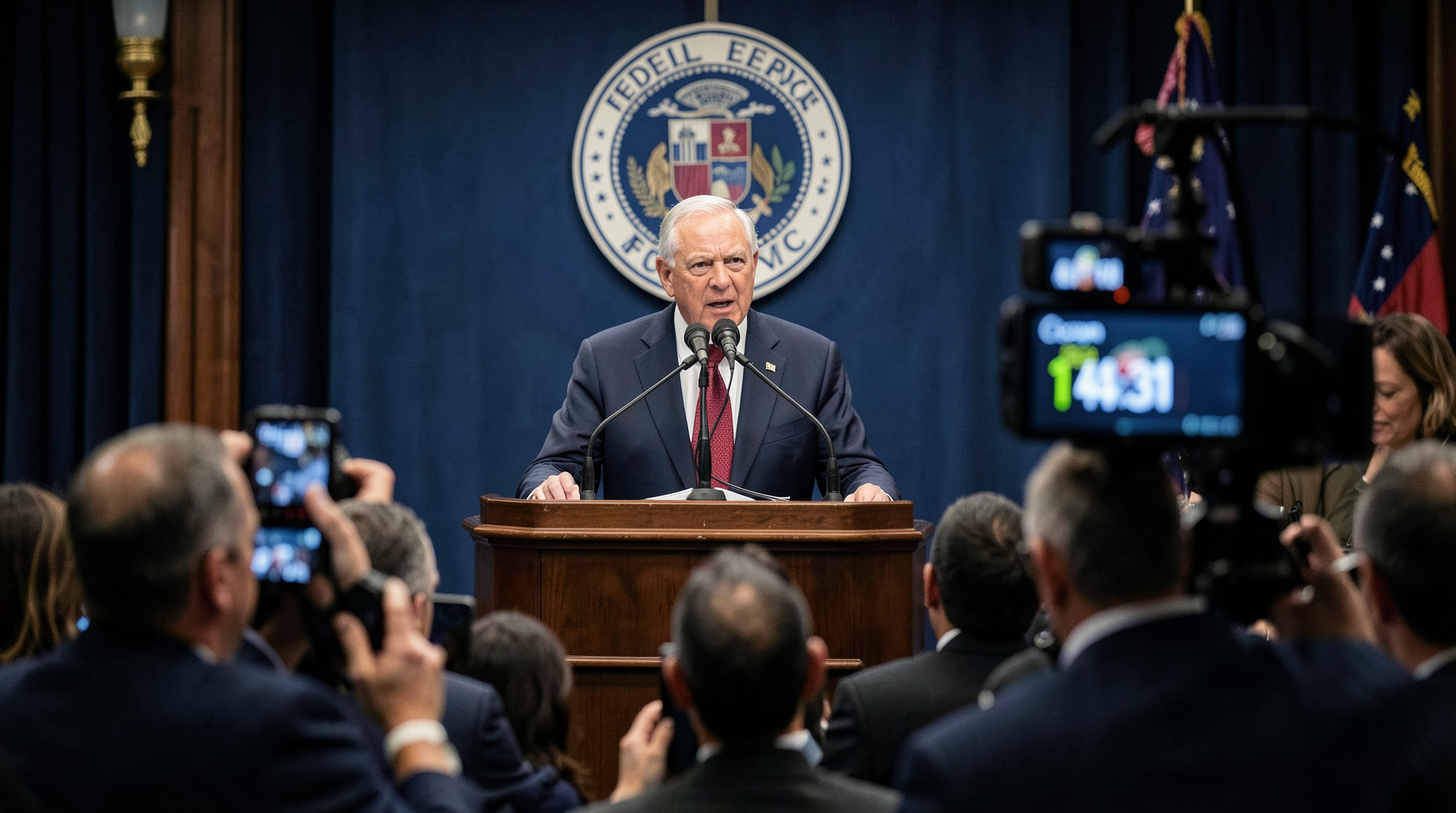
The Federal Open Market Committee will hold the federal funds rate at 3.50–3.75 percent at 2 p.m. Eastern Wednesday, ending Jerome Powell's final policy meeting as chair without a rate change for the third meeting in a row. [1] [2] The CME FedWatch tool, which trades the probability of every rate path, is pricing a 100 percent hold. [3] Powell will brief the press at 2:30 p.m., where the language to watch is what the statement says about the source of the inflation that has kept the Committee on hold. The March statement called the Iran war's economic implications "uncertain." Wednesday's statement is expected to be more specific, attributing the persistence of price pressure to "external energy conditions" — the central-bank phrase for the Strait of Hormuz blockade. [4] If Powell uses that language, it will be the first FOMC decision that publicly attributes its monetary inertia to a foreign chokepoint rather than to domestic data.
The Fed is not fighting this inflation. It is inheriting it.
The April 28 paper argued that Senator Thom Tillis dropping his hold on Kevin Warsh, after the Department of Justice abruptly closed its investigation of Powell on Friday, had turned the DOJ-Powell collapse into a confirmation pathway. Wednesday is when that pathway acquires a same-day broadcast partner. The Senate Banking Committee will vote Warsh out on a 13-11 line at 10 a.m. Eastern, four hours before Powell's last press conference. [5] By 3 p.m. the country will have heard the outgoing chair attribute its inflation problem to a war and seen the incoming chair clear his last committee hurdle. Both men will, on Powell's own April language, be on the Federal Reserve Board on May 16 — Warsh as chair, Powell as governor through January 2028. [6] The post-Powell Fed has a name and a residual board check on the same broadcast.
The substantive content of Wednesday's statement, leaked in part through the FOMC March minutes released April 8, is that the Committee's internal debate has shifted from "how soon do we cut?" to "do we hold, cut, or hike?" — a three-way debate with material probability mass on all three outcomes. [7] The minutes recorded that the number of officials willing to consider a 2026 rate hike grew between January and March from "several" to "some" — a meaningful Fed-language shift that traders read as a credible upside-risk vote. [7] Cleveland Fed President Beth Hammack and St. Louis President Alberto Musalem have publicly endorsed staying on hold "for an extended period"; Governor Christopher Waller said his entire path depends on whether Hormuz reopens. [8] Governor Stephen Miran, who voted for a cut at the March meeting, scaled back his estimate for cuts this year in remarks last week — even the lone dove is making room for war-driven inflation in his rate path. [9]
What the rate path is, in plain English: the Fed is not cutting because gasoline is at a four-year high, core CPI ticked up to 2.6 percent in March, headline CPI rose from 2.4 to 3.3 percent on the back of pump-price pass-through, and the Strait of Hormuz is closed. [10] [11] If the strait reopens, energy prices fall and the labor market — already weakened by 4.3 percent unemployment and slowing wage growth — becomes the binding constraint. If the strait stays closed through Q2, inflation accelerates and the Committee faces a real hike question for the first time in this cycle. The Wall Street Journal report Tuesday night that President Trump has told aides to plan for an extended Hormuz blockade is the second scenario. [12] Powell is delivering Wednesday's statement against the backdrop of that tasking.
Treasury Secretary Scott Bessent told reporters last week that Iran's onshore storage at Kharg Island would be "full" within "a matter of days," after which Iranian production would have to be shut in. [13] An Eurasia Group/Vortexa analysis put the combined floating-and-onshore Iranian buffer at roughly two and a half months. [14] That window is the window inside which the Hormuz price pressure persists at current intensity before the supply curve adjusts on the producer side. The Fed's hold is, in effect, a sixty-to-ninety-day option on whether the war ends inside that window. If it does, the Fed cuts in September or December, in line with consensus. If it does not, the Fed faces the question Powell has avoided framing publicly: whether a supply-shock inflation that runs into a third quarter is still "transitory" in any usable sense.
Powell's own language has tracked the ambiguity. In the March press conference, he said price shocks "are normally a temporary factor" but added that "given that the U.S. has seen above-target inflation for five years now, simply discounting them is inadvisable." [15] The Wednesday version of that sentence, if Powell delivers it, is the bridge between his eight-year tenure and Warsh's incoming one. Warsh has publicly expressed views more tolerant of inflation-fighting through hikes than the post-pandemic FOMC has been; the post-Powell consensus on the Committee will, on the public record of officials' speeches, be more hawkish than the consensus Powell leaves behind. [16] The handover is at a moment when the Committee's hawkish minority language is gaining institutional weight.
The Senate Banking math on Warsh, in the morning's other broadcast, is straightforward. The 13-11 line clears the committee on a party-line vote. Tillis, who said in mid-April he would block the nomination as long as the DOJ investigation of Powell continued, dropped his hold Monday after Attorney General Pam Bondi's deputy issued the no-action memo on Powell on Friday. [17] The Senate floor vote is expected by mid-May; Warsh would assume the chair on May 16, the day after Powell's term ends. Powell has signaled he will remain on the Board past that date. [6] Whether Powell stays as a board governor or steps down is the residual question Wednesday's press conference will not answer; both Powell himself and Fed legal counsel have framed his board tenure as separate from his chairmanship and running through January 2028.
The institutional consequence — for the Federal Reserve as an entity, separate from the policy path — is that Trump will get the chair he nominated and Powell will, in declining to leave the board, retain a vote. The post-Powell era begins Wednesday with both facts on the same broadcast. The DOJ-Powell investigation that the prior administration's critics described as a tool of presidential pressure has been quietly closed; the confirmation Warsh needed to start the chairmanship has been quietly cleared. Both quiet acts will be loud Wednesday because they share a clock with Powell's last press conference.
The market is positioned for the hold but not for the language. Reuters' April 17 poll of Fed-watcher analysts put the median 2026 rate-cut path at one quarter-point cut, most likely December. [18] Goldman Sachs raised its Brent forecast Sunday to a range that includes $115-$125 per barrel through year-end if Hormuz remains closed; the same forecast assumes one Fed cut in December and zero before. [19] Citi has flagged $150 Brent as a tail risk if oil flows remain disrupted through the end of June. [19] Federated Hermes' Sue Hill told USA Today the Hormuz uncertainty "reinforces the case for a Fed that remains on the sidelines, certainly for the upcoming meeting and in all likelihood for many months thereafter." [2] The consensus has converged on hold. The dispersion has migrated to the language Powell uses to explain it.
There is a frame the paper has carried through this cycle that today's meeting tests. The "war is the inflation story" frame held that the Iran conflict had become the binding macroeconomic variable, not a backdrop. Wednesday is the first time the country will hear the Federal Reserve chair say so under his own name. If Powell does — if the statement says the Committee is on hold because of "external energy conditions" rather than because of "elevated uncertainty" — the frame is in the official transcript, and the post-Powell Fed inherits it as a written premise rather than as an analyst's read. If Powell does not, and the statement holds the March language about "uncertain" Middle East implications, the war remains backdrop in the official record while the rate path absorbs it in fact. Either way, the substance is the same. The naming is the news.
Powell's eight years end in this room with this statement. The room he leaves is the same one Warsh will speak from in June. The country between the two press conferences will price the same blockade, watch the same FedWatch, and read the same Reuters lead. The Committee that was supposed to be cutting in 2026 is not. The Fed that is supposed to be independent of the war's politics is not, in the operational sense — its rate path is being set by a Strait of Hormuz fact that the President's tasking on Tuesday extended. Powell will say so, in central-bank prose, at 2:30 p.m. Wednesday. Then he will leave. Then Warsh will arrive at the same problem, with a more hawkish disposition and the same inflation. The handover is the policy, and the policy is the war.
-- THEO KAPLAN, San Francisco