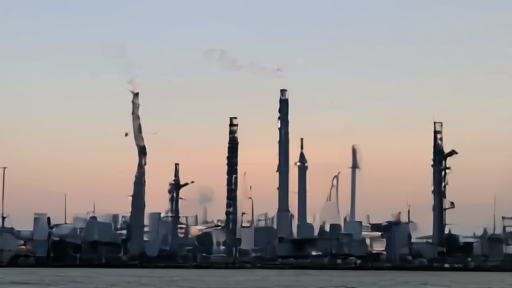
The U.S. Treasury issued a fresh advisory on Tuesday warning financial institutions that they could face sanctions for handling business with Chinese independent refineries — the so-called "teapots" — that import Iranian crude. [1] Treasury asked institutions to perform "enhanced due diligence" on transactions involving refineries in Shandong province, plus Asian and Middle Eastern entities tied to Iran's supply chain to China. [2]
The advisory landed the same day Reuters and Bloomberg sources reported that Hengli Group had shifted 95% of its Singapore trading arm to Dalian Changxing International Trade, a Chinese local-government entity. The paper's Monday account of Hengli's market-price denial after the OFAC designation framed the share-price collapse as the first sanctions-meet-corporate-response artifact. The Tuesday news is the second artifact: the company is not denying any longer; it is restructuring.
China buys roughly 90% of Iran's oil exports, with teapot refineries handling the bulk of those imports, Treasury noted in its statement. [1] Hengli Petrochemical's Dalian facility — designated April 24 as one of Iran's largest crude customers — has a processing capacity near 400,000 barrels a day. [3] The Singapore restructuring moved the trading arm out of a jurisdiction with extensive U.S. financial linkages and into one owned by a Chinese sub-sovereign government.
Treasury Secretary Scott Bessent posted on X that the department would "continue to exert maximum pressure and any person, vessel, or entity facilitating illicit flows to Tehran risks exposure to U.S. sanctions." [1] He added that Iran's main export terminal on Kharg Island was "soon nearing storage capacity," a claim that, if accurate, would tighten the blockade's domestic squeeze on Tehran. [1]
Sanctions experts read the bank advisory as the operative move. Refineries themselves have limited exposure to U.S. financial channels; the banks that finance them, often based in Hong Kong, Singapore, and the UAE, do. By telling those institutions that "any person, vessel, or entity" handling teapot transactions risks U.S. sanctions, Treasury is using the dollar's payments dominance as the enforcement layer. [1] That layer reaches further than designations of individual refineries.
The timing complicates Beijing's calendar. President Trump is scheduled to visit China in less than a month, in a trip framed publicly as a trade reset. [1] Bessent's advisory is the first major sanctions decision priced for that summit. The choice is to lift maximum pressure before the trip — making the trip easier — or maintain pressure and let Beijing register the cost of whatever talks produce. The advisory chose the latter.
Hengli's restructuring is the first publicly visible Chinese corporate response to the sanctions architecture. Reuters' sources placed the 95% ownership transfer to Dalian Changxing within days of the April 24 designation. [4] MarketScreener reported that Hengli's listed shares lost roughly $1.4 billion in market value as the news broke and traded "limit down" — the maximum permitted single-session decline on the Shenzhen exchange. [4] The Yicai coverage characterized the company's denial as a face-saving statement filed alongside the operational pivot. [4]
The two-track move — federal entity ownership in Dalian, plus a U.S. bank advisory — produces a tension neither side has fully tested. Treasury's leverage runs through the dollar payments system. China's response runs through state ownership and local-government opacity. The Singapore arm, when it was a private trading entity, was easier for Western counterparties to underwrite. As a sub-sovereign Chinese asset, it sits inside a category Western banks have historically been more cautious about declining, because the political costs of refusing run in both directions.
OFAC has now sanctioned five teapot refineries since the war began. [1] The advisory expanded the dragnet to port terminal operators in Shandong and logistics providers tied to the trade. [1] Hengli was the largest by capacity. The next test is whether the bank-level warning slows new business with the remaining four — or whether they too restructure under sub-sovereign Chinese cover before the Beijing trip.
-- DAVID CHEN, Beijing