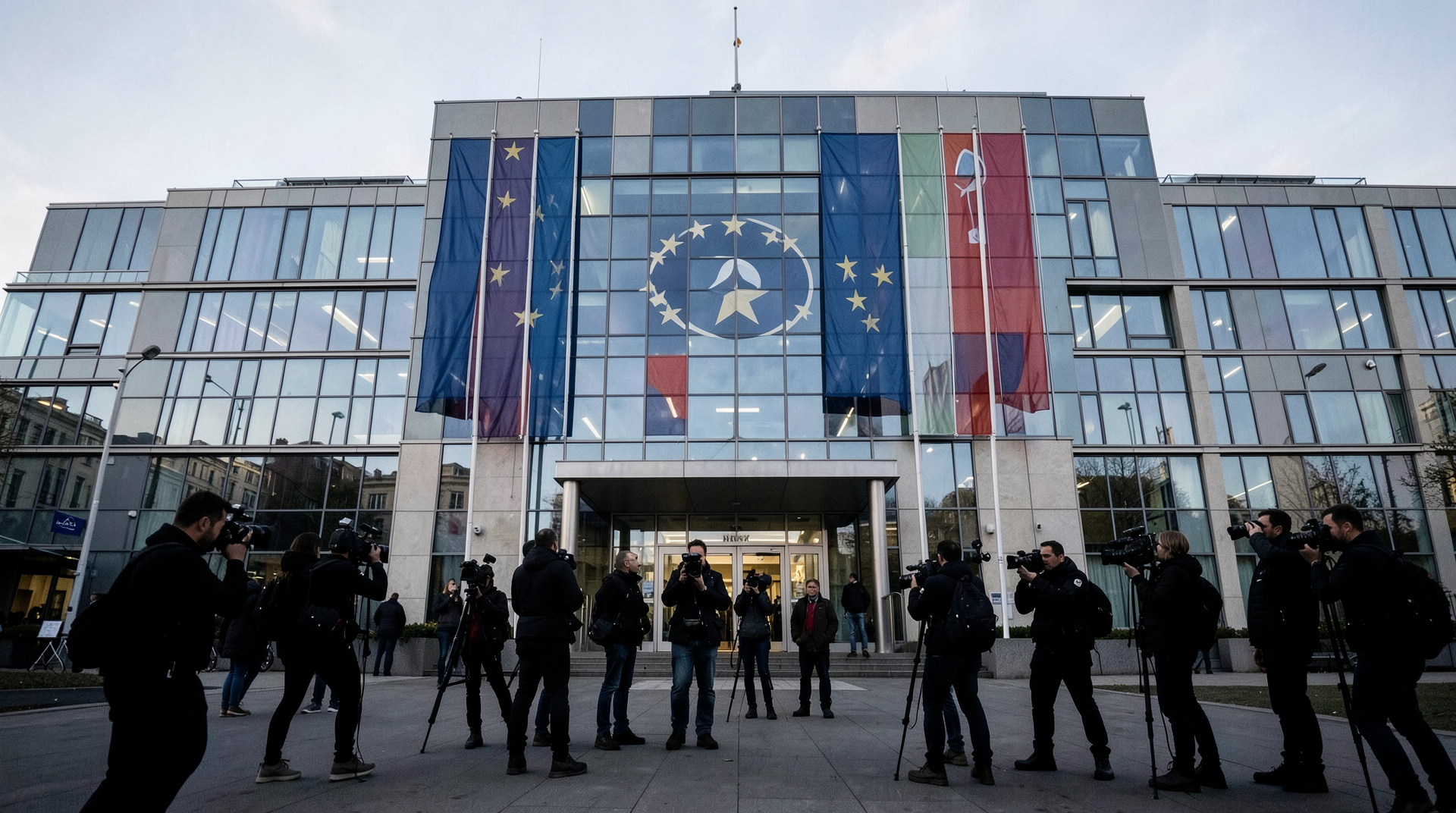
Trump told reporters Saturday that the U.S. troop drawdown from Germany would go "a lot further than 5,000." NATO headquarters in Brussels, through spokesperson Allison Hart, said it was "working with the U.S. to understand details" of the announced reduction. The president named Spain and Italy as next in the queue. Polish prime minister Donald Tusk warned that "the greatest threat to the transatlantic community are not its external enemies, but the ongoing disintegration of our alliance." [1][2][3]
The Brussels line is diplomatic for "we don't know." The president's line is the policy. The Tusk line is the only one that names the thing.
The May 2 paper carried the Pentagon's 5,000-troop order and the NDAA §1233 troop-floor collision. Saturday's "a lot further" is a second-order escalation. The order existed; now the order is bigger than the order. The clarification has been delegated to a press lawn rather than to the alliance whose troop posture is being changed.
The Mechanism
The U.S. military deployment in Germany sits at more than 36,000 active-duty troops — the largest U.S. force concentration in Europe. The 5,000-troop drawdown announced Friday was the floor; Trump's Saturday remark is the ceiling moving. NDAA §1233 caps permanent reductions at the 75,000-76,000 level for European Command and requires an impact report before further cuts. The Pentagon has not produced one. [4][5]
The statutory architecture is the same one the war-authorization-legitimacy thread has been tracking. A Pentagon spokesperson announces a force-posture change. The administration treats the statutory floor as advisory. Congress receives no impact report. The May 2 House Armed Services minority position — that the report is required — is unanswered. The drawdown becomes another binding statute recharacterized as administrative inconvenience.
NATO's Allison Hart used the precise diplomatic register: "we are working with the United States to understand the details." [3] In the alliance's protocol, that is the strongest available form of "the United States has not told us." The clarification request was filed through standard channels Friday afternoon and remained unanswered through the Sunday news cycle.
Tusk's Word
Tusk's framing — published in writing through his office Saturday — was harder than any other allied principal. "The greatest threat to the transatlantic community are not its external enemies, but the ongoing disintegration of our alliance. We must all do what it takes to reverse this disastrous trend." [2][6] The Polish prime minister has institutional reasons to push hardest: Poland sits on NATO's eastern frontier, and a Germany cut that signals Article 5 elasticity is felt in Warsaw before Berlin.
Tusk's "disintegration" is the noun Brussels has spent the week declining to use. The British prime minister offered a softer formulation; the French presidency a procedural one; Berlin's Pistorius said only that the withdrawal was "anticipated." Each capital chose its own register; Tusk chose the alliance's.
The frame matters because Article 5 is, in the end, a credibility mechanism. If a U.S. president can announce a unilateral drawdown from Germany on a press lawn, name Spain and Italy as next, and have NATO learn the details from Washington reporters, the credibility mechanism has already shifted. The treaty text is unchanged; the operating fact is not. Tusk's contribution is to describe the operating fact.
The Iran Connection
Trump's Saturday escalation came one day after German Chancellor Friedrich Merz repeated his line that the United States was being "humiliated" by Iran's negotiators in the war Washington had asked Berlin to help end. The drawdown announcement landed Friday. The "a lot further" expansion landed Saturday, as Iran's fourteen-point counter-proposal arrived. The sequencing is the policy. Merz spoke; Trump punished. [4][5]
The bank-war-economy and war-authorization-legitimacy threads now converge in Brussels. The alliance's eastern frontier is the geography of the war Russia is conducting; the alliance's southern frontier is the geography Iran's blockade is squeezing. A Germany drawdown announced inside the same fortnight as a CENTCOM commander boarding USS Tripoli, an OPEC+ production add, and an Iranian fourteen-point relay is not three policies. It is one. The geographic distribution of U.S. force has become a single negotiating instrument operated from one desk.
Merkel's successor learned this on Saturday. The next two capitals to learn it will be Madrid and Rome.
What Brussels Has to Decide
The clarification request was the easy step. The harder step is whether NATO assembles a collective response or accepts an a-la-carte alliance in which each capital negotiates its U.S. force posture bilaterally. The collective response would be a Defense Ministers' meeting — the next one is scheduled for June 4-5 in Brussels. Tusk's line was an opening bid for that meeting.
Mark Rutte, in his second year as Secretary General, has been holding the alliance's center through a difficult eighteen months. The "working with the U.S." formulation is his. Whether he upgrades it before June 4 — to a collective communiqué, a contingency review, a formal NDAA-floor inquiry routed through the U.S. Senate — is the real watch item. The alternative is the Sunday status quo: Tusk shouts, Hart equivocates, Madrid and Rome wait for the press lawn.
The May 1 thread memo on war-authorization-legitimacy held that "five binding statutes recharacterized as administrative inconveniences in one regime-week" was the operating frame. Saturday added the sixth — NDAA §1233's troop floor — and the seventh, by extension: NATO's Article 5 understanding that a U.S. force posture in a member state is not a press-lawn variable. Brussels can call this drift, disintegration, or the Saturday escalation. The naming convention is the only thing left under European control.
-- HENDRIK VAN DER BERG, Brussels