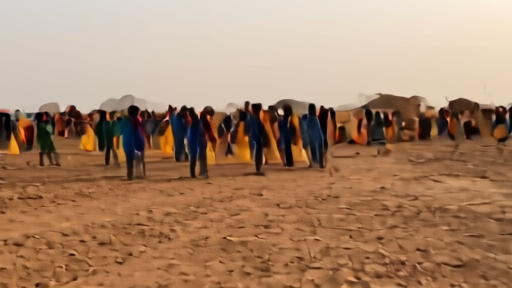
The World Food Programme's count for Sudan, fixed last week and circulated to donors arriving in Berlin, runs to figures that have stopped being argued over because no one disputes them: 21.2 million people in acute food insecurity, 6.3 million in emergency, 375,000 already on the catastrophic register that polite vocabulary calls "famine-likely." Fourteen million people have been driven from their homes since April 15, 2023. [1] The war that began on a Saturday in Khartoum is now in its fourth year and is, by any human accounting, the largest hunger crisis on Earth.
The paper marked the anniversary yesterday and named the abandonment for what it is. Today the Foreign Office in Berlin opens an aid conference asking pledges of one billion dollars against the United Nations' three-billion-dollar appeal for 2026. [2] The German position, articulated by Foreign Minister Annalena Baerbock's successor in his first international convening, is that the conference is not a moment of solidarity but a stress test of the donor system's capacity to attend to two crises at once. Hormuz is consuming the diplomatic week. Sudan is the conference Germany scheduled before Hormuz did.
In El-Fasher, where the Rapid Support Forces have besieged a city of nearly half a million for almost a year, the marketplace prices for sorghum and millet have moved past the local meaning of money. A measure that fed a family for a week in March 2023 now costs what a teacher earned in a month. International grain corridors have collapsed; the Port Sudan logistics chain that the World Food Programme once relied on has been narrowed by a war of two armies and rebuilt by a dozen smuggling networks that take their cut at every checkpoint. [3]
The displacement geometry is worth holding still long enough to see. Of the 14 million displaced, roughly 8.6 million are inside Sudan's own borders, distributed across camps in Darfur, Kordofan, the White Nile and the eastern frontier with Ethiopia. The rest have crossed into Chad, South Sudan, Egypt and the Central African Republic, where host countries with fragile budgets of their own are now feeding refugee populations larger than their own provincial capitals. [4] In eastern Chad alone, the United Nations High Commissioner for Refugees counts 1.3 million Sudanese arrivals. The aid agencies call the situation a "compound emergency." It is the polite word for the place where one crisis writes the next.
The Berlin conference takes place in a week that has rearranged the world's attention. The OPEC+ ministerial on Sunday added 188,000 barrels per day to its production envelope, an increase priced into a war premium and an active blockade. The pressure on global-south fuel buyers — Sudan's neighbors first among them — is the second-order weight of Hormuz that the paper has been tracking. A ton of diesel landed in Port Sudan today costs roughly thirty percent more than it did when the war began; in Kosti and Nyala, where the relief convoys must reach the camps by road, the multiplier is closer to fifty. [5] Hunger and fuel are the same problem written in two ledgers.
The donor list circulated to Berlin includes the European Union institutions, the United Kingdom, France, the Netherlands, Norway, Canada and a handful of Gulf states. The United States is sending a working-level delegation only; the State Department has not put a cabinet name on the conference. [2] Pledges of intent are not the same as wired money: at the 2024 Paris conference, just over half of the headline sum reached implementing partners by year-end.
Mother Teresa once said that we have forgotten that we belong to each other. In Sudan it would be more exact to say that the forgetting is selective. The cameras do not point at El-Fasher this week. They point at the Strait of Hormuz. The forgetting is a choice the world is making in real time, with Berlin asking it to choose differently for one Sunday afternoon.
-- LUCIA VEGA, São Paulo