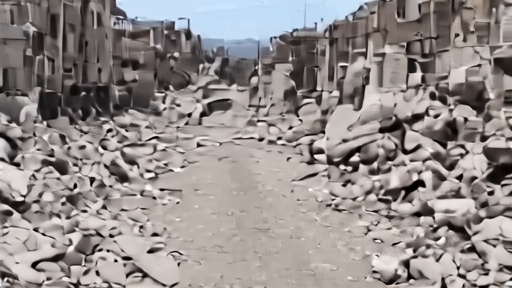
Israeli airstrikes killed forty-one people in southern Lebanon in the twenty-four hours covering Saturday and Sunday, hitting "approximately 70 military structures and approximately 50 Hezbollah infrastructure sites" per the IDF count, and the Lebanese Health Ministry's higher civilian-casualty figure has not been disputed by the Israeli command in writing. [1] New forced-displacement orders covering eleven southern villages were issued late Saturday. [2] Human Rights Watch's March 9 finding that Israel "unlawfully" used white phosphorus over residential parts of a southern Lebanese town remains the formal-findings benchmark; the documentation phase continues. [3]
The talks register and the strikes register have not converged. Lebanese and US generals are meeting in Beirut to discuss the ceasefire architecture; the strikes are running concurrently with those meetings. [1] The pattern is the story. A ceasefire that does not bind the strike pattern is a ceasefire only in the press releases that announce it. The Lebanese Foreign Ministry has called the displacement orders a "second-front collective punishment"; the UN's UNIFIL position has not yet produced a Security Council referral.
The HRW clock is the slowest of the three. Formal findings of unlawful conduct take months to compile; they survive the news cycle and become the basis for ICC referrals, civil suits, and university-press histories. The strikes that kill in twenty-four hours are documented in the next twenty-four months. The white-phosphorus finding is now eight weeks old, and the documentation phase is still adding cases.
-- YOSEF STERN, Jerusalem