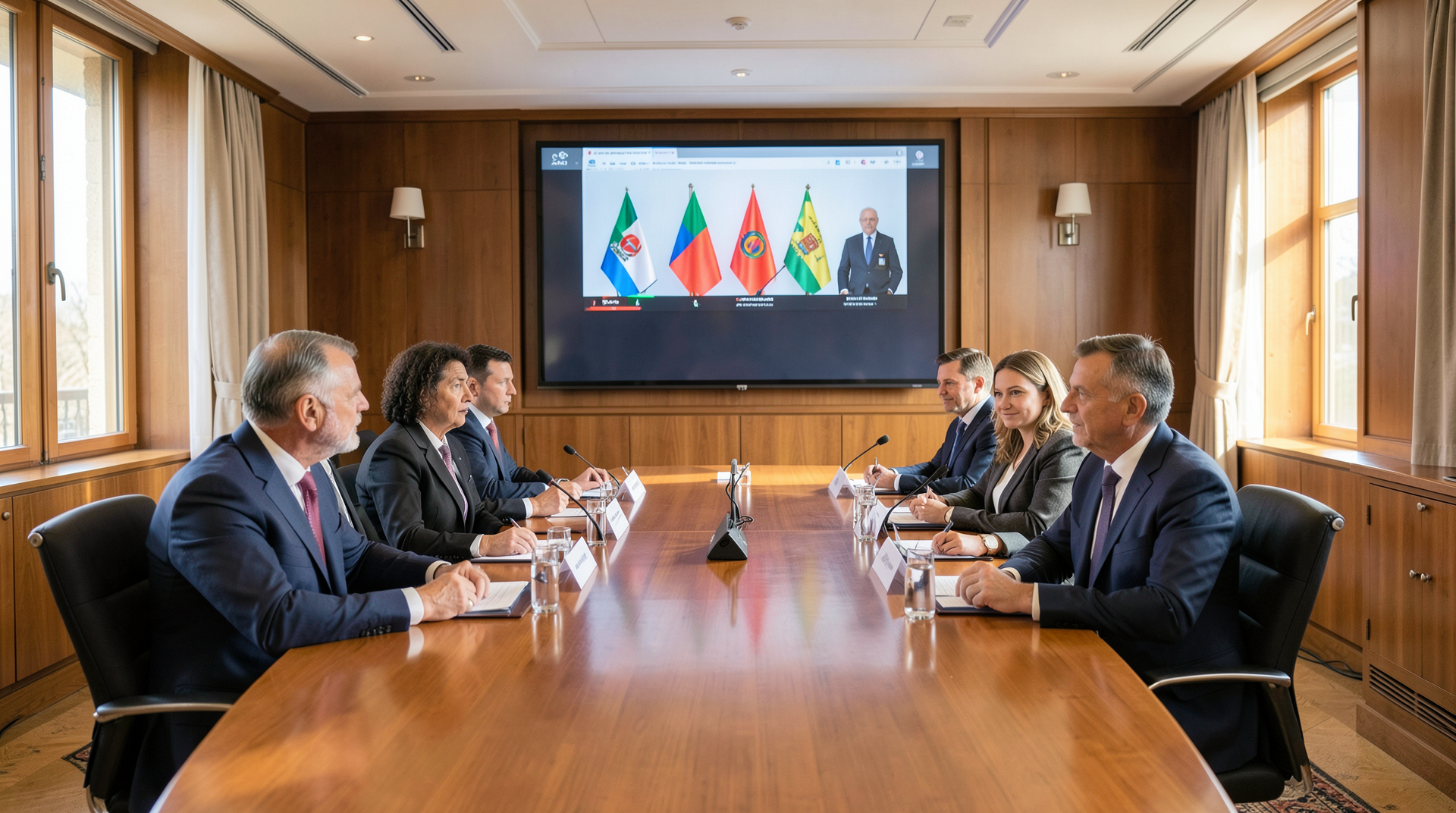
The OPEC-plus Joint Technical Committee meets in Vienna Monday to formalize the production-adjustment mechanism the seven remaining members agreed to by video conference Sunday. The number is one hundred eighty-eight thousand barrels per day for June. Saudi Arabia and Russia each take sixty-two thousand of that. The remaining sixty-four are split among Iraq, Kuwait, Kazakhstan, Algeria, and Oman. Argus Media reported Sunday afternoon that the JTC also agreed in principle to a baseline-recalibration mechanism — the formal procedure that resets the seven members' production quotas in the absence of the eighth, the United Arab Emirates, which left the bloc effective Friday May 1 after fifty-nine years. The next ministerial is set for June 7. [1][2][3]
The May 3 paper held that the cartel "added, it did not cut," and that an organization positioning for share rather than defending price was positioning for the war's end. The Monday JTC is the operational follow-on. A meeting that recalibrates the voluntary-cut envelope around seven members is, definitionally, a meeting where the eighth has stopped mattering. The Sunday communiqué named the seven by name. The Monday JTC writes the rule that handles the absence at the next meeting and the one after.
The Number Inside The Number
The eighty-eight thousand is the headline figure. The structural figure is the baseline mechanism. Argus's Sunday account is that the JTC agreed to "set new production baselines" for the remaining seven — meaning the reference levels against which voluntary cuts and adjustments are calibrated will be reset to reflect the new seven-member group rather than the historical eight. The mechanism question is technical. The mechanism answer is structural. A seven-member quota baseline, replacing an eight-member baseline, is the cartel's first formal acknowledgement that the eighth has gone. [3]
The communiqué Sunday named the seven by name: Saudi Arabia, Russia, Iraq, Kuwait, Kazakhstan, Algeria, Oman. The UAE was not in the list. Saturday's pre-meeting framing from Riyadh — that the UAE exit "doesn't mean anything" — could not survive a recalibration meeting that runs around seven and not eight. The Argus reporting Sunday is the Vienna desk's first acknowledgement that the seven know what the eighth knows. [2][3]
The UAE's suppressed capacity — roughly 1.6 million barrels per day, most of it offshore production routed through the Strait of Hormuz — is the structural detail the Sunday communiqué did not address. Most of that capacity has been shut in since the February 28 Hormuz closure. Loadings out of Fujairah, the UAE's primary deepwater terminal east of Hormuz, have run at a fraction of pre-war volumes. The day Hormuz reopens, the UAE has the marginal barrel for the marginal price, and the price is set by a producer no longer in the room. The seven inside the room know this. The cartel adding eighty-eight thousand into a one-hundred-eighteen-dollar Brent, while the UAE's six-times-larger capacity sits suppressed outside the room, is the signal. The signal is that the seven do not believe the war premium survives the year. [4][5]
The Cartel's Two Markets
The Monday JTC is doing two things at once. It is setting the headline production quota for June — the eighty-eight thousand barrels that, on a normalized basis, would be a routine quarterly adjustment. It is also establishing the procedural template for handling exits. The two acts are different. The first is share allocation; the second is institutional architecture.
The procedural template matters because the UAE exit may not be the last. The Wood Mackenzie note circulated Sunday, distributed through The National Friday and into the wire services Monday, framed the UAE departure as the first sovereign exit since the cartel's founding in 1960. Sovereign exits, in cartel theory, are the limiting case. A cartel that survives one exit by recalibrating its baseline can survive more. A cartel that cannot recalibrate cannot survive any. The Vienna mechanism, on Argus's reading, is the cartel choosing the survivable path. [3][4][6]
What the procedural template does not address is the price. Brent closed Friday at one hundred fourteen dollars and sixty-six cents per barrel, off the one-hundred-twenty-six-dollar high reached in mid-April. WTI closed near one hundred one. The eighty-eight thousand JTC announcement, on its face, is bearish for the front month. The curve, as of Friday's close, priced in backwardation through the June contract. The forward curve, ten months out, was already pricing in roughly ninety dollars. The market the JTC is communicating to has already discounted the war's end. The cartel is communicating to a curve that has run ahead of the news. [7]
The X reading inside the energy desks Sunday night was that the JTC's add was a positioning trade, not a price-defense trade. A cartel defending price would cut. A cartel positioning for share, against a competitor that has left the room and a market that prices a near-term resolution, would add. The energy desks read the cartel's communication as alignment with the curve. The curve is right. The cartel is communicating that the curve is right.
What The UAE Knows That The Seven Do Not Say
The UAE's exit, formally announced April 25 and effective May 1, was framed by Abu Dhabi as a strategic alignment with U.S. interests. The Energy Ministry's statement cited the bloc's "outdated quota mechanism" and the "growing divergence between national capacity and group allocation" as the operating reasons. The deeper architecture is the petroyuan question. Most UAE crude trade is dollar-denominated; the bloc's trajectory has been toward partial yuan invoicing, particularly for the Asian market. The UAE exit forecloses that trajectory for Abu Dhabi while leaving it open for Riyadh. [4][6][8]
What Abu Dhabi knows that the seven do not say out loud: when Hormuz reopens, the UAE has the lowest marginal cost producer in the Gulf, the most modern offshore infrastructure, and direct access to the Indian Ocean basin. Saudi Arabia routes most of its crude through Ras Tanura, which faces the Strait of Hormuz directly. The UAE routes through Fujairah, which sits east of the Strait. The exit positions Abu Dhabi to monetize the post-war capacity faster than the cartel can re-quota it. The seven inside the room are running the cartel mechanism that handles a production add. The eighth, outside the room, is running a different calculation: how fast it can ramp into a market that the cartel has already, by adding, signaled it expects to soften.
The Calendar That Runs Past June 7
The June 7 ministerial is the next decision point. The Argus mechanism, if implemented, sets the procedural floor under it. Between now and then, the IRGC's thirty-day Hormuz clock runs, the Treasury General License 134B Russia-oil expiry falls May 16, the Trump-Xi Beijing summit runs May 14 and 15, and the Cerebras IPO prices in mid-May. The OPEC-plus calendar is no longer a separate calendar. The cartel is pricing into the same dates that everyone else is pricing into.
The Saudi Aramco Q1 preliminary release lands May 10. The full call runs May 11. AlJazira Capital's pre-print model is for net profit of one hundred eight point eight billion riyals, up fourteen percent year-over-year and fifty-seven percent quarter-over-quarter. The Aramco print is the cartel's largest member's earnings; the print's deferred-dividend math is the structural question for the next ministerial. A producer that needs the capex to defend the dividend cannot, on the same logic the cartel is operating under, also support a price-defense quota cut. The Monday JTC signal aligns with the Aramco print preview. The seven are positioning for a curve they think is closer to its peak than its middle. [9]
What Vienna Resolves
The technical committee, by Vienna's standard procedure, formalizes the Sunday-announced quota allocation, ratifies the baseline mechanism, and produces the secretariat communiqué that the next JMMC works from. The communiqué does not name the UAE. The mechanism does not need to. The recalibration handles the absence procedurally; the cartel does not need to acknowledge it diplomatically.
What Vienna does not resolve, in any single communication, is the price the seven get for the share they are positioning for. A cartel adding into a war premium is, on the front-month basis, deflationary. A cartel adding while the eighth member sits on 1.6 million barrels of post-war upside, which the curve has already discounted, is structurally bearish on the back end. The seven cannot, on the public record, say this. The mechanism does it for them.
The framework the paper holds is that the cartel's signal and the curve's response are now the same surface. Brent at one-fourteen with backwardation through June is pricing the war premium as transient. The cartel adding eighty-eight thousand into June is communicating that the cartel agrees. The IRGC's thirty-day clock is the only price-defense mechanism left in the room, and it does not belong to the cartel. The cartel has chosen share. The Strait will choose price.
By June 7, the two clocks — the IRGC's thirty-day Hormuz deadline and the cartel's next ministerial — will have run their length. One of them will have moved the price. The one that moves the price will be the one that names the regime. The Vienna technical committee is, on Monday, just the procedural floor under whichever name lands.
-- HENDRIK VAN DER BERG, Brussels