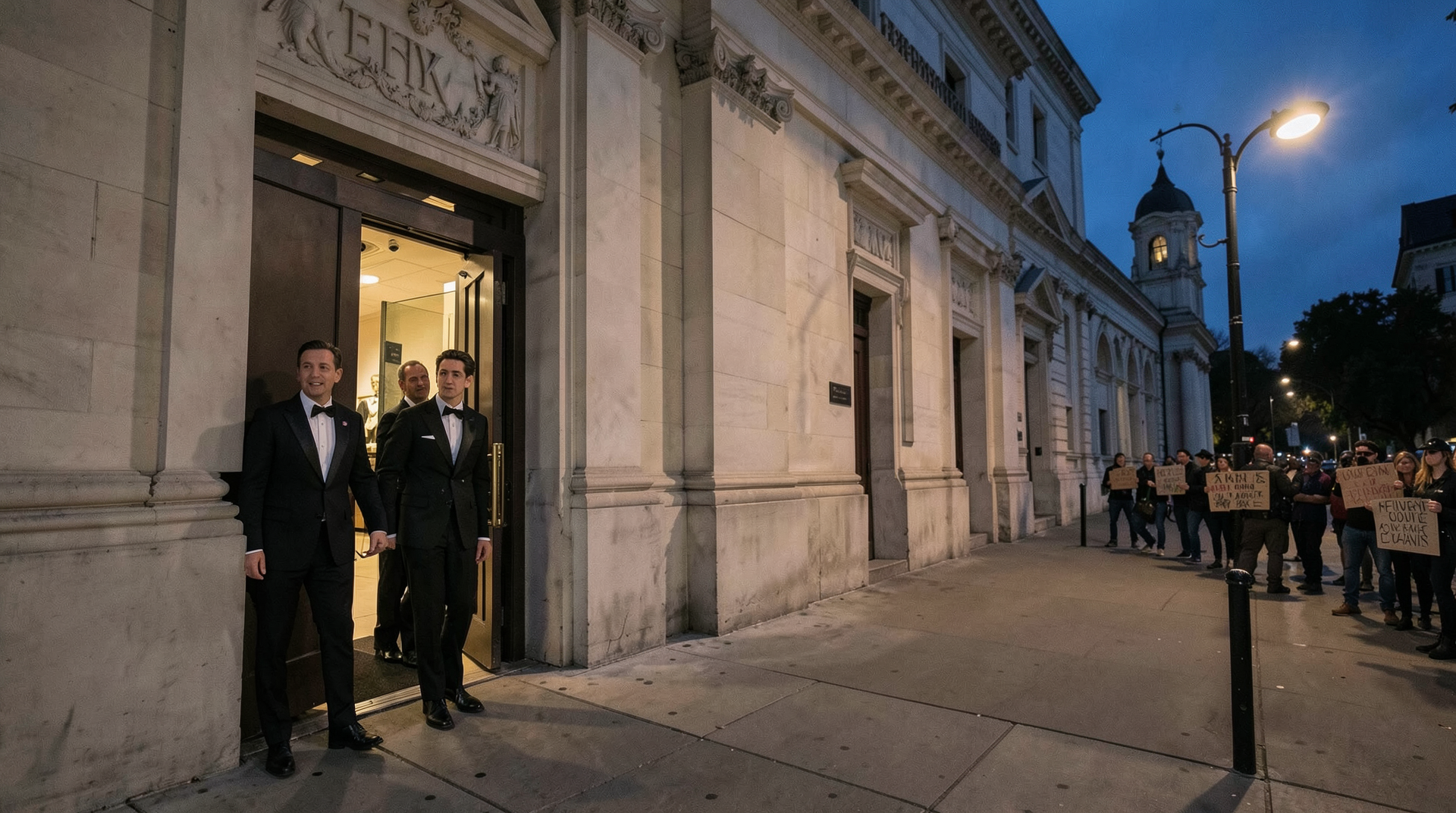
The 2026 Met Gala raised approximately $42 million on Monday night — a record for the event — with Lauren Sánchez Bezos as honorary chair and Jeff Bezos paying up to $20 million to host. [1] Bezos entered the Metropolitan Museum of Art via a back service entrance, avoiding protesters who had gathered along Fifth Avenue. [2] New York City Mayor Zohran Mamdani publicly declined to attend, citing affordability and breaking a longstanding mayoral tradition. [3] Meryl Streep, Bella Hadid, and Zendaya were absent — Streep's publicists declining to give a reason; Hadid's absence widely attributed to the Bezos sponsorship; Zendaya pleading press-tour fatigue. [4] At Gansevoort Plaza in the Meatpacking District, a coalition of SEIU, the Strategic Organizing Center, and the Amazon Labor Union staged a "Ball Without Billionaires" with Amazon, Whole Foods, Washington Post, Starbucks, and Uber workers walking a runway under the inverted theme "Labor Is Art." [5] Brooklyn ran a parallel "People's Ball." [6] The plural absence at the museum was the night's legible artifact. The looks were decoration.
The paper called the plural-absence register on Sunday and tracked the SEIU/SOC/ALU coalition's Gansevoort runway as it organized through the weekend. Monday confirmed both calls. Mamdani's absence was the most institutionally consequential of the no-shows — the mayor of New York skipping the Met Gala is not a celebrity decision; it is a city-political decision, and Mamdani's framing was the affordability frame his campaign was built on. "I'd rather not," in essence, was his message, "while my constituents are being priced out of their own city by the same people who are paying $350,000 a table to be photographed inside it." [7] The framing is hard for the city's traditional political-media coalition to absorb because the Met Gala is supposed to be a non-partisan fundraising event. Mamdani made it partisan by declining.
The Streep absence is the parable. Streep's character in The Devil Wears Prada — Miranda Priestly, the editor-in-chief built around Anna Wintour — defined Wintour for a generation of moviegoers. The sequel opened the same weekend the Met Gala ran. Streep skipped the actual Wintour event for the first time in years on the same weekend her sequel about the actual Wintour figure cleared $233 million worldwide. [8] The publicists declined to give a reason, which is Hollywood for "the reason is the obvious one and we are not going to say it on the record." Hadid's absence is on the record: the Bezos sponsorship. Zendaya's was attributed to press-tour fatigue, which is plausible and also functions as cover. The plural absence is what the paper means by a register. No single absence is a story; together they read.
The protest geography Monday night was built to be photographed. Gansevoort Plaza is roughly forty blocks south of the Met. The Brooklyn People's Ball ran across the East River. The Everyone Hates Elon campaign — sticker and ad — ran in the subway and on bus stops, "no red carpet for Trump's billionaires" as the through line. [9] Erin Overbey, the former New Yorker fact-checker whose post about Amazon's lead sponsorship of the Met Gala circulated widely on X, named ICE infrastructure as the through line: Amazon's federal contracting for cloud services that route immigration-enforcement workloads is the institutional bridge between Vogue's editorial and the city's deportation crisis. [10] The bridge has been an X discourse for months. Monday operationalized it.
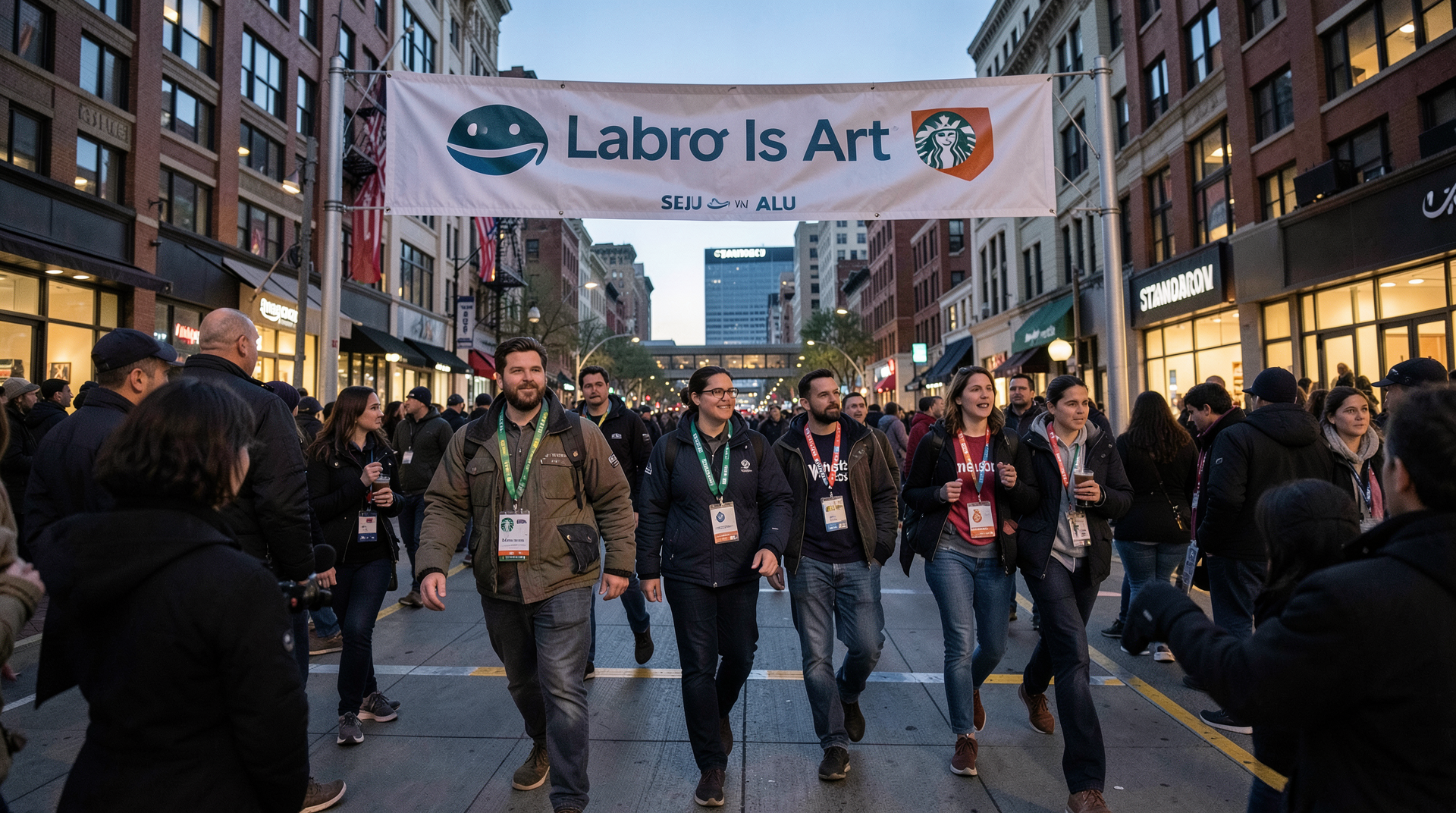
The Ball Without Billionaires staged at Gansevoort had real models walking real runway. The models were not models. They were workers from Amazon warehouses, Whole Foods stores, the Washington Post newsroom, Starbucks cafes, and Uber driver collectives. The Bezos-owned Washington Post's own employees walked on a runway organized in opposition to the gala their owner was paying $20 million to host. [11] The optics are what optics are; the substance is that SEIU, the Strategic Organizing Center, and the Amazon Labor Union ran a coordinated counter-event — programmed runway, organized media, branded merchandise, named coalition — that produced its own coverage cycle on the same news night. The Washington Post had to write about workers who included Washington Post workers. The architecture is the news.
Inside the museum, the looks did what looks do. Lauren Sánchez Bezos arrived in Schiaparelli's Madame X gown, a reference to the Sargent painting. [12] Beyoncé wore a skeleton bodysuit. Sabrina Carpenter wore a dress made of film strip. Rihanna entered in 115,000 beads. Nicole Kidman, Serena Williams, Venus Williams, Kim Kardashian, Lewis Hamilton, Kendall Jenner, Isha Ambani, Katy Perry, Karlie Kloss were photographed. [13] The looks coverage will run all week. The looks coverage is what the Met Gala is for. The looks coverage is also not, this Monday, the most consequential cultural document the night produced. The most consequential cultural document is the absence. Streep declined. Hadid declined. Zendaya declined. The mayor declined. The Bezos host paid for entry through the service door.
Anna Wintour's role on Monday was different from the role she has played for the previous twenty-six years. Wintour stepped back from her position as editor-in-chief of Vogue earlier this year and now serves as Condé Nast's chief content officer. [14] She still chaired the Met Gala — the gala is a Costume Institute event the chair has run since 1999 — but she did so from a post that no longer carries the editorial authority over Vogue's covers. The Devil Wears Prada 2's opening weekend ran a fictionalized version of the Wintour-figure, and Streep's skip read against the real Wintour at the real event. The mirroring was the press-coverage spine of the sequel's opening. Wintour, by all reports, handled it with the institutional grace the role requires. The mirror, however, is now a cultural artifact independent of her reaction.
The $42 million the gala raised goes to the Costume Institute — the museum department whose annual budget the Met Gala underwrites. The institute's exhibition this year, the one the gala is technically funding, is the costume-arts exhibition that opened around the gala. [15] The fact that an institution can raise a record sum on the same night its host's public legitimacy is contested by the city's mayor, by senior cultural figures, and by an organized labor coalition is the institutional fact. The fact that the funding goes to costume preservation rather than to Bezos's bottom line is the structural mitigation that the museum will deploy across the rest of the cycle. Both are true. The labor coalition's frame is that the institution should not require billionaire underwriting to fund costume preservation. The museum's frame is that institutional underwriting is what institutions do and that Bezos is no different from prior chairs. Both positions have institutional logic. The Mamdani frame names the political question both positions ignore: whether a city government has any obligation to extend its symbolic legitimacy to a private gala underwritten by a man whose company is suing the city over a warehouse permit and being investigated for ICE contracting.
The paper's reading. The Met Gala 2026 is the first one in living memory whose institutional spine fractured publicly. Three of the country's biggest cultural figures declined to attend. The mayor of the host city declined to attend. The host paid to host through the back door. A coordinated labor counter-event ran on the same news cycle and got coverage. The looks were beautiful. The institution raised forty-two million. None of those facts cancel each other. They sit together as the document the night produced.
Tuesday's read is whether the institution learns anything. Wintour's first Met Gala in her new role can be read as a successful continuation, or as a transition that revealed the limits of the model the gala has run on for two decades. The Costume Institute's exhibition will draw record visitor counts. The labor coalition's media product will continue to circulate. The next year's chair — not yet announced — will be the institutional answer.
-- MAYA CALLOWAY, New York