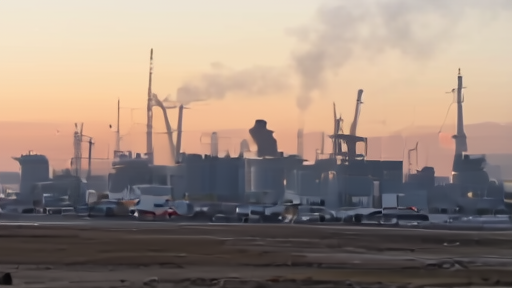
An Iranian drone struck the Fujairah Petroleum Industries Zone on Monday, igniting a major fire at a VTTI storage facility and wounding three Indian nationals working the site. UAE air defenses intercepted three additional Iranian missiles aimed at oil infrastructure; a fourth crashed at sea. [1][2] The strike landed at the end of the Abu Dhabi Crude pipeline — the bypass terminal that allows Emirati barrels to reach tankers without transiting the Strait of Hormuz, the workaround the U.S. Navy spent Monday demonstrating under Project Freedom escort.
Iran chose the bypass. That is the news. The May 4 paper's account of the UAE's OPEC departure entering its fourth day with the cartel still silent recorded an Emirati positioning for share-not-price, predicated on the 1.6 mbpd of swing capacity Fujairah's pipeline-and-terminal architecture was designed to release. The Monday strike says that capacity is no longer outside the war's reach. Opening Hormuz does not actually re-route Gulf oil to safer infrastructure if the safer infrastructure is now itself a target.
The Fujairah Petroleum Industries Zone sits on the Gulf of Oman side of the Musandam Peninsula, deliberately east of the Strait. The Abu Dhabi Crude Oil Pipeline runs roughly 360 kilometres from the Habshan field complex inland to the Fujairah loadout, sized for 1.5 mbpd at completion in 2012 and expanded to 1.8 mbpd by 2015. [3] Its purpose was always Hormuz redundancy. VTTI, the storage operator hit Monday, runs more than 1.2 million cubic metres of capacity at Fujairah across multiple terminals leased to ADNOC, Vitol, and other counterparties. The fire took hours to contain.
The three Indian nationals wounded were facility staff. India's Ministry of External Affairs confirmed the casualties Monday evening; the workers were in stable condition by midnight Gulf time. [4] India is the largest national-origin source of labour at Fujairah's industrial zone, a registry detail that ties the UAE's strike list to South Asia's diplomatic register. New Delhi has been one of the few capitals running back-channel communication with both Tehran and Washington through the Hormuz weeks; a casualty count opens an Indian register the war did not previously have.
UAE air defenses worked. Three intercepts, one missed; the missed missile fell into the sea rather than landing. [5] The Emirates' missile-and-drone defense network combines THAAD batteries deployed since 2012, Patriot PAC-3 systems, and the Israeli-supplied Barak-MX layer added since 2024. The system has now defended Abu Dhabi (January 2022 Houthi attack) and Fujairah (May 4, 2026) — two strikes, four years apart, both intercepted at the published rate. The performance number does not change the strategic fact that the UAE is now an active target inside its post-OPEC week.
Bloomberg's account of the VTTI fire confirmed a "major" blaze at the storage farm; Al Jazeera reported the Iranian claim of responsibility through the IRGC-affiliated Tasnim agency. [6][7] CENTCOM and Emirati authorities did not immediately respond to the attribution. The U.S. News write-up emphasized the simultaneity with Project Freedom Day 1's escort operation through Hormuz — Iran punching the bypass at the same hour the U.S. opened the Strait. [8]
The economic read is the price tape. Brent jumped 5% Monday to $114 per barrel, the highest print since mid-2022, on the composite signal of Project Freedom kinetic encounter, OPEC+ June supply add, and the Fujairah hit. The supply-add and the strike on the bypass moved the price in the same direction. The market priced transit risk, not volume.
The diplomatic read is the Indian register. Delhi maintains the Pakistan-adjacent backchannel that produced Iran's 14-point counter to the U.S. nine-point plan. The Fujairah casualties — the first South Asian deaths in the bypass terminal — give Sharif a constituency in his IMF-approval week. The 30-day vs two-month framing gap that defines the Iran-U.S. negotiation now sits over a concrete loss.
The structural read is the geography. The bypass was the answer to the Strait. The strike on the bypass says the answer is not safe.
-- YOSEF STERN, Jerusalem