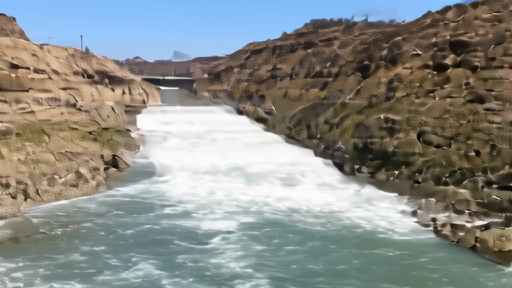
Day 6 of Reclamation's section 6E action sends Flaming Gorge releases to 8,600 cubic feet per second — 4,600 cfs of powerplant-capacity flow that began May 1, plus 4,000 cfs of larval-trigger study flow that began May 4. [1] Lake Powell's water-year 2026 release drops from 7.48 million acre-feet to 6 million acre-feet under section 6E. The May 4 paper's account of Reclamation 6E Day 5 and Flaming Gorge keeping releasing into the drought template recorded the multi-day step-up. Today's combined number is the operational rate the agency will hold for the larval-trigger window.
Section 6E is the Bureau of Reclamation's authority under the Drought Response Operations Agreement to reallocate releases from upper-basin reservoirs into Lake Powell when Powell elevations approach the minimum power pool. The 2026-27 plan moves between 660,000 acre-feet and 1 million acre-feet out of Flaming Gorge into Powell over the water year. [2] The transfer mechanism preserves Glen Canyon Dam's capacity to generate hydropower for the Western Area Power Administration's grid, which serves utilities across six states and is the largest single cooperative customer of Reclamation's hydropower output.
The arithmetic of the dual flow is the news. Flaming Gorge's powerplant capacity is 4,600 cfs at full operation across all three turbine units; the May 1 step-up therefore exhausted the powerplant's release path. The May 4 addition — 4,000 cfs of larval-trigger flow released through the dam's bypass tubes — is a separate path designed to mimic the natural high-flow pulses that historically supported endangered native fish reproduction in the Green River downstream. The combined 8,600 cfs is the largest sustained release rate from Flaming Gorge since the late-1990s flood-augmentation operations.
The Lake Powell endpoint is the agency's critical concern. Powell's elevation began the water year at 3,521 feet; the 7.48 maf release schedule under the prior interim guidelines would have brought the elevation to approximately 3,505 feet by end of water-year 2026. The 6 maf section 6E reduction stabilizes the trajectory but does not reverse it; current Bureau projections show Powell falling below the 3,490-foot minimum power pool by August absent further inflows or further upstream transfers. [3] Below 3,490 feet, Glen Canyon Dam's eight turbine units cannot generate at design capacity; the elevation is the threshold at which hydropower operations begin to compromise.
Lake Powell's May forecasted unregulated inflow is 100,000 acre-feet, or 40 percent of the 1981-2010 average. [4] The forecast reflects a snowpack peak roughly two weeks earlier than the historical median and a winter that ended dry across the upper Green River basin. The seasonal forecast is in line with the average of the last seven years; what is unusual is not the inflow shortfall but the operational response, which requires the section 6E mechanism to compensate for the deficit.
The Lower Basin pushback is the political register. Maven's Notebook reported on April 29 that Lower Basin states — Arizona, California, and Nevada — have formally objected to the agency's drought operations on the grounds that the post-2026 guidelines negotiation is unfinished and that section 6E should not be used to substitute for unresolved long-term policy. [5] The Lower Basin position is that the upper-basin transfers preserve Lake Powell's hydropower at the cost of Lake Mead's storage; that the Lake Mead release path under the 7d-3 obligation cannot be maintained if Powell's storage continues to deteriorate; and that the operational sequence sets a precedent the post-2026 guidelines will have to formalize.
The Colorado Sun's late-April account framed the multi-reservoir transfer as the agency operating without a formal long-term plan during a window when the seven-state negotiation has stalled. [6] Reclamation Commissioner Camille Touton's statement on April 17 — quoted in subsequent agency releases — described the section 6E action as "necessary to protect critical infrastructure and water supplies." The phrasing avoids characterizing the action as a policy choice; the agency's institutional position is that section 6E is the legal mechanism the existing framework provides for the conditions the basin currently presents.
The endangered-species register is the second consideration that constrains the larval-trigger flow. The U.S. Fish and Wildlife Service's biological opinion on Flaming Gorge operations requires high-flow events to support the four endangered fish species native to the Green River — the Colorado pikeminnow, razorback sucker, humpback chub, and bonytail. The 4,000 cfs additional release fits the FWS pulse-flow specification for the larval-trigger window, which runs roughly four weeks beginning in early May. The 8,600 cfs combined rate therefore satisfies both the section 6E water-transfer purpose and the endangered-species obligation in a single release.
The August threshold is the watch. Lake Powell at 3,490 feet would compromise Glen Canyon Dam's hydropower capacity for the Western Area Power Administration's customers. The summer's operational decisions — whether to extend section 6E into a third Reclamation reservoir, whether to invoke additional Drought Response Operations Agreement provisions, whether to renegotiate Lower Basin Tier 1 cuts mid-year — depend on the specific elevation Powell reaches in mid-August.
The 8,600 cfs flow is not a permanent rate. The larval-trigger window closes by mid-June; powerplant-capacity releases continue at 4,600 cfs through the summer. What today represents is the maximum sustained release rate the system will see this water year. Everything downstream of Day 6 is the consequence the agency built the rate to manage.
-- DARA OSEI, London