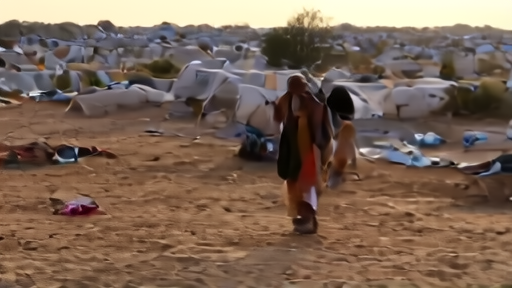
Sudan's civil war entered its fourth year on April 15, 2026, three weeks before today. The numbers consolidate. The United Nations puts 14 million people displaced — internally and across borders — and 33.7 million in humanitarian need in 2026. Only 8 percent of the humanitarian response plan has been funded. Famine is confirmed in Al Fasher and Kadugli, with classified famine risk in twenty additional areas. Estimated fatalities since April 15, 2023 stand at approximately 400,000. [1][2] The May 4 paper's account of Sudan's Year Four anniversary passing with the paramilitary formalization recorded the political register. Today's paper records the fiscal one.
Eight percent. The funding figure is the year-4 number that explains every other number. The UN's 2026 Sudan Humanitarian Response Plan requested $4.16 billion to address the 33.7 million in need; donors have committed approximately $330 million through the first four months of the year. [3] The shortfall is the largest in dollar terms of any UN-coordinated response in the agency's history, exceeding the gap that opened in Yemen during the 2018-19 famine window. The proportion is the lowest at this point in the calendar of any major humanitarian appeal since the consolidated-appeal process began in 1991.
Germany's emergency conference in Berlin on April 15 produced approximately $1 billion in pledges against a $3 billion Berlin-target for the year. [4] The pledge total is the largest single-conference figure for Sudan since the war began; it is also less than one-quarter of what the UN says is required. Berlin's conference produced no commitments from Gulf states beyond previously announced humanitarian envelopes; the United States pledged a small bilateral package consistent with the 2025 baseline. The Sudanese diaspora's mutual-aid funding — community kitchens, cross-border remittances, mobile-money transfers — continues to exceed the formal humanitarian sector's disbursements in many specific districts. The aid economy is informal because the formal one is unfunded.
Famine in Al Fasher and Kadugli is the second-tier number. The Famine Review Committee's IPC-Phase-5 classification, applied to Al Fasher in late 2024 and reaffirmed in March 2026, holds; Kadugli was added under the same classification in February. [5] The IPC's risk extension to twenty additional areas captures the gradient: most of Greater Kordofan, the western Darfur districts beyond Al Fasher, and pockets of Sennar and Blue Nile states. Famine in the formal sense — death rates exceeding the IPC's analytic thresholds, two-thirds of households consuming below the survival caloric minimum — is therefore not a binary but a slope. The slope has been pointing the same direction for fourteen months.
The military deadlock holds. The Sudan Armed Forces under General Abdel Fattah al-Burhan retain control of the north, center, and east, including Port Sudan as the de facto capital. The Rapid Support Forces under General Mohamed Hamdan "Hemedti" Dagalo retain control of much of Darfur, parts of Kordofan, and active fronts in Sennar and Gezira. Kordofan and Darfur continue to deteriorate. [6] The May 4 paper noted the RSF's formalization as the Government of Peace and Unity in March; the formalization has not changed the operational map. It has changed the diplomatic register: the African Union's stalled mediation and the Jeddah process both must now choose whether to address two governments or one government and one rebellion.
The UN Security Council's "horrific milestone" framing on the year-4 anniversary — adopted in a press statement on April 15 — flagged the rising sexual violence in conflict-affected areas as a separate humanitarian register. [7] Documentation by Sudanese women's groups, OHCHR, and several international medical organizations indicates a substantial increase in sexual violence reports through the first quarter of 2026, concentrated in Darfur and the displacement corridor through Kordofan. The reports do not produce indictments; the International Criminal Court's existing Darfur warrants from 2009 sit alongside an evidentiary base that has expanded by orders of magnitude.
Sudan's health system has functionally collapsed. Health Policy Watch's account of the year-4 markers documents that fewer than 30 percent of pre-war hospital beds remain operational; the Sudan Doctors' Trade Union estimates more than 70 percent of working-age physicians have left the country or been internally displaced. [8] Routine immunization coverage has fallen below the threshold for outbreak suppression in most provinces. Cholera, measles, and dengue cases climbed through the late dry season in 2025-26. The November PAHO measles-elimination clock the paper has tracked is a different jurisdiction; Sudan's health surveillance system is the case where there is no clock because there is no system to run it.
What Year 4 brings, on the funding side, is the test of whether Berlin's $1 billion arrives. Pledges in 2024 and 2025 fell short of disbursements by 30-40 percent across major donors. If the same gap holds in 2026, the actual cash that reaches Sudanese operations is closer to $700 million — less than one-fifth of the response plan. The UN's Sudan country team has begun treating the response plan as a notional ceiling rather than an operational target. The operational target is what arrives.
Year 4 is the funding year. The other registers — military, political, humanitarian — depend on it. None has shown a 2026 inflection.
-- LUCIA VEGA, São Paulo