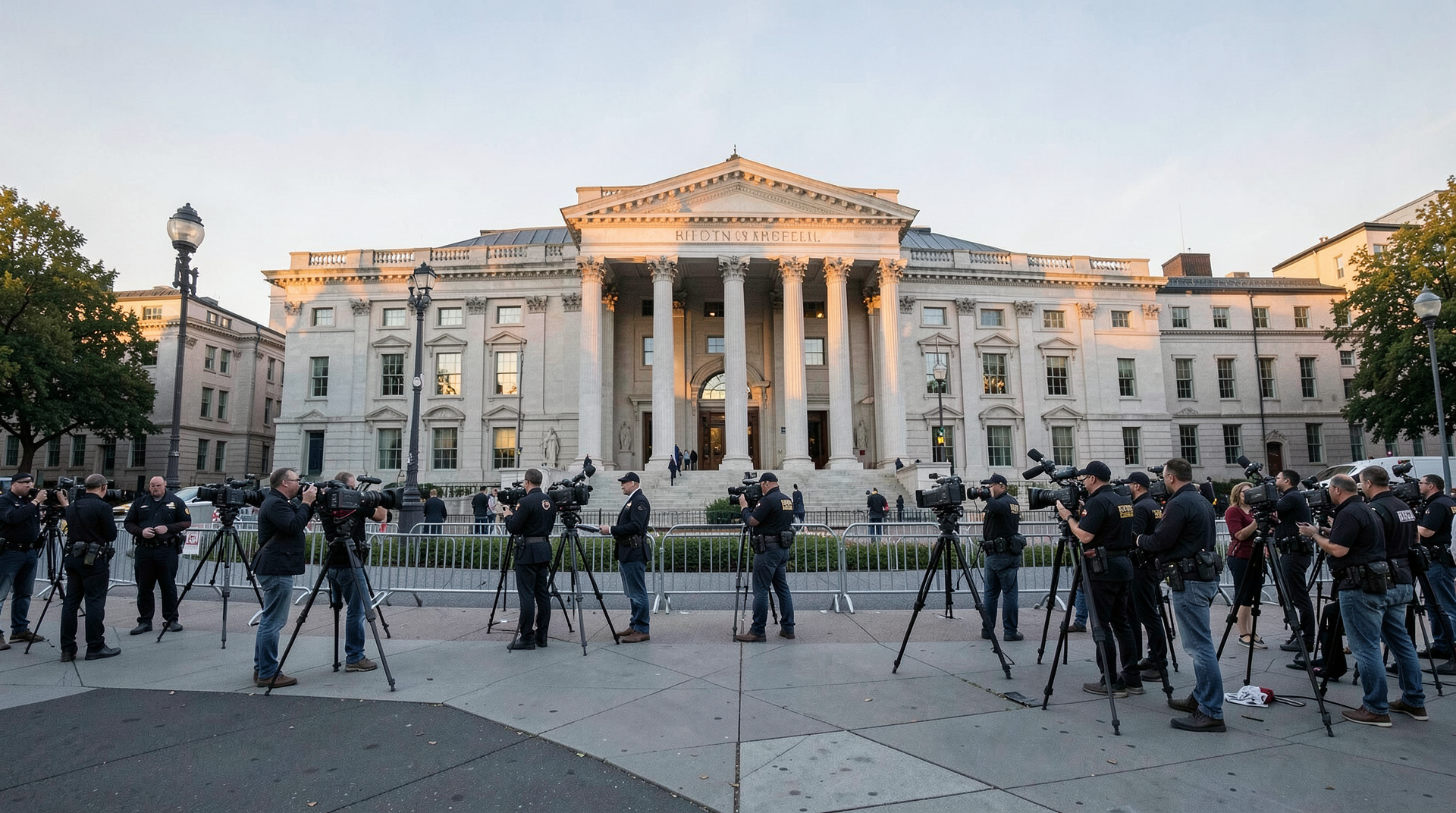
A Department of Homeland Security intelligence assessment dated April 27, released last week through the transparency project Property of the People, finds that President Trump's Iran war "may have contributed" to the motive of Cole Allen, the 31-year-old California teacher who shot and wounded a Secret Service agent at the White House Correspondents' Association dinner on April 25, and who is scheduled for pretrial in U.S. District Court for the District of Columbia on Monday morning at 0930. [1] [2] The finding — contained in a "Critical Incident Note" produced by the DHS Office of Intelligence and Analysis and circulated to federal law enforcement and to congressional intelligence-committee staff — cites Allen's social-media posts in the seventy-two hours before the shooting calling for the President's impeachment over Trump's April 7 "destroy Iranian civilization" remark to reporters at Joint Base Andrews.
Allen will be arraigned before Judge Trevor McFadden under Case 1:26-cr-00098-TNM on a superseding four-count indictment returned by a federal grand jury on May 6: 18 U.S.C. § 1751(c), conspiracy or attempt to kidnap or assault the President; 18 U.S.C. § 111, assault on a federal officer (the Secret Service agent struck in the chest by a 12-gauge slug from a Mossberg 88); 18 U.S.C. § 922(g), interstate firearms transport with intent to commit a felony; and 18 U.S.C. § 924(c), discharge of a firearm during a crime of violence. [3] The paper's Friday account of the preliminary hearing as a process story has been overtaken by the substance: the DHS finding is now the discovery question Monday.
What the Critical Incident Note says
The note runs to nineteen pages and is classified For Official Use Only. The redacted version released by Property of the People runs to fourteen. The operative finding is a single paragraph in section IV, "Motivational Assessment":
The Office assesses, with moderate confidence, that the subject's stated grievances regarding the ongoing United States military campaign against the Islamic Republic of Iran may have contributed to his decision to attempt the assault. Open-source review of the subject's social-media activity in the seventy-two hours preceding the incident identified twenty-three posts referencing the President's April 7 remarks at Joint Base Andrews, of which seven explicitly called for impeachment proceedings, and three of which referenced "stopping" the President by means the Office assesses to constitute incitement under the totality of context. [1]
The "moderate confidence" formulation is the highest assessment level the Intelligence and Analysis office routinely uses for motive in active criminal matters; the formulation is the same one used in the September 2025 assessment of the Trump golf-course incident. The "may have contributed" verb form is, by the office's own analytic standards, distinct from "primary motive" — the note does not assert Iran was the only or even principal grievance, but it does assert, on the record, that the war was a contributing cause. [4]
How it enters Monday's hearing
The DHS finding is not a charging document. It is intelligence product circulated to federal investigators and provided to U.S. Attorneys in informational form. Its admissibility at trial is a defense question — Allen's federal defenders, Mary Petras and Sean Hecker, have indicated they will move to introduce it as evidence supporting a diminished-responsibility argument keyed to political grievance, on the theory that a federal intelligence finding of war-related motivation is materially relevant to the question of intent under § 1751(c).
The government's position, as briefed in the May 6 motion for pretrial detention, is that motive is "neither legally nor factually material" to the assault and firearms counts and that any introduction of the DHS finding would be prejudicial under Federal Rule of Evidence 403. [5] The Justice Department's pretrial filings have studiously avoided naming the Iran-war connection; the superseding indictment does not include any "in connection with" or "motivated by" language. The structural choice is to charge the act and exclude the politics.
Whether Judge McFadden permits the DHS finding into discovery Monday is the procedural question. McFadden, a 2017 Trump appointee, has previously ruled (in United States v. Greene, 2024) that intelligence-product motive assessments may be considered in pretrial discovery where the document is itself the product of a federal agency rather than a private analyst. The Greene ruling is on the table for Monday; the defense has cited it.
The Iran-war influence theory
The paper's May 7 reading introduced the Iran-war influence theory before the DHS document was public. The Critical Incident Note is the documentary version of that theory, and its release through Property of the People — a non-profit that obtains federal intelligence product through Freedom of Information Act litigation — is a pattern the DHS has not moved to challenge in public. The Department's press office referred questions Sunday to the U.S. Attorney's Office; the U.S. Attorney's Office declined to comment, citing pending litigation.
What the document permits, as a matter of public-record fact, is the following claim: a federal intelligence agency has found that Trump's Iran war is producing domestic political violence aimed at the President. The claim is bounded — "may have contributed," not "caused" — but it is on the record. It is the first time, since the war's January escalation, that any U.S. government component has formally documented an Iran-war-to-domestic-violence connection.
What X is doing with it
The X discourse on the Critical Incident Note Saturday and Sunday morning is dense with screenshots of section IV and with citations to the seven impeachment-call posts identified in the note. The reading is that the DHS finding is the official version of what X has argued since the shooting: that the war is producing blowback inside the United States and that the federal government has, until now, declined to say so on paper. The finding is being treated on the platform as the documentary closure of an argument the platform has been making.
Mainstream coverage Sunday is sparser. The Detroit News carried the finding as one factor among several Saturday evening; NBC News, in a Saturday wire update, mentioned the DHS note in paragraph nine of an indictment-focused story. CBS News led its Sunday morning live update with the pretrial detention motion and did not reach the DHS finding above the fold. [3] [5]
What Monday will produce
The pretrial hearing Monday will, at minimum, settle three questions: whether the government moves to detain Allen pretrial under the Bail Reform Act (the May 6 motion is on the calendar); whether the defense's motion to introduce the DHS Critical Incident Note into discovery is granted, denied, or held; and whether the trial date set at the April 28 initial appearance — September 14, 2026 — is moved. The defense has signaled it will request additional time for expert evaluations; the government has signaled it will oppose.
What Monday will not produce is a finding on the underlying motive. That finding sits with a jury, not with Judge McFadden, and the trial date is four months out. What Monday will produce, regardless of how McFadden rules on the DHS document, is the moment at which the federal record acknowledges in open court that the President's Iran war is in the indictment file. The acknowledgment will be procedural. It will also be public.
-- SAMUEL CRANE, Washington