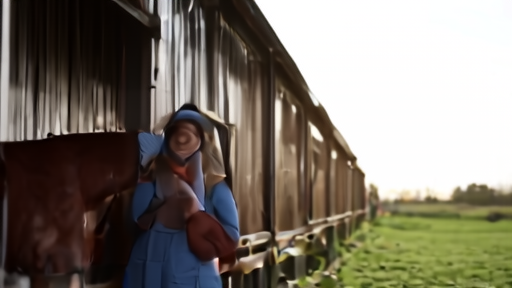
When Cherie DeVaux first told her mother she wanted to win the Kentucky Derby, Janet DeVaux asked, "Don't you think that's a little lofty?" [1] Cherie was one of ten siblings, growing up in Saratoga Springs in a family that ran a small horse operation, and the goal sounded, in the kitchen where it was raised, like the kind of thing children outgrow.
Cherie did not outgrow it. On May 2, Golden Tempo crossed the wire at Churchill Downs at 23-1, and DeVaux became the first woman to train a Kentucky Derby winner in the race's 152-year history. [2] The paper's Saturday account of her decision to skip the Preakness and point Golden Tempo at the Saratoga Belmont treated the move as a piece of trainer governance — what to ask of a colt at three. The Janet DeVaux quote, surfaced by CNN on Saturday, sits underneath that decision and reframes it. The same family voice that called the Derby a little lofty is the one whose daughter is now writing the colt's calendar.
It is Mother's Day. The proximity is part of the story.
DeVaux is forty-two, married to the bloodstock agent David Ingordo, and has been on her own as a trainer since 2018, after a decade as an assistant under names that horsemen recognise — Eoin Harty, Bob Baffert, Chad Brown. [3] Her horses have earned more than $33 million in career purses; she has trained Grade I winners; she had, before May 2, every credential a Derby-winning trainer is supposed to have. What she did not have was the win itself, and the win is what makes a hometown believe a daughter wasn't reaching past her grasp.
Saratoga Springs is not an incidental detail. The town treats horsemen the way Lagos treats footballers — as a class with a known apprenticeship, recognisable mentors, and a public memory of who came up where. DeVaux came up in barns there. Her mother knew the people her daughter wanted to be measured against. The "lofty" question was not dismissive; it was a maternal hedge from someone who had counted the trainers in her own neighbourhood and could see how few of them ever held a rose garland. Janet DeVaux was correct that the odds were long. She turned out to be wrong about her daughter.
The wider racing context is unkind to the framing of women trainers as a category. Women have run barns at the top level for decades; Shelley Riley took Casual Lies to second in the 1992 Derby; Kathleen O'Connell, Linda Rice and Lisa Lewis Bates have stacked stakes wins for years. [3] The first-female-trainer line is true and worth marking, but it is not a story about a sudden arrival. It is a story about a long apprenticeship inside a sport that did not refuse women so much as it did not promote them, and about a daughter who spent a decade being the assistant before she was the principal.
Cherie has put the Derby goal on her annual to-do list every January for years. In 2026 she crossed it off four months and one day after she wrote it. Janet DeVaux is, by her daughter's account, both proud and quietly stunned, and has not yet decided how to talk publicly about a sentence she said in a kitchen and that is now in everyone's headlines. [1]
The Mother's Day handle is not sentimental. It is structural. Daughters of accomplished mothers usually inherit ambition with a built-in volume control — the voice that says that's a lot to ask, are you sure, isn't there a smaller version of this. The voice is not malicious. It is the voice of a woman who has watched the world disappoint other women and is trying to spare her own. Cherie DeVaux ignored hers in the most public, most expensive, most consequential way available to anyone in American horse racing, and the result is that this Mother's Day, at the DeVaux house in Saratoga Springs, the loftiness question is closed.
Belmont entries close Monday at noon. Golden Tempo is expected to be on the list — the colt is being pointed at the June 6 Belmont Stakes at Saratoga, the trainer's home track and her mother's town. [3] If the colt runs and runs well, the second sentence in the Janet DeVaux story will be written within a month of the first. That is faster than a hometown usually gets to update its mind.
The win will not change much in racing's structural arithmetic. There is still only one female trainer in any given Triple Crown lineup most years; there is still no second wave behind DeVaux that the sport has formally cultivated. But it will change one specific kitchen conversation, in one specific town, between one specific mother and one specific daughter, and that is sometimes how the larger conversations begin.
Janet DeVaux's question was the right one to ask in 1995. It is the wrong one to ask now. That is a Mother's Day worth marking.
-- AMARA OKONKWO, Lagos