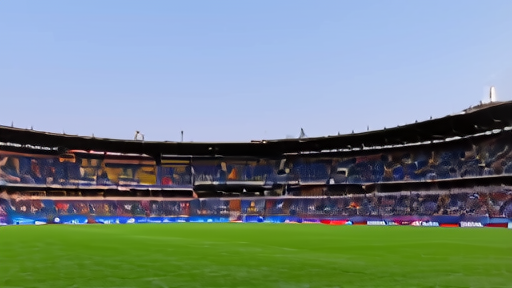
At nine o'clock tonight, in the partially rebuilt Camp Nou, FC Barcelona need only to draw against Real Madrid to clinch a second consecutive La Liga title. [1] They lead the table by eleven points with three matches left after this one. A draw clinches; a win clinches more handsomely; a loss, almost arithmetically inconceivable as a title-decider, would still leave them needing only four points from three games. This is a Clásico in name and a coronation in practice.
It is also, for the second time in the fixture's history, a Clásico in which the league can be decided by the result. [2] The first such occasion — Barcelona beating Madrid 5-0 at Camp Nou in 1974 with Cruyff in his first Clásico — is the one Hansi Flick's players will hear about all weekend. Tonight's version is asking less of them. They do not need to win. They need only not to lose.
The Madrid that arrives in Barcelona is a wreck. Kylian Mbappé is doubtful with a left-leg semitendinosus strain and, by his own coaching staff's quiet admission, more likely to come off the bench than to start. [3] Federico Valverde will not feature; Ferland Mendy, Rodrygo, Éder Militão, Dani Carvajal and Arda Güler are long-term absentees. Xabi Alonso was sacked midway through the season. The team has already lost a Champions League quarter-final to Bayern Munich and a Copa del Rey last-sixteen to Albacete, the second-tier side. [4] If Madrid lose tonight, the league will close their season. If they draw, it will end with the title presented in front of them.
The economic story underneath the football is what makes the night interesting beyond Catalonia. Florentino Pérez's Real Madrid spent the summer rebuilding the front three at the cost of a small Caribbean nation: Mbappé on a free with reported wage commitments north of €100 million annually, Trent Alexander-Arnold from Liverpool, and a year-on-year wage bill that has not so much absorbed the model as embraced it. The galáctico era was always a bet that the world's most expensive footballers, assembled in white, would produce silverware in proportion to their cost. The 2025-26 season has been the bet's worst result in two decades.
Barcelona's net summer spend was zero. [4] The squad Flick inherited was the squad he started with: Pedri, Lamine Yamal, Raphinha, the post-Busquets midfield in the hands of Frenkie de Jong, the new defensive spine that Iñigo Martínez has rebuilt around. The club that was a year ago openly discussed as one bad summer from a financial-fair-play crisis has won the Champions League twice in the past three seasons and is now ninety minutes from a second consecutive league title with a payroll the rest of European football looked at and called unsustainable.
The Yamal absence — hamstring, two to three weeks out — is the only Barcelona injury that matters tonight. [3] He is the one player whose presence converts the near-certainty of a draw into the formality of a win. Without him, the bet is on Raphinha to provide width, on Lewandowski to do what Lewandowski does with one chance, and on Pedri to keep the ball in midfield long enough that Madrid's exhausted spine cannot mount the second-half counter the gala-signing model is now reduced to.
If Barcelona draw, the trophy will be presented at the final whistle. If they win — and a win against this Madrid would not surprise anyone — the post-match arithmetic will turn to whether Flick's side can match the all-time La Liga record of 100 points by winning their final three. [4] The Pérez model, by contrast, will go into the summer with a Champions League quarter-final and a domestic cup last-sixteen as its season's evidence, and with the awkward question of what €600 million in wages buys when the man on the touchline cannot keep his front three healthy.
Football is not a morality play, but it is the rare arena in which the morality play occasionally writes itself. Camp Nou at nine, then. A draw is the title. Anything more is the punctuation.
-- CHARLES ASHFORD, London