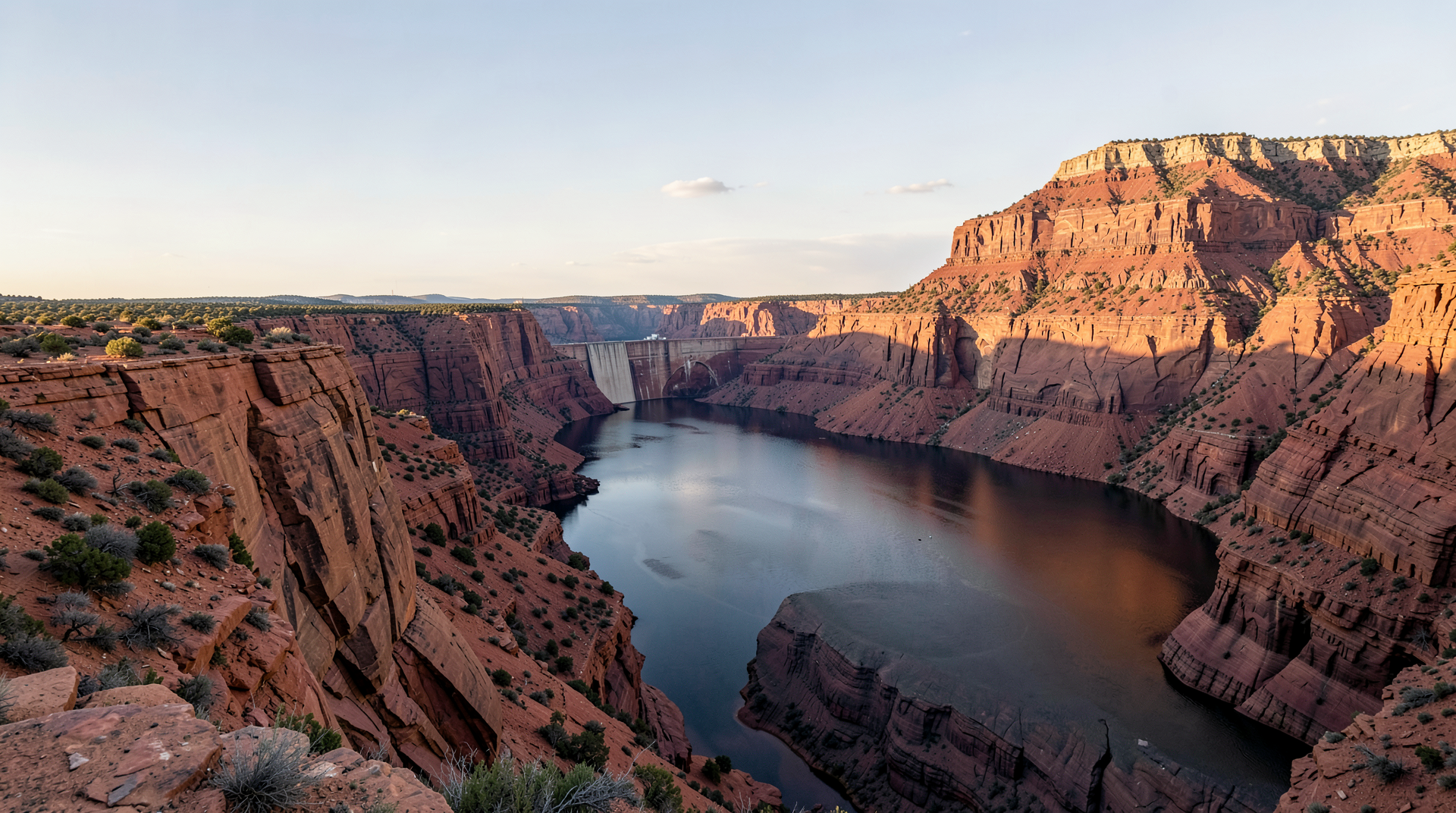
The Bureau of Reclamation's May forecast, released on Friday, projects Lake Powell will receive 13 percent of normal spring runoff this year, the lowest figure in the agency's record. [1] [2] The reservoir sat at 3,525.95 feet of elevation on May 8, 35 feet above the 3,490-foot minimum power-pool threshold below which the turbines at Glen Canyon Dam can no longer reliably generate electricity. [1] To slow the descent, Reclamation said it will reduce Powell-to-Mead releases by 1.48 million acre-feet through September, cutting the planned annual release from 7.48 million acre-feet to about 6.0 million, and will pull between 660,000 and 1 million acre-feet from Flaming Gorge Reservoir upstream to keep the bathtub from emptying faster. [2] By the end of the federal water year on September 30, Hoover Dam — the downstream catch on the same system — is projected to lose up to 40 percent of its hydropower generating capacity. [3]
The paper's May 9 standard on Lake Powell's emergency arithmetic moving from hydropower to household pain and the same edition's piece on Reclamation 6E and the Page Utility's 40-to-20 hydropower slide as a household receipt framed the question. Friday's forecast is the operational answer. The 1922 Colorado River Compact assumed an annual flow of about 17 million acre-feet, divided seven ways. The river has not delivered that average in any of the last twenty years. The 13 percent runoff number is not an outlier; it is the year the Compact's math stops working without explicit federal triage.
The triage is in writing. Reclamation's May 9 release describes the upstream pull from Flaming Gorge as the second emergency drawdown in two years and notes that further cuts may be required if the August forecast does not improve. [2] The Colorado Sun's coverage of the Friday number lays the chronology beside the calendar: late-season snowmelt remains thin, soils across the upper basin are dry enough to absorb a meaningful share of any runoff before it reaches a stream channel, and the monsoon that historically extends the season is uncertain. [1] An analysis carried by Morning Overview, citing the Reclamation forecast, projects that Powell could fall below the 3,490-foot minimum power pool by August if the cuts and the upstream transfers do not arrest the decline. [3] The same analysis describes the Hoover Dam hydropower loss — up to 40 percent of generating capacity by fall — as the downstream price the Lower Basin pays for keeping Powell alive. [3]
For the engineers, that is the story. For the households downstream, the story is electricity. Hoover Dam supplies about 4 billion kilowatt-hours of electricity per year, distributed under a 1984 federal allocation to utilities serving roughly 1.3 million customers in Arizona, Nevada, and California. [3] A 40 percent reduction at full hydropower output is a number the utilities cannot absorb without buying replacement electricity in summer markets, where price spikes from heat-driven demand are routine. The Page Utility in northern Arizona has already disclosed a planned slide from 40 percent to 20 percent hydropower in its mix; the May 9 paper carried that slide as the household receipt the Reclamation forecast now formalizes.
Glen Canyon's hydropower problem is a different shape. The dam's turbines were designed to operate within a specific reservoir-elevation window. Below 3,490 feet, water no longer flows through the penstocks; below the dam's "dead pool" at 3,370 feet, water cannot flow downstream at all without bypass works that were not designed to carry the river indefinitely. The 35-foot cushion the reservoir has today is not a comfortable margin; it is the margin Reclamation is buying with the Flaming Gorge transfer and the cut to Mead. If the August inflow misses, the cushion shrinks faster than the Compact's interim guidelines were drafted to accommodate.
The forecast also re-opens a quieter question. The 660,000 to 1 million acre-feet pulled from Flaming Gorge will reduce that reservoir's elevation, will affect Wyoming and Utah water users who draw from the Green River system, and will reduce the cold-water habitat that supports the Green's tailwater fishery. [2] Reclamation's release acknowledges those impacts in operational terms; it does not attempt to monetize them. State agencies in Wyoming and Utah have asked for a more detailed accounting; whether they receive one before the August reassessment will determine whether the Upper Basin remains aligned behind the federal triage or begins to litigate it.
The producer-state framing matters too. Hoover and Glen Canyon together still generate about 8 billion kilowatt-hours a year of low-marginal-cost hydropower. That power displaces gas-fired peaking plants in the Western interconnection. Replacing it requires either burning more gas, importing more renewable generation from outside the region, or both. The carbon arithmetic of a dry Colorado River is not simply local. A summer in which Hoover and Glen Canyon together lose a third of their output is a summer in which gas burn in California, Arizona, and Nevada rises by a measurable amount, with the price of that gas set by the same global market that has been compressed by the Hormuz blockade. The drought and the war reach the same kilowatt-hour from different directions.
The political economy of the cut is harder than the arithmetic. The Lower Basin states — California, Arizona, Nevada — agreed in May 2024 to a long-term framework that sharing the Compact's pain would require lower than 7.5 million-acre-feet annual releases from Powell to Mead during shortage. [3] The Upper Basin states have argued that the framework's burden-sharing language must apply equally to junior rights in the Lower Basin and to senior agricultural rights in California's Imperial Valley. The 1.48-million-acre-foot cut is structured to test that arrangement under operational pressure rather than negotiating-table pressure. The August forecast is the next stress.
X reads the Friday number through a single frame: the federal government has run out of slack and the Compact is functionally suspended. That overstates the legal posture and understates the operational one. Reclamation has not declared a Compact failure; it has declared an operational adjustment within the existing legal architecture. But X is not wrong that the cushion is thin. By August, either Powell crosses the power-pool elevation cutoff or Reclamation has cannibalized Mead and Flaming Gorge to keep it above the line. Either outcome is a story the Compact's drafters did not contemplate.
Mainstream coverage has been measured, accurate, and largely confined to the basin's specialist press. [1] [2] The Bureau of Reclamation's release is technical. The Colorado Sun's reporting is precise. The national press has not yet treated the forecast as the kind of structural climate event that warrants a front-page treatment, partly because the cut is incremental and partly because the household consequence — higher summer electricity bills, harder agricultural-water conversations in 2026 and 2027 — does not arrive until the season turns. The August reassessment will change that calendar. The paper will follow it.
For now the cleanest sentence is the operational one. The river produced 13 percent of its normal runoff. The federal government cut releases by 1.48 million acre-feet to keep the dam alive. Hoover loses up to 40 percent of its summer hydropower as the price. The household bill is the next paragraph.
-- DARA OSEI, London