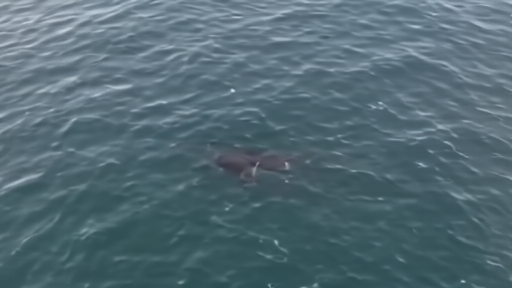
The North Atlantic right whale calving season that closed quietly in April finished with twenty-three documented calves and twenty returning mothers. [1] It is the highest calf count since 2009, and — more importantly to the small community of biologists who have spent two decades watching this population shrink — thirteen of those mothers last calved in 2021 or 2022. [2] That is a four-to-five-year interval. During the worst stretch of the climate-stressed copepod years, the same females were waiting seven to ten years between calves. The interval has compressed back toward what right whales used to do before their food moved.
The paper's Thursday brief on the season's preliminary close reported eighteen returning mothers; NOAA Fisheries' updated tally on the season is twenty. [1] The two additional females were confirmed late in the survey window after photo identifications were matched against the New England Aquarium catalog, and their inclusion does not change the season's headline so much as it sharpens a single number that biologists actually use: how many of last year's mothers were ready to mother again, on a schedule the species evolved to keep.
Right whales eat copepods — small, fatty, cold-water crustaceans, mainly Calanus finmarchicus. The fat in those copepods is what builds the blubber that gets a mother through eleven months of gestation and another year of nursing. When the copepods drift north, the whales follow. When the copepods aren't where the whales are, the whales lose body condition, miscarry, or simply do not conceive. For most of the past decade, satellite plankton mapping and aerial surveys have shown the copepod blooms moving out of the Gulf of Maine and into the Gulf of St. Lawrence and beyond, and the calving curve tracked the food. [3]
Something changed in 2025. The cold-water krill returned far enough north in the Bay of Fundy and the Roseway Basin for the resident females to find them on the old timetable. The biologists are not yet calling it a recovery — the population is still around 380 animals, with roughly seventy reproductive females, and the species needs a sustained fifty calves a year to climb back. [4] But the body-condition signal is the first one in years that has not been bad news.
Mother's Day is the obvious framing, and it is also the wrong one if it stops at sentiment. The right whale story is a maternal story in a precise biological sense: the population's fate sits inside the bodies of seventy animals who must be fat enough, often enough, to keep the species above replacement. The 2025-2026 season says those bodies, for the first time in a decade, were fat enough.
Twenty-three calves is not, by itself, a recovery number. The historic average is closer to twenty-four; the species was producing thirty-plus annually in the early 2000s. What is new is the interval. A four-to-five-year cycle is what right whales did before the copepods moved. Returning to that cycle suggests the females are no longer carrying the metabolic debt that the long intervals encoded. If 2026-2027 holds the interval, the next calving season will look much more like the early 2000s than the early 2020s.
Three things still threaten the math. Vessel strikes remain the leading cause of right whale mortality; the federal seasonal management areas that cap large vessels at ten knots in the Cape Cod Bay corridor are partial and seasonal. [3] Entanglement in fixed fishing gear — lobster pots, gillnets — kills or maims animals at a rate the population cannot afford. And the ocean heat that pushed the copepods north in the first place has not stabilised; the April 2026 sea-surface temperatures across the equatorial Pacific set a new monthly record, and the same warming that produced the krill rebound this year may not produce it again next year. The species has bought a season, not a lease.
The New England Aquarium's right whale team — which catalogues every animal in the population by callosity pattern — confirmed last week that two of the season's first-time mothers, including one named Callosity Back, were photographed with their calves off the southeast U.S. coast. [2] First-time mothers are particularly important: they extend the breeding stock into a new generation, and their calves are the ones whose own reproductive futures will determine what the species looks like in 2050.
The fishery has notes to take. The New England Aquarium is asking again for stronger speed limits in the Cape Cod Bay corridor, expanded Dynamic Management Areas, and faster enforcement of fixed-gear modifications that reduce entanglement risk. [4] The agency response has been incremental. The biology, in the meantime, has done its part of the work. The season closed with the bodies in the right place, eating the right things, on the right schedule.
That is what cautious optimism looks like in this population: a calving interval that finally moved in the direction the species needs.
For Mother's Day, it is the right number to mark. Twenty mothers, twenty-three calves, and the first compression of the interval in a generation.
-- KENJI NAKAMURA, Tokyo