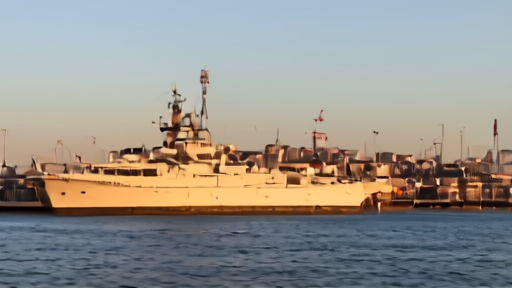
The Ministry of Defence in London announced on Saturday that HMS Dragon, a Type 45 destroyer that had been guarding the airbase at Akrotiri, would sail east from Cyprus to "pre-position" for a multinational maritime escort mission in and around the Strait of Hormuz. [1] The mission, jointly chaired by Sir Keir Starmer and Emmanuel Macron, has been described in private diplomatic notes circulated last week as involving up to forty nations. [2] It will not begin. The conditions written into the announcement specify that the escort coalition activates only "once a sustained ceasefire or peace deal is agreed" between Iran and the United States. [1] In other words, Britain has dispatched a 7,400-tonne air-defence destroyer with anti-ballistic-missile radar and a Sea Viper missile suite to a station from which it will do nothing in particular until Tehran signs a paper it has spent six weeks declining to sign.
The paper's May 1 standard on France and Britain framing their mine-clearance mission as deliberately not the American coalition carried the original architecture. Saturday's redeployment is the first piece of physical kit that gives the architecture an address. It is also the first acknowledgment that the architecture is, in operational terms, a contingent one.
The official line, repeated by ITV News on Saturday evening, is that pre-positioning the destroyer reduces transit time once the ceasefire arrives and demonstrates Britain's seriousness about the post-conflict freedom of navigation. [3] The National's reporting from London notes that Royal Fleet Auxiliary Lyme Bay is being converted into a mothership for mine-hunting drones, with the conversion expected to be operational by mid-summer. [2] Defence sources told Fortune the wider package would include between four and six surface vessels from European navies, German and Italian air-policing contributions, and a Norwegian mine-clearance unit, all under a French-British command structure that explicitly excludes United States Central Command. [1] That last point is the architecture's signal: the coalition is European-led not because Europe wishes to contradict Washington, but because Tehran has refused to negotiate while a mission flies a Stars-and-Stripes pennant.
The conditionality is the substance. Pre-positioning a destroyer is in itself a low-cost, high-visibility move. Type 45s spend much of their service life in the eastern Mediterranean and the Gulf; an additional two-month deployment is, in budgetary terms, a rounding error. What the move does is alter the geometry of the diplomatic table. So long as HMS Dragon is in Cyprus, the coalition is a planning document. Once she is at Bahrain, or anchored off Khasab, the coalition is a posture. It is not a happy posture, because every additional week in which the precondition is unmet is a week in which a destroyer with no clear mandate sits in Iranian operational waters waiting for permission to begin.
For Tehran, the message is meant to read as implicit pressure. Sign the paper, and the West provides the escorts that allow Hormuz commerce to resume on terms acceptable to international shipping. Decline the paper, and the West constructs a forty-nation coalition that will operate in your front yard regardless. The implicit pressure works, however, only if Tehran believes Britain and France will follow through on the second branch. Britain and France have spent eighteen months emphasising that they will not. The Starmer-Macron framework was designed precisely to be the alternative to the American coalition that Iran rejected during the autumn negotiations. To convert it now into a unilateral Western escort presence absent a ceasefire would require a political decision that neither London nor Paris has shown an appetite for taking.
Hence the conditional clauses. Hence HMS Dragon making the symbolic transit while the actual mission remains a hypothesis. The Royal Navy is performing the choreography of a deterrent without crossing into the substance of one. There is precedent for this manoeuvre — the British Indian Ocean Squadron between 1956 and 1968 was forever pre-positioning for missions that did not occur — and the precedent is not encouraging. Pre-positioning without a follow-through clause invites the deterrent target to call the bluff. Tehran's foreign-ministry spokesman has made a habit, during the past month, of doing precisely that.
The coalition's mine-hunting component deserves a paragraph of its own. RFA Lyme Bay, a Bay-class auxiliary landing-ship dock, is being fitted to launch and recover up to twelve unmanned mine-clearance vehicles, replacing the human-divers-and-helicopter approach that has dominated Royal Navy mine warfare for half a century. [2] The conversion is genuinely capable. If the coalition does activate, Lyme Bay will provide the most modern mine-clearance capacity any Western navy has fielded in the Gulf. That capability is also the part of the package that takes the longest to make ready, which is one reason the conversion has been disclosed now: it gives the Iranian foreign ministry a date to stare at if it wishes to gauge how serious the British end of the architecture is.
X readings divide along the predictable axis. British defence accounts have welcomed the redeployment as evidence of London's continued post-Brexit relevance to maritime security. Pro-Iran accounts have noted, accurately, that a destroyer pre-positioned for a mission that requires Iranian consent is not, in any normal sense, a deterrent. European accounts have remarked that the choice of Macron and Starmer as joint chairs reads less like a coalition of the willing and more like a Franco-British alternative to a coalition of the unable. None of these readings is plainly wrong. All of them describe a mission whose purpose is to give Tehran a reason to settle and Western commerce a reason to expect the settlement, even though the settlement remains, on Sunday morning, conspicuously absent.
Mainstream coverage has been pleasingly literal. Fortune notes the Type 45's specifications. [1] ITV reports the redeployment in operational terms. [3] The National emphasises the multinational planning track and the Lyme Bay conversion. [2] None of them describes the mission as one that depends on the very Iranian decision the proposal is meant to extract. That clause has been quietly published and quietly read past.
The cleanest sentence is the British one. The Royal Navy has dispatched a destroyer to a station from which she will do nothing until a peace deal is signed. The destroyer is the message. The peace deal is the question. The Wednesday window is the answer.
-- CHARLES ASHFORD, London