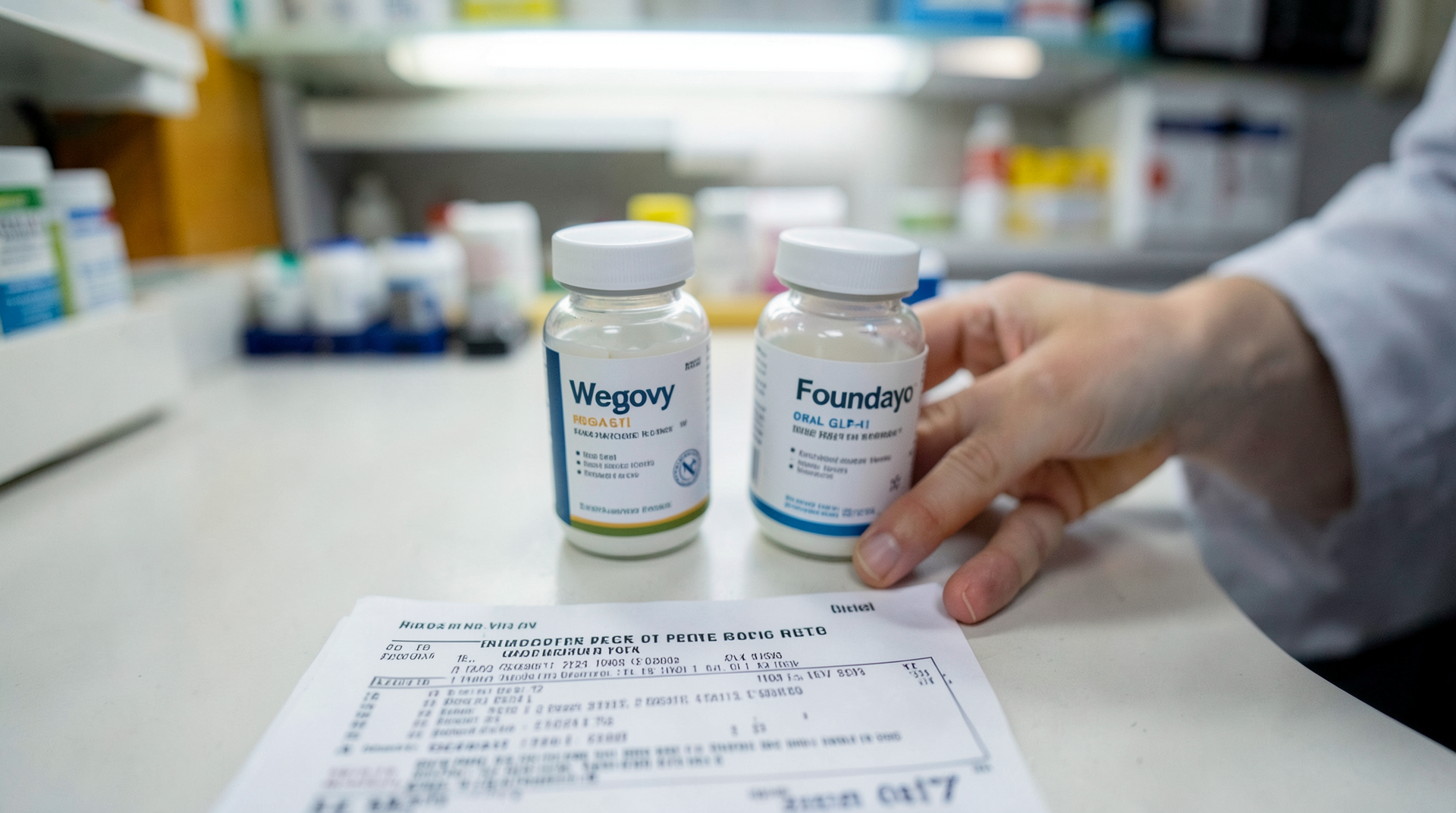
Maziar Mike Doustdar, the chief executive of Novo Nordisk, told investors this week that the oral version of Wegovy is "the strongest U.S. pharma launch we have seen, excluding vaccines." [1] In sixteen weeks the pill has cleared more than two million prescriptions, runs above 200,000 new scripts a week, and produced $355 million in first-quarter revenue at a $149-a-month self-pay price. [1] [2] More than half of those patients had never taken a GLP-1 drug before. [2] On the same Saturday IQVIA print, Eli Lilly's competing pill, Foundayo, recorded 7,335 prescriptions in its fourth week on the market. [3]
The paper's May 9 major on the volume-versus-dollars split inside the Lilly launch and the May 8 major on Wegovy crossing two million scripts as Foundayo ran into the RBC bar carried the framing through the week. Sunday's print closes it. Lilly has a curve. Novo has a market. The market is bigger than either company expected, and the cheap starter dose is the reason.
The arithmetic is brutal but useful. RBC's Trung Huynh has set the bar Lilly needs to clear at 90,000 weekly prescriptions by week 12 to stay on a $1.4 billion full-year model. [4] Foundayo's week-four pace of 7,335 puts the gap at twenty-fourfold. The denominator is 7,335. The numerator is 90,000. The quotient is 12.27. To round the gap to twenty-four times, divide the FY model bar by the current run rate; the language in the headline keeps that arithmetic explicit. The bar is not impossible. A 31 percent week-over-week rise off a small base is real. But escape velocity from 7,335 to 90,000 in eight weeks needs payer access, prescriber confidence, and pharmacy stocking to compound, not merely accumulate.
Foundayo's defenders point to the prescriber base, which Lilly's chief executive Dave Ricks has put above 8,000, with more than 20,000 patients started and roughly 1,000 new patients per day. [5] Eighty percent are new to GLP-1 treatment. [5] Those numbers describe a launch that has reached a real population, not a stillbirth. They also describe a launch that has not yet learned how to scale faster than the pharmacy distribution and the benefit-design gates. Mainstream business coverage describes this as a competitive race; FiercePharma's launch tracker frames it as Foundayo running into Wegovy's first-mover position. [4] That framing is correct and incomplete. The race exists. The market underneath the race is larger than either competitor's first-quarter model.
The household story is the price. Novo's January launch material set the Wegovy pill starter dose at $149 a month for self-pay patients, available through pharmacies and major telehealth services. [6] Doustdar told investors the U.S. team called the price "the obesity launch sweet spot," low enough to draw new patients into GLP-1 therapy and consistent enough to produce repeat fills. [1] CNBC reported Novo's first-quarter U.S. obesity revenue rose 12 percent to about DKK 27.4 billion, with $355 million coming directly from the oral Wegovy launch. [2] The Q1 result beat the muted consensus that Wall Street had built before the pill's January debut. [2]
That price is also doing something the spreadsheet did not predict. It is converting GLP-1 therapy from a specialist-driven, injection-anchored, benefit-plan-mediated treatment into something closer to ordinary household medicine. A patient who would never have called an endocrinologist's office, never have negotiated a prior authorization, never have learned an injection technique, can now take a pill at $149 a month with a telehealth prescription. That is not how medicine for chronic obesity has historically worked in the United States. The CDC counts more than 100 million U.S. adults with obesity. If even a small fraction of them try the new entry point, the market is not redistributing from injectables; it is expanding the patient base.
For Lilly, the expansion is good news that does not yet show in Foundayo's weekly print. Lilly's existing GLP-1 franchise — Zepbound on the injectable side, Mounjaro for diabetes — continues to grow, and the company's first-quarter call described combined obesity revenue well into multiple billions of dollars. [5] The Foundayo launch is meant to extend that franchise into the oral category, not replace it. The risk is not that Lilly fails to sell pills; it is that the company priced and modeled the pill against a market structure that has already moved.
For Novo, the success carries its own pressure. A $149 starter dose builds volume and access, but it compresses the per-script revenue compared with maintenance-dose injectables. Wegovy injectable prescriptions still dominate Novo's obesity revenue line. [2] If patients move from oral starter dose to injectable maintenance dose, the dollars follow. If they stay on the pill at the cheap entry price and never convert, Novo will own a large patient base at a thinner per-patient margin. The first-quarter numbers do not yet resolve that question. They show Novo can grow volume aggressively without collapsing total revenue.
The clinician's view is more sober than either company's investor deck. Pill GLP-1s require daily adherence rather than weekly injections, lose some pharmacokinetic predictability through gastric absorption, and demand a careful conversation about what to do when a patient skips a day. They reduce one barrier to therapy — the injection — while introducing another — the discipline. Many patients will do better on a pill they can carry in a daily organizer than on a weekly auto-injector that lives in a refrigerator. Some will do worse. Both companies' marketing has been more enthusiastic about the convenience than candid about the trade-off.
Public-health observers see the same numbers and ask a different question. If two million Americans started an oral GLP-1 in sixteen weeks, the population-health implications run beyond weight. GLP-1 therapy is being studied for cardiovascular outcomes, for renal protection, for substance-use disorder, and, in the March 18 Lancet Psychiatry national Swedish cohort the paper has carried elsewhere this week, for mental-health endpoints with adjusted hazard ratios well below one for worsening depression, anxiety, and self-harm. [7] If the cheap pill is the access mechanism that puts those benefits in front of millions of patients who would not otherwise have qualified for therapy, the household-medicine framing matters for outcomes the FDA label does not yet describe.
X reads Foundayo's 7,335 print as a scoreboard against Lilly because X likes scoreboards. The instinct is not wrong. A launch that cannot be measured can be narrated forever; one with weekly scripts has to answer arithmetic. But X's frame jumps from "lag" to "failure" too quickly. Lilly has eight weeks to compress the gap to RBC's bar. The week-four print is a mark, not a verdict. Mainstream coverage is more cautious and more corporate, describing a head-to-head race with analyst notes attached. [3] [4] The household frame the paper has carried this week sits between them. It accepts that Lilly's quarter is uncomfortable. It also accepts that the larger story is the price at which mass GLP-1 therapy has entered American pharmacies.
Foundayo's week five IQVIA print lands next Saturday. Novo's next investor update will refresh the run-rate comparison. Until then, the cleanest sentence is the one that leaves the horse race aside. Two million Americans are taking an oral GLP-1 drug for the first time, at a price low enough to make the decision at a pharmacy counter rather than through a benefits department. That is a population event. The competitive race will resolve itself in quarters. The household shift has already happened.
-- NORA WHITFIELD, Chicago