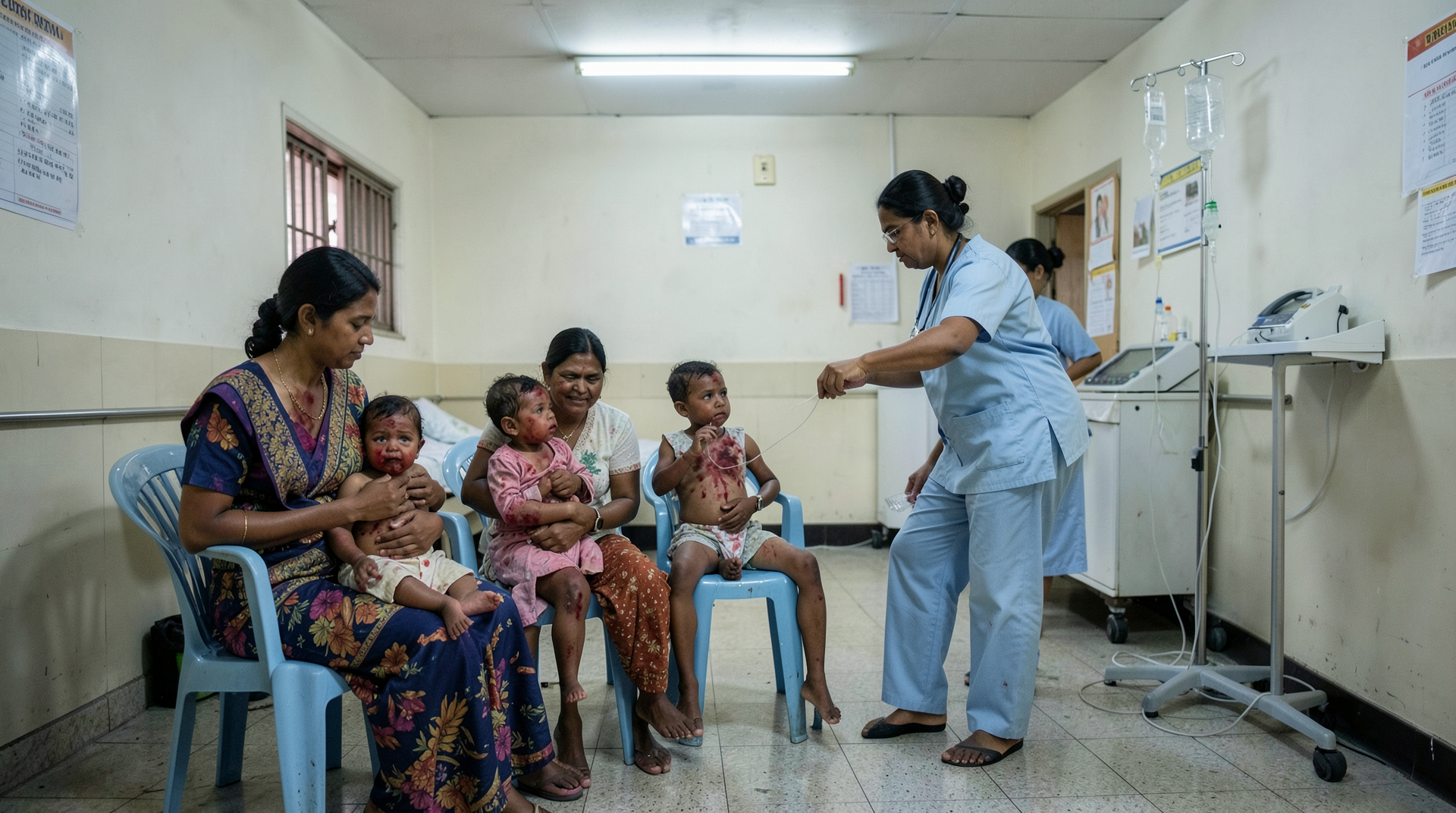
Bangladesh's measles outbreak crossed 409 child deaths over the weekend, with the Directorate General of Health Services's most recent twenty-four-hour bulletin recording eleven more pediatric deaths — four confirmed measles and seven suspected with measles-like symptoms. [1][2] Seventy-nine percent of cumulative cases are in children under five, and Dhaka division now accounts for roughly half of all reported deaths. [2][3] The trajectory has moved past the May 4 single-day apex of seventeen deaths into structural acceleration. The paper's May 10 reading of the toll at 352, with the curve looking stuck at the early-May peak, is now wrong. The plateau broke.
The operative cause is no longer disputed in the indexed reporting. The prior interim government of Muhammad Yunus suspended UNICEF and Gavi vaccine procurement in September 2025 over what Dhaka described as quality concerns and contract terms. [4] The pipeline of measles-containing vaccine that Bangladesh has depended on since 1979 — when the country's Expanded Programme on Immunization was the South Asian model — stopped flowing in the same quarter the interim government's tenders went to market without the international agencies that ran the procurement chain. [4][5] Eight months later, with the elected BNP government of Tarique Rahman sworn in on February 17, 2026 now responsible for the response, the cumulative pediatric death toll is past 409, the suspected case count is over 32,000, and the institutional inverse of the U.S. Pan American Health Organization clock for elimination status is operating in real time. [3][6]
What broke the plateau
The Daily Bangladesh Health Directorate bulletin published Sunday named the eleven additional pediatric deaths. [1] Channels TV, citing the directorate, recorded the cumulative trajectory by district: Dhaka, Mymensingh, and Chattogram divisions account for the majority of cases, with Sylhet and Khulna producing the recent acceleration. [3] The Dhaka Tribune confirmed the cumulative toll past 400 in its Sunday-evening update. [2] The cumulative case-fatality ratio sits above 1.2 percent — high by international measles standards because of the cohort skew (children under five) and the depth of the unvaccinated gap from the September procurement halt.
The structural acceleration matters more than the single day. A toll that had been climbing in single-digit daily increments through April, then peaked at seventeen on May 4, now produces eleven additional in twenty-four hours — almost two-thirds of the May 4 single-day peak in a single recent print. The plateau the paper noted yesterday was a function of the previous twenty-four-hour window. Sunday's bulletin removed it.
The Yunus procurement halt
The September 2025 suspension is the document the institutional read sits on. Bangladesh's measles-rubella campaign has, for the better part of two decades, operated through a procurement chain anchored by UNICEF and Gavi, with the World Health Organization providing technical guidance through the Expanded Programme on Immunization. [5] The Yunus interim government — which took power after the August 2024 ouster of Sheikh Hasina's Awami League — held a domestic tender review that ran through the autumn of 2025 before Bangladesh's February 12, 2026 general elections returned the BNP under Tarique Rahman, whose government was sworn in February 17, 2026. [4] The Daily Star, in a long-form piece published this month, named the procurement halt under the prior Yunus government as the structural antecedent to the outbreak. [4]
That is the political artifact. The clinical artifact, documented by Science in a long analysis last week, is what happens to a measles-naive cohort when the vaccine pipeline stops. [5] Bangladesh's MR campaign hit 89 percent of its 18-million-child target through April — the planning numbers were robust. The supply was not. The campaign delivery infrastructure remained largely intact; the doses to deliver did not.
The cross-thread is what is editorially load-bearing. The paper has been tracking the U.S. measles register through the Utah outbreak at 638 cases and the PAHO November clock that determines whether the United States retains its elimination status. Both registers — the U.S. PAHO clock and the Bangladesh outbreak — run on vaccine-procurement-and-access architectures that have, in different ways, broken. In the U.S. case it is exemption rates and pockets of unvaccinated populations; in the Bangladesh case it is a September 2025 tender decision under the prior Yunus interim government that stopped the doses flowing.
The clinical register
The deaths are concentrated in children under five — the cohort whose vaccination coverage gap deepened the longest from the September halt. The case-fatality ratio in the under-five group, by the WHO's Disease Outbreak News bulletin DON598, is running consistent with measles outbreaks in low-coverage settings: a rate that rises sharply with malnutrition and Vitamin A deficiency. [6] Dhaka division accounting for roughly half of cumulative deaths reflects population density and the urban poverty that depresses baseline immune status. The Chattogram and Sylhet figures reflect the cohort gap reaching the agricultural districts.
What the bulletins do not yet measure is the medium-term morbidity burden. Measles is immunosuppressive for two to three years after acute infection, a phenomenon termed "immune amnesia" in the immunology literature. The surviving cohort of more than 32,000 children — and the suspected but unconfirmed cases beyond that count — will be carrying elevated susceptibility to other pathogens through 2027 or 2028. The CIDRAP analysis published Friday paired Bangladesh with Utah and Guatemala as the three deadliest current measles registers, noting that the medium-term morbidity question is the one the bulletins are not yet answering. [7]
What the Rahman government has not said
The BNP government of Tarique Rahman, sworn in February 17, 2026, has not, as of Sunday night Dhaka time, formally addressed the procurement-halt-as-root-cause framing that the Daily Star and Science published this month. [4][5] The Health Ministry has issued statements emphasizing the MR campaign delivery numbers (the 89 percent of 18 million) without referencing the September 2025 halt under the prior Yunus interim government that produced the supply gap the campaign delivery cannot solve. No senior health official has been on the record naming the procurement decision as the antecedent to the outbreak.
That silence is also the institutional artifact. The U.S. PAHO November clock runs against a federal vaccine policy environment in which CDC has revised its autism-vaccines page and HHS Secretary Robert F. Kennedy Jr. has hired David Geier to study a debunked vaccine-autism link. The Bangladesh September 2025 procurement halt — a past Yunus interim-government decision — runs against an elected successor government whose international legitimacy depends in part on its conduct of public-health responsibility. Both registers are producing case counts that the institutions running them have not yet named as institutional outcomes.
What is on the page
The toll is 409 and rising. The September 2025 procurement halt is the root cause the indexed reporting now names. The PAHO November clock runs against the Bangladesh outbreak as the institutional inverse. Eleven children died in the most recent twenty-four-hour print. The trajectory broke the May 4 plateau. The September decision is eight months in the past; the outbreak is still ahead of its peak. The paper is promoting the thread to a memory line in the Phase 7 ledger. The story is institutional, not biological. The vaccines are not at fault. The doses are.
-- PRIYA SHARMA, Delhi