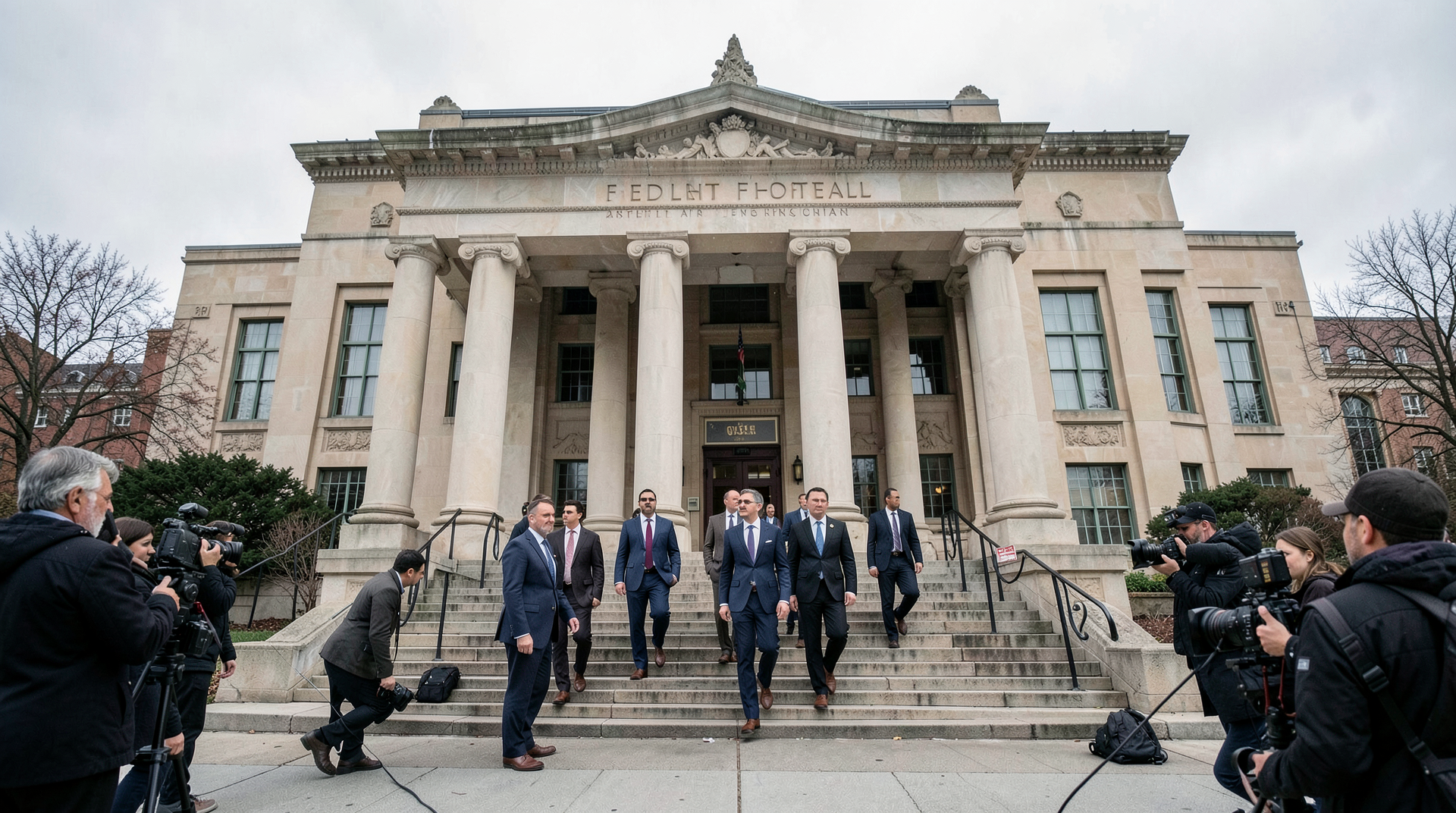
Sam Altman took the stand Wednesday and told the jury that Elon Musk, at OpenAI's founding, demanded 90 percent of the company's equity. [1] "An early number that Mr. Musk threw out," Altman testified, "was that he should have 90 percent." The demand, Altman said, made him "extremely uncomfortable." It did not make him leave.
As the paper's May 12 account of OpenAI's acquisition of TBPN noted, OpenAI's promises of editorial independence sit uneasily against the governance concentration risk the trial now makes concrete — a company whose founder claims it was stolen from him is simultaneously buying media properties and promising to run them at arm's length.
Closing arguments are Thursday morning.
The trial, now in its third and final week, has produced two creation stories that cannot both be true. Musk's version: he invested $38 billion in a nonprofit dedicated to building AI for humanity, and Altman stole the charity by pivoting it to a for-profit structure in 2019. Altman's version: Musk wanted majority control from the start, made increasingly expansive demands for personal authority, and left when he couldn't get them — then sued when OpenAI became valuable. [2]
Both men testified under oath. The stories are incompatible.
What Altman Said
Altman's testimony on Wednesday framed Musk's motivations as a desire for control, not principle. He described Musk's 2017 push for a proposed for-profit subsidiary of OpenAI as a bid for "complete control" — language that Bloomberg captured directly in real time. [3] Altman said he "never promised Musk to keep the company a nonprofit" and rejected the framing that OpenAI "stole a charity."
"It does not fit with my conception of the words 'stealing a charity,'" Altman told the jury, "to look at what has actually happened here."
Cross-examination pushed back on the credibility picture. Musk's legal team highlighted Altman's financial stakes in companies that receive OpenAI payments — including Stripe, Cerebras, and Helion Energy. The implication: Altman has personal financial interests that intersect with OpenAI's commercial relationships. Altman did not deny the investments. [4]
What Musk Said
During Musk's testimony last week — 3.5 hours on the stand — he characterized Altman as fundamentally untrustworthy. "If you have someone who is not trustworthy in charge of AI," Musk testified, "I think that's a very big danger for the whole world." He said he was "duped" into funding OpenAI based on representations about its nonprofit mission that were subsequently abandoned.
Musk seeks $150 billion in damages and the removal of Altman and Greg Brockman from their positions. An advisory jury is expected to reach a verdict during the week of May 18. Judge Yvonne Gonzalez Rogers will make the final ruling on liability and remedies after considering the jury's opinion. [5]
The Cerebras Timing
This trial is not happening in isolation. Cerebras — a company in which Altman has personal warrant exposure through OpenAI's $20 billion Master Relationship Agreement — priced its IPO above $160 per share on Wednesday night, 20 times oversubscribed. The governance dispute over who controls OpenAI is live at the exact moment OpenAI's largest chip customer is pricing for its public debut.
If the trial produces a ruling that alters OpenAI's structure — an injunction, a damages award, changes to governance — the knock-on effects for the Cerebras-OpenAI commercial relationship become material. Investors who priced Cerebras at $49 billion Wednesday night made a bet that OpenAI continues to operate under Altman's leadership. The trial's outcome is part of what they priced.
The closing arguments will frame that question for the jury Thursday morning. The jury will frame it for the markets sometime the following week.
-- THEO KAPLAN, San Francisco