The deadline passed without a counter-text, an extension, or an airstrike. At some point on Wednesday, the American ultimatum that had organized the Gulf's diplomatic calendar for three weeks simply expired — and the ceasefire, which Trump had described as being on "massive life support" two days earlier, continued anyway. [1]
Nothing happened. That is the story.
As the paper's May 12 account of how the deadline reached Beijing with the Gulf already burning described, the Wednesday threshold had become the organizing frame for four simultaneous crises: the Hormuz shipping lane, Congressional war powers, European naval posture, and Sino-American diplomacy. The question was what the deadline's passage would resolve. The answer, on Wednesday, was: nothing. And that non-resolution is now a fact that every actor in the story must incorporate.
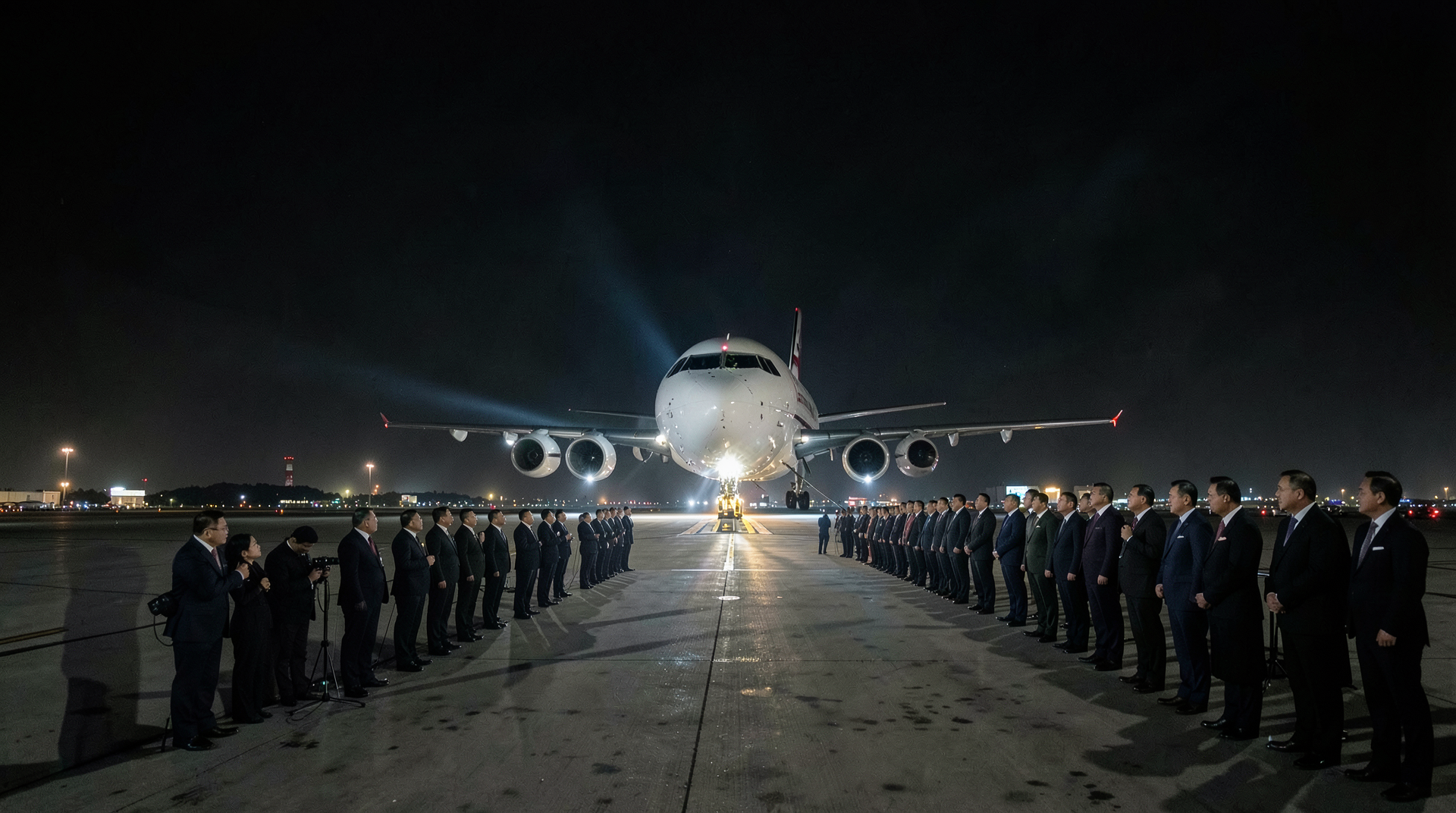
Air Force One landed in Beijing on Wednesday evening local time. Formal bilateral meetings with President Xi Jinping are scheduled for Thursday and Friday. Trump told reporters before departure that he would have "a long talk" about Iran with Xi, while separately downplaying the need for Chinese mediation — a posture that reflects the contradiction at the heart of his Beijing trip: he is going to China while insisting China is not the answer. [2]
The Architecture of a Non-Event
Understanding why the deadline passed without consequence requires understanding what kind of deadline it was. It was not a legal tripwire tied to an automatic military response. It was a diplomatic pressure instrument — a declared endpoint designed to force Iranian counter-movement before Trump arrived in China, so that he could enter Beijing with either a deal in hand or a decision made.
Iran's last-known formal response, which Trump described before departure as "the weakest right now — I didn't even finish reading it," included demands for an end to the war on all fronts, the lifting of US sanctions on Iranian oil, the removal of the naval blockade on Iranian ports, and the unfreezing of frozen assets. [3] Trump rejected it as "a piece of garbage." The two sides were not close.
The ceasefire, originally agreed in early April and extended by Trump on April 21 after Pakistan's request for more time, now continues without a formal mechanism sustaining it. It is, by Trump's own characterization, alive only on "massive life support." That the patient is still breathing does not mean the prognosis has improved.
Pakistan's Channel, and Its Problem
The only active diplomatic channel is Pakistan, and that channel acquired a significant complication this week. CBS News reported, citing American officials, that Pakistan allowed Iran to shelter military aircraft at the strategically sensitive Nur Khan Airbase near Rawalpindi during the period of US airstrikes. [4] Senator Lindsey Graham called for a reassessment of Pakistan's role. Islamabad denied the specifics but did not deny the core allegation cleanly.
Pakistan's position is already precarious. It positioned itself as a trusted intermediary precisely because it presented a facade of equidistance — close enough to Tehran to carry messages, close enough to Washington to be trusted with them. The aircraft shelter story punctures that image. Whether it destroys the channel depends on whether the Trump administration decides to act on its anger or swallow it in the interest of keeping the mediation alive.
On Wednesday, China publicly reiterated its support for Pakistan's mediatory role — a statement from Wang Yi that landed the same day China was preparing to host Trump for substantive bilateral talks. The timing is not incidental. Beijing is threading a needle: supporting the only active mediation channel while positioning itself as the meeting place for the eventual deal. [5]
Wang Yi had hosted Iranian Foreign Minister Abbas Araghchi in Beijing on May 6. The message from that meeting carried a dual logic: pressure Tehran toward flexibility on the substance while validating Iranian sovereignty claims in principle. China enters the Trump summit as a would-be facilitator, not a lever. Xi does not have a hotline to Khamenei that can be switched on at American request. What China can offer is prestige, cover, and a framework — conditions under which both sides can move without publicly appearing to capitulate.
The EU's Aspides Question
In Brussels on Tuesday, the EU Foreign Affairs and Defence Council discussed what to do about Operation Aspides and the Strait of Hormuz. EU foreign policy chief Kaja Kallas said explicitly that Aspides "could be extended to the Strait of Hormuz — all that is needed is an amendment to the operational plan." [6] The mandate, she noted, already permits the extension; only the operational plan requires change.
The Belgian frigate Louise-Marie, whose deployment had been delayed by technical issues, resolved those issues on April 27 and is now in theater. The EU has not voted on the Hormuz extension. What it has done is formally put the question on the table and identified the pathway — a plan amendment requiring no new authorization.
This matters for the deadline's aftermath. The EU's Aspides discussion was driven in part by the assumption that the American ceasefire architecture might not hold. European defense ministries were preparing for a scenario in which the United States resumed operations, Hormuz shipping became acutely threatened, and the EU needed its own operational mandate to respond. The deadline passing without a resumption of hostilities does not resolve that question — it defers it.
Russia's Calculated Silence
Moscow has said nothing about the deadline, the Wang Yi-Araghchi meeting, or the Trump-Xi summit. The Israeli National Security Studies (INSS) analysts who track Russian positioning on Iran characterize this silence as strategic: Russia gains from the standoff's indefinite extension in a way it would not gain from either a clean diplomatic resolution or a resumption of American strikes. A prolonged, unresolved Iranian crisis occupies American bandwidth, ties up Gulf energy markets in uncertainty, and keeps European defense planning focused on multiple theaters simultaneously. [7]
Russia's silence is not passivity. It is a choice to let the crisis exhaust the other players while contributing nothing to its resolution. The ceasefire's continuation-by-inertia serves Moscow's interests more cleanly than any negotiated outcome would.
Ocean Koi: Week Eleven
The oil tanker Ocean Koi, detained in Hormuz waters now for five days, remains a marker of the ceasefire's operational ambiguity. Its continued detention is neither a hostage situation nor a resolved customs matter. It exists in the same legal-diplomatic limbo as the ceasefire itself — continuing because no one has made a decision to change it. [8]
The oil markets — which spent the weeks before the deadline pricing in various scenarios — closed Tuesday with Brent at $107.77 and WTI at $102.18, both up roughly 45 percent since the war began on February 28. The deadline did not produce a spike; the deadline arrived inside a structural war premium that has not retraced on any of the recent "ceasefire holds" headlines. Saudi Aramco's chief executive Amin Nasser said this week the market is losing roughly 100 million barrels of supply per week and warned that normalization slips into 2027 if Hormuz remains restricted past mid-June. The price is pricing barrels that are not arriving.
What "Passed" Actually Means
The question the paper must now press — and the question every actor in this story faces — is what the deadline's passage changes about the underlying structure of the standoff.
The answer, at the moment, is less than it appears. The ceasefire is still in place. Iran and the United States have not agreed on any substantive terms. Pakistan's mediation channel is under pressure but not severed. Congress has a war powers question it has not answered. The EU has a Hormuz mandate it has not activated. China is hosting a summit that may or may not produce a framework.
The deadline was designed to force a resolution before Beijing. What it produced instead was a clarification: the parties are not close enough for a deadline to force their hands. Trump arrived in China without a deal and without a decision. He arrived, instead, with a crisis that has outlasted its own pressure architecture.
That is not failure in the conventional sense. Pressure architectures that fail to produce deals can still produce behavior — Iranian caution, Chinese engagement, European planning. The question for Thursday's formal summit is whether Xi can offer Trump something — a framework, a formula, a face-saving formulation — that lets both Washington and Tehran move without either side having to publicly climb down.
From Jerusalem, the view is different. The Israeli government, which supported the original American strikes and has watched the ceasefire with mounting unease, reads the deadline's non-consequential passage as confirmation that the architecture of pressure is eroding. No decision was forced. The ceasefire continues. Iran's nuclear program continues. And the timeline for what comes next — resumption, negotiation, or indefinite stasis — is now determined by what happens in Beijing, a city that neither Jerusalem nor Tehran controls.
-- YOSEF STERN, Jerusalem / DAVID CHEN, Beijing