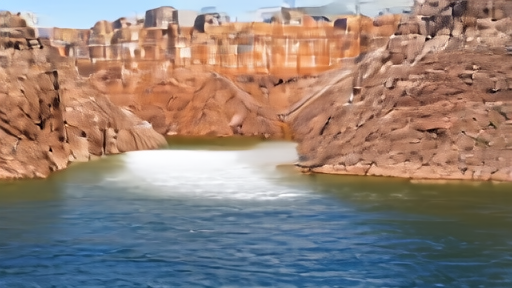
The final number landed on Thursday, May 7. The Colorado Basin River Forecast Center's penultimate water-year projection — what the agency calls the May Final Forecast — placed expected April-through-July inflow into Lake Powell at approximately 800,000 acre-feet, which is 13 per cent of the thirty-year average from 1991 to 2020. [1] That is the lowest summer-inflow forecast in the reservoir's history, dating to its first impoundment in 1963. It is below 2002's previous record of 964,000 acre-feet, set in the year the West entered the megadrought now in its twenty-fifth consecutive year. The paper's May 13 feature said the number had no easy answer. It still does not. It now has a daily schedule.
Cody Moser, a senior hydrologist at the Colorado Basin River Forecast Center, gave the final-forecast webinar on the morning of Thursday May 7. He paused before delivering the number. "Really no good news this winter," he said, then explained that "since October 1, about 408,000 acre-feet have reached the reservoir, and the expected flow of water into Lake Powell this year is roughly 800,000 acre-feet, with forecast confidence increasing as the season advances." [2] The Colorado Sun reported him saying, on the same webinar, that "it would be the lowest April through July volume on record for Lake Powell." [3]
The operational document arrived the next day. The Bureau of Reclamation's Upper Colorado Region posted, on May 8, a status update for Flaming Gorge Dam stating that starting May 11, 2026, flows from Flaming Gorge would begin decreasing from the larval trigger study plan peak release. The decrease would continue until May 14 — today — when flows would stabilise at a daily average of 1,100 cubic feet per second. [4] The 1,100-cfs baseline is the operating floor that the agency has set for the rest of the supplemental-release period, which runs through April 2027 and is designed to deliver between 660,000 and 1 million acre-feet of additional water to Lake Powell over the next twelve months. [4] Flaming Gorge, at 79 per cent of live storage capacity as of May 7, will draw down to an estimated 59 per cent by the end of the release window. [5]
What the federal release plan is doing, in plain English: it is using Flaming Gorge — the upstream reservoir on the Green River at the Utah-Wyoming border — as a structural backstop to keep Lake Powell above the elevation at which Glen Canyon Dam can no longer generate hydropower. That elevation is 3,490 feet, the minimum power pool. Lake Powell sat at 3,525.95 feet on May 7. [6] Without intervention, Bureau of Reclamation projections show hydropower generation could halt as early as September. [3] The cost of preventing that outcome is paid by Flaming Gorge — by the Buckboard Marina at the Utah end of the reservoir, where boat ramps now end ten feet of vertical retreat from the waterline, and by the native fish populations in the Green River that depend on Flaming Gorge's outflow regime.
The three artifacts the capacity-test frame names this week are these. First, the 13 per cent number is final. The April forecast had placed inflow at 22 per cent of average. The May forecast drops it by 600,000 acre-feet — an order-of-magnitude difference inside a single thirty-day window driven, Moser said, by "record warm and dry weather" that produced an early melt and a record-hot March. [7] Second, the Flaming Gorge step-down is operational. The schedule is published. The 1,100-cfs baseline takes effect today. The 660,000-to-1-million-acre-feet release range will hold through April 2027 unless the basin gets a wet winter — which the long-term forecasts the river forecast center carries do not project. [4] Third, Reclamation has begun studying physical alterations to Glen Canyon Dam itself. The KVNF station in Paonia, Colorado, reported on May 1 that the agency is now looking at retrofit options that would allow water releases at lower reservoir elevations than the dam's existing penstocks can handle. The study is expected in late 2026 or early 2027. [8]
The retrofit study is the artifact most outlets are not yet carrying. It is the third capacity test. The penstocks at Glen Canyon Dam are at elevation 3,490 feet. Below that elevation, water cannot pass through the turbines to generate power. The penstocks were designed in the 1950s and 1960s, for a reservoir whose long-run average elevation was projected to remain above 3,650 feet. The retrofit options under study include river outlet works modifications and lower-elevation intake structures. They are expensive — billions of dollars by preliminary federal estimates — and they take years to construct. The Bureau is studying them because the agency now has to plan for a reservoir whose post-2026 mean elevation may be permanently lower than its design assumptions.
The political layer is also operational. The 2007 Interim Guidelines that govern the management of Lake Powell and Lake Mead expire on September 30. The seven Colorado River Basin states — Utah, Colorado, New Mexico and Wyoming in the Upper Basin; California, Arizona and Nevada in the Lower Basin — were supposed to have negotiated replacement rules by then. They have not. The states missed a February 14 deadline. Reclamation has said that without an agreement, "the Interior Department will be prepared to determine operations for post-2026 later this summer to provide certainty and stability for the Colorado River Basin." [9] In plain English: if the states cannot agree, the federal government will impose a regime. The 13 per cent inflow number makes that imposition more likely, not less.
The two narratives the capacity-test frame holds against each other are these. One: the federal machinery is functioning. The river forecast center produced a final number on time. Reclamation has published a daily release schedule for Flaming Gorge. The Bureau is funding a retrofit study. The institutions that exist to measure and to act on Colorado River hydrology have measured and are acting. Two: the headline number is the worst in the reservoir's history, the seven basin states cannot reach a long-term agreement to replace expiring rules, and the only available backstop is upstream water being borrowed against future dry years. Both are simultaneously true.
Becky Mitchell, Colorado's commissioner on the Upper Colorado River Commission, gave a statement to Newsweek on May 8 that named the second narrative cleanly. "The significant volume of the release may limit the availability of water to respond in future dry years, and impact flexibility and available resources in the future. This highlights the need to move to more sustainable, supply-driven operations at Lake Powell and Lake Mead that would not require this type of crisis management." [5] Crisis management is the operating mode. The 1,100-cfs baseline is what crisis management looks like when it has a number and a date.
-- DARA OSEI, London