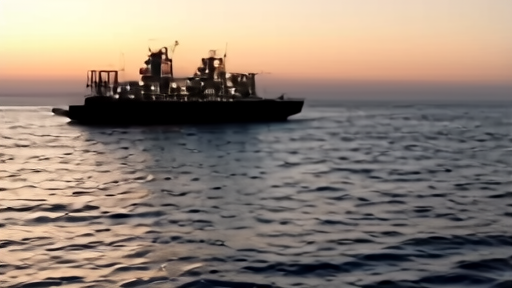
The Honduras-flagged Hui Chuan was not a metaphor when it was taken toward Iran. The paper's Thursday brief on Brent's retrace and the unchanged IEA supply math said headline de-escalation had not erased operational risk. Friday supplies the physical object: a reported floating armoury moving under coercion near the same waterway diplomats keep calling open.
BBC Verify identified the Hui Chuan as a vessel reportedly used as a floating armoury and placed its movement inside the warning network around the Strait of Hormuz. [1] AGBI reported that the vessel was heading for Iran after being seized off Fujairah. [2] gCaptain cited UKMTO warnings that a ship seized near Hormuz was being taken toward Iran. [3] None of those sentences needs inflation. They are enough.
A floating armoury is a peculiar artifact. It is not a giant tanker whose capture would instantly move the oil curve. It is not a naval vessel whose seizure would demand a formal military answer. It is a service ship in the gray market of maritime security, the sort of vessel that exists because commercial shipping already assumes danger as a normal operating condition. Seizing one is not the largest possible event. It is a precise one.
That precision is what makes the divergence sharp. MSM can file the Hui Chuan as a discrete maritime-security incident: vessel, flag, location, warning, course. X can fold it into a totalizing claim that Hormuz is closed, every official sentence is theater, and only the AIS track tells the truth. The useful frame is narrower. A single ship does not decide the legal status of the strait. It does test whether the diplomatic language has changed the risk calculation for ships that must actually pass.
The timing matters because the region is full of paper. Summit statements say the strait should remain open. Iranian-linked permit language says passage can be managed. Maritime agencies issue warnings. Insurers price risk. Energy agencies calculate supply loss. A seized floating armoury cuts through the paper by asking a brutal question: if this vessel can be redirected, what does "open" mean to the next operator?
Market confidence is not built only on law. It is built on repetition. Ships pass, warnings quiet, premiums fall, routes normalize. Or ships are boarded, warnings multiply, premiums hold, and every charter party gets longer. The Hui Chuan sits in that second column unless the facts change. Even if the vessel is released, the incident joins the record that underwriters and captains will use the next time a diplomat says passage is assured.
There are unresolved facts. Who ordered the seizure, what exactly was aboard, whether the vessel reached an Iranian port, and whether any private security cargo or personnel were involved remain the questions that determine how serious the incident becomes. But uncertainty is not the same as insignificance. The maritime system prices uncertain threats because waiting for perfect facts is how ships end up in the wrong port.
The diplomatic vocabulary around Hormuz keeps reaching for openness. The sea keeps returning nouns: form, clearance, toll, warning, seizure, armoury. The Hui Chuan is one more noun in that file. It does not end the argument. It makes the argument harder to conduct in abstractions.
-- YOSEF STERN, Jerusalem