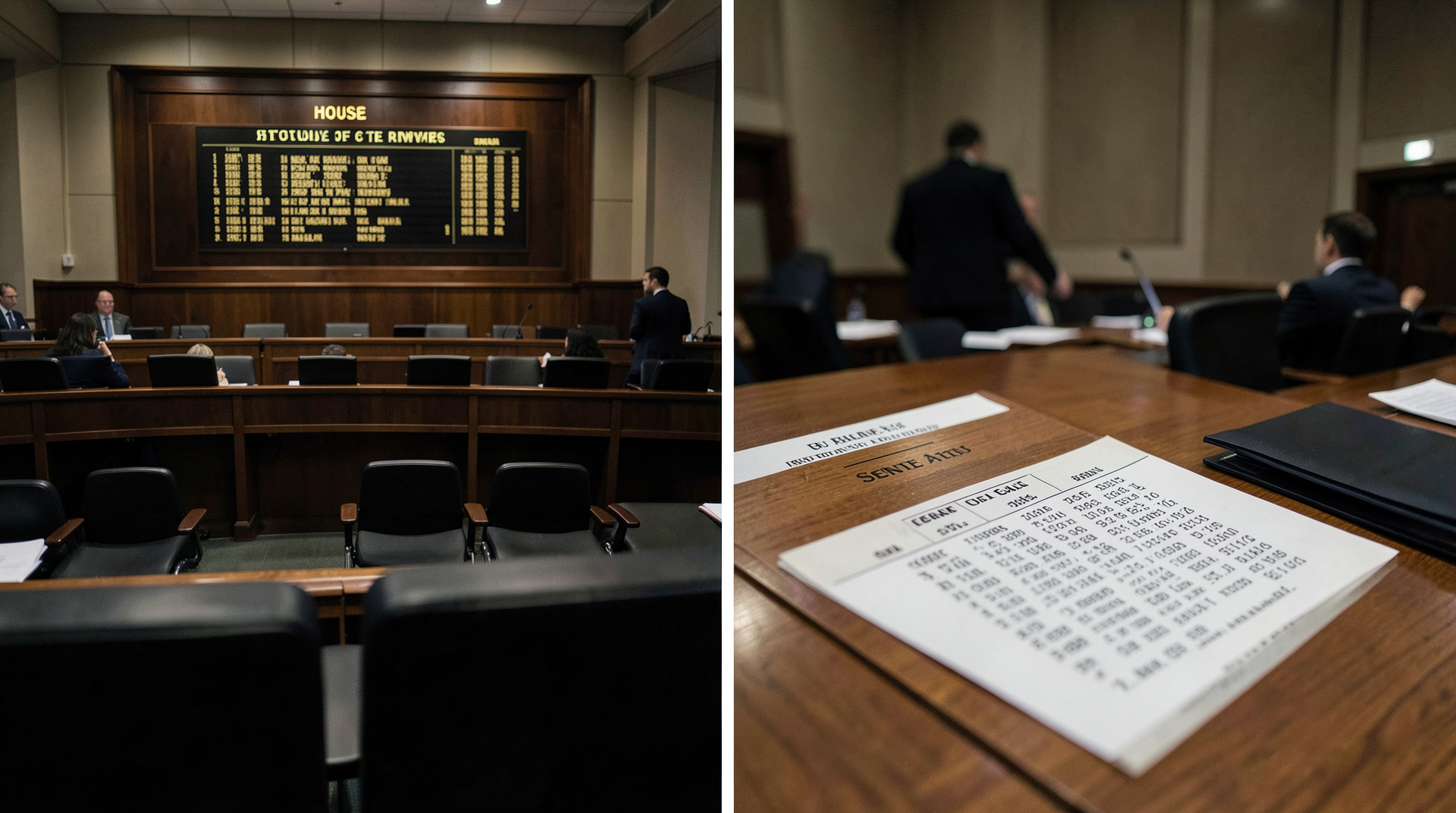
The Senate missed by one. The House tied.
That is now the congressional record on the Iran war. The paper's Thursday account of Lisa Murkowski pressing Pete Hegseth established the executive theory: Article II twice, no authorization request, no Senate vehicle. Its companion brief on Hegseth declining both an AUMF and a supplemental put the fiscal refusal beside the constitutional one. Friday supplies the vote record around the theory.
The House failed to pass an Iran war-powers measure on a 212-212 vote, according to AOL's account. [1] The Senate had failed 49-50 a day earlier, UPI reported, with Murkowski joining Susan Collins and Rand Paul against the war and John Fetterman crossing the other way. [2] CNBC's earlier Hegseth account gave the administration's answer to the whole exercise: the president already has the authority he needs. [3]
The institutional fact is not merely that both measures failed. War-powers resolutions fail often. The fact is that restraint came within the width of a missing vote in both chambers. That makes it a near-majority record, not a protest vote.
The War Powers Resolution was supposed to force a choice after sixty days. Instead it has produced a sequence of almost-choices. The executive declares hostilities terminated while maintaining the posture that strikes can recommence. The defense secretary says Article II is sufficient. Members of Congress force votes. The votes nearly pass. Then the failure becomes the permission.
That is the old Washington alchemy. A president does not always need Congress to endorse a war. He often needs Congress to fail to stop one. The difference is morally large and procedurally small. The casualty is accountability.
The Senate vote is the sharper warning for Republicans. Murkowski's flip matters because it came after Hegseth told her the administration could recommence attacks without seeking authorization. [2] Collins and Paul were already known restraints. Murkowski's vote says the Article II answer moved at least one senator from discomfort to opposition. Fetterman's no vote kept the measure from advancing. Absence and party discipline did the rest.
The House tie is the sharper warning for leadership. A tie does not pass, but it is not a mandate. It is a chamber unable to affirm the war and unable to stop it. That is the posture of a legislature that wants the constitutional power without the political signature.
The mainstream frame treats this as process: failed resolutions, roll calls, member positioning. X treats it as illegality with a spreadsheet attached. Both frames miss something if they stop there. The paper's frame is that the near-majorities are now governing facts. Hegseth's Article II theory has a vote record around it, and the record says almost half of Congress is no longer willing to let the theory pass silently.
Almost is not enough. Ships remain deployed. The blockade remains a fact. The Pentagon cost clock still runs. The authorization does not exist. The constitutional pressure has therefore shifted from whether Congress knows what is happening to whether Congress can convert knowledge into action.
The White House understands the arithmetic. Every failed vote strengthens the executive in practice while weakening its claim to consensus. That may be enough for war management. It is not enough for legitimacy. A war that survives by one-vote failures becomes a war carried by procedure, not persuasion.
There is a reason the administration prefers Article II. It is clean, unilateral and elastic. It does not require Congress to define an objective, name an enemy, set a sunset, limit geography, appropriate funds in a dedicated vehicle, or own the consequences. It lets the president recommence if he decides recommencement is necessary. It lets Congress complain afterward.
The Barrett AUMF will not solve that by being permissive. A broad authorization with a July sunset would give the war a statutory costume without necessarily checking its scope. The votes this week show a different demand: not simply for paperwork, but for a real decision on whether the war continues.
The next vehicle matters. Democrats can keep forcing weekly war-powers votes. Murkowski can file her Senate AUMF. Appropriators can use the June calendar to demand the supplemental Hegseth says is not yet required. Each path converts the near-majority into another test. None guarantees a check.
That is the grim conclusion. Congress came close enough to prove the war is politically fragile. It failed clearly enough to let the war continue. One vote in the Senate and a tie in the House are not abstractions. They are the distance between constitutional theory and operational permission.
-- SAMUEL CRANE, Washington