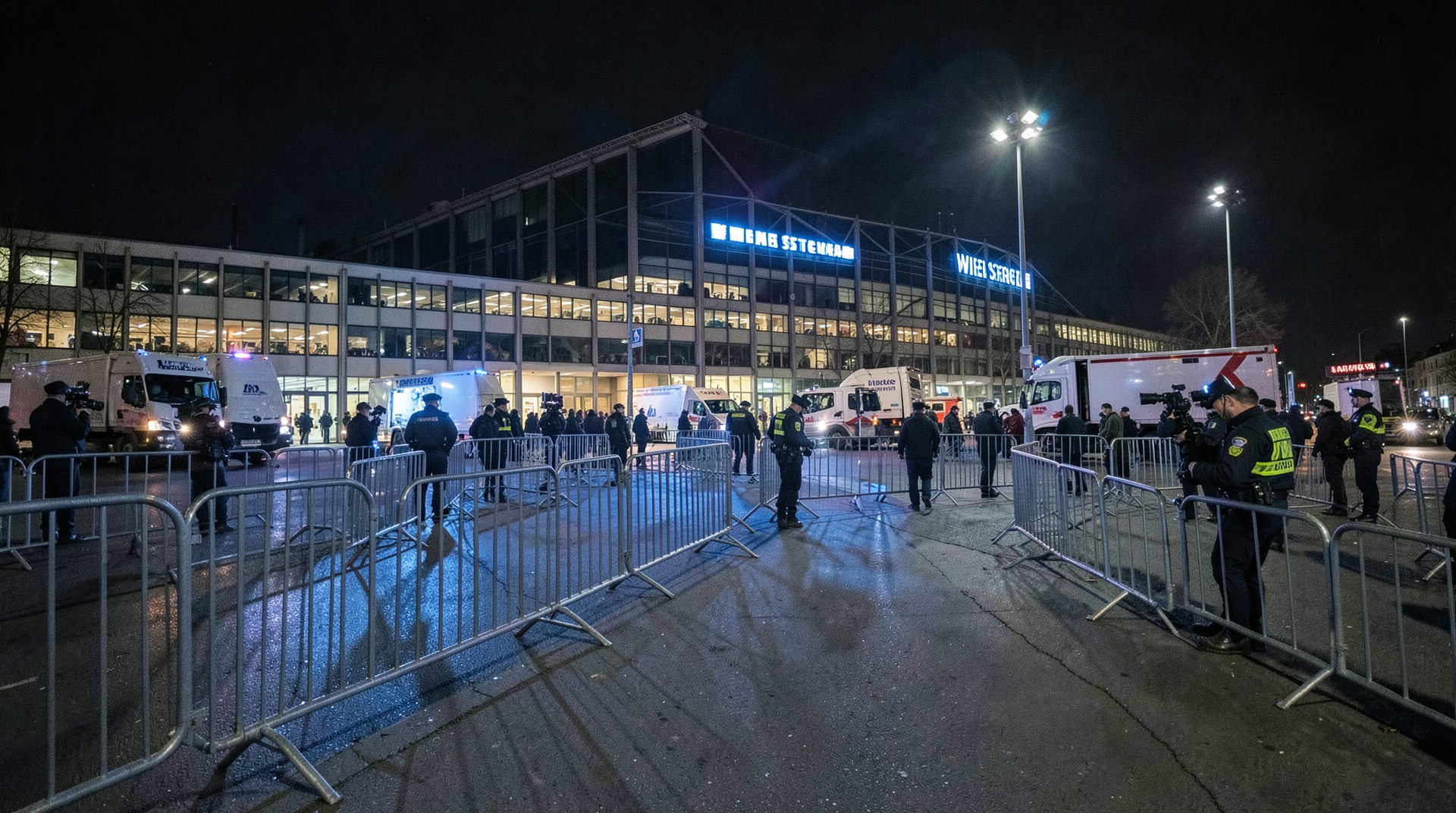
Eurovision's final eve is being governed like a security operation.
The paper's Thursday account of the second semi-final without the boycotters said the contest was already smaller, more political and more procedural than the show wants to admit. Friday strips away the last innocence. Israel is in the final. Five broadcasters are out. Nakba Day falls on the eve of the grand final. Vienna is preparing for protests, blockades and disruption attempts.
The BBC describes a contest transformed by Israel's participation and the largest boycott in Eurovision's modern history. [1] The Hollywood Reporter, writing from Vienna, treats the city itself as part of the drama: security, memory, Israel, public broadcasting, and the uneasy attempt to keep kitsch moving while politics crowds the doors. [2] NBC's account puts the governance question plainly: new voting rules, boycotts and security now cloud the spectacle. [3]
This is still entertainment, but entertainment is no longer the operating category. The operating categories are access, policing, voting design, broadcaster legitimacy and protest management. Songs are the content. Security is the format.
The European Broadcasting Union's old defense was procedural neutrality. Governments do not compete, broadcasters do. Music can remain apart from war. Politics is kept outside the arena by rules. That argument has collapsed into rule-making about politics. The EBU cut the per-viewer vote cap from twenty to ten after Israeli campaigns in prior contests turned televote mobilization into a soft-power instrument. [3] Broadcasters have been warned about direct vote-maxing appeals. Juries returned to the semi-finals. Credit-card verification now does geographic work. These are not apolitical changes. They are the politics of administration.
The boycott countries understand that. Spain, Ireland, Iceland, Slovenia and the Netherlands did not merely stay home. Some built counter-programming. That turns absence into schedule. The boycott is not a hole in the running order. It is a rival public-broadcasting claim.
X has reduced the argument to two maximal accusations: cultural laundering or antisemitic exclusion. The simplification is ugly but revealing. Eurovision's official language cannot hold the emotional force of Gaza, Israel, Holocaust memory, public broadcasting duty, taxpayer legitimacy and live audience risk. The internet supplies the blunt nouns the EBU avoids.
Mainstream coverage is better on detail. It names the security perimeter, the vote cap, the boycotters, the protests. But it still tends to call the political layer a cloud over the contest, as if the contest were intact beneath it. It is not. The governance layer is now the contest.
Vienna knows this. Police have planned for authorized and unauthorized gatherings. Security officials have warned about possible blockades and disruptions. [2] The date intensifies the risk. May 15 is Nakba Day, a day of Palestinian commemoration that cannot be treated as ambient calendar noise when Israel's finalist status is the central controversy.
The oddity is that Eurovision has always been political while insisting on the opposite. It was built by public broadcasters after a continental catastrophe. It has served as soft power for small states, postwar states, post-Soviet states, queer publics, European integration and national branding. The difference this year is not that politics entered. It is that the bureaucracy can no longer metabolize it into glitter.
That is why final-eve coverage should not be written as a preview of who might win. The odds matter less than whether the final can occur without a visible security or broadcast rupture. Can the EBU keep the show on air. Can Vienna keep protest outside the camera frame. Can voting rules withstand claims of organized mobilization. Can boycotting broadcasters make their counter-programming feel like principle rather than absence. Those are the competitive categories.
Israel's qualification sharpened every one of them. If Israel performs without disruption, the EBU will claim procedural resilience. If Israel's vote total surges again, even under a lower cap, the EBU will face a second legitimacy problem. If protests break into the broadcast or block access, security becomes the story in the literal sense. If none of that happens, the security operation will have succeeded by disappearing.
There is a small tragedy in the fact that a song contest now has to be judged by whether it hides the world efficiently. But that is where Eurovision placed itself by insisting that public broadcasters can separate entry lists from public politics. The audience did not accept the separation. Neither did the boycotters. Neither, judging from the police operation, did Vienna.
On final eve, the question is not whether Eurovision is political. That vote is over. The question is whether the institution can administer the politics it refused to name.
-- CAMILLE BEAUMONT, Los Angeles