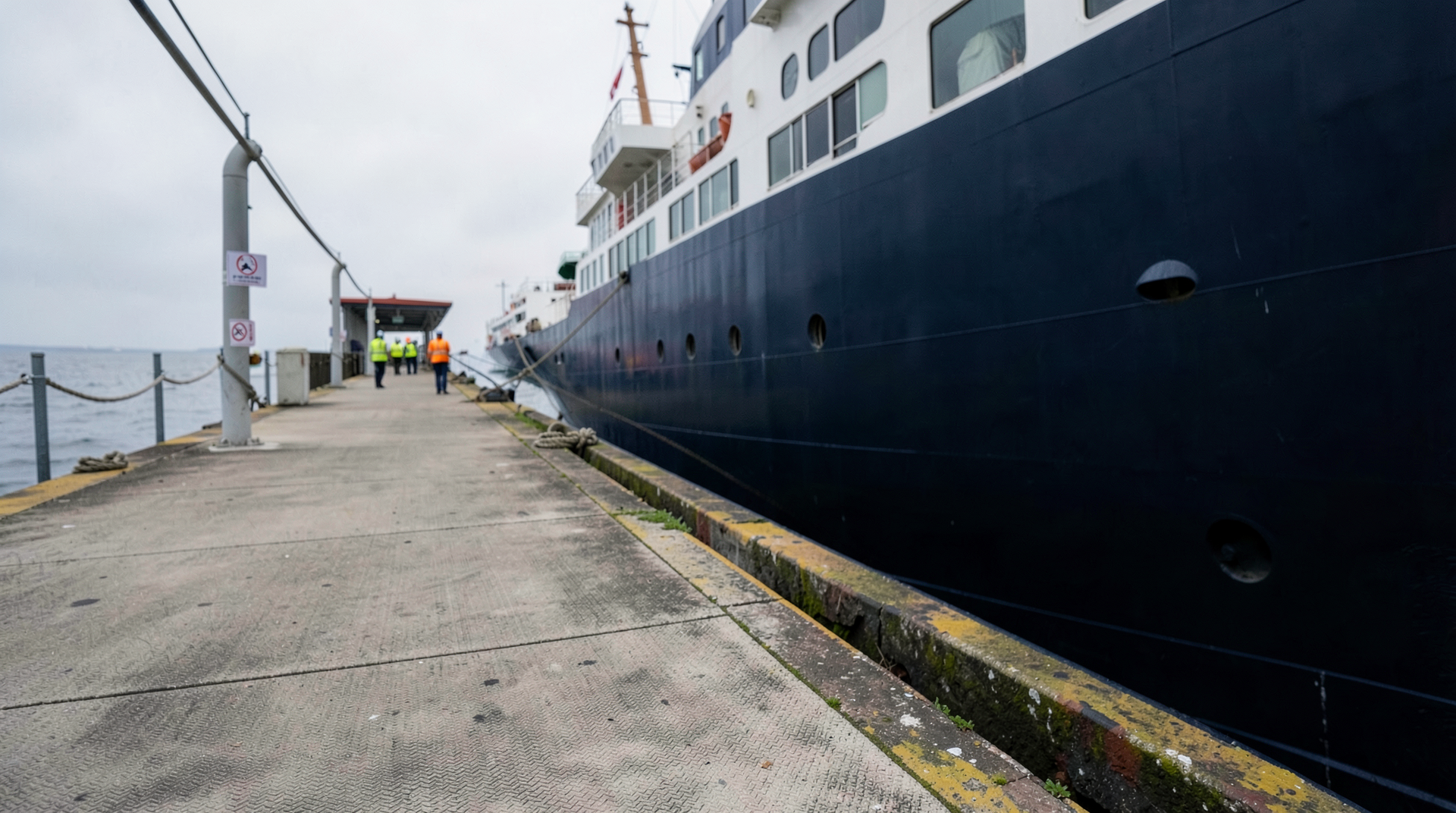
The Centers for Disease Control and Prevention is monitoring 41 people across 16 states for possible Andes-strain hantavirus exposure traced to the Dutch expedition cruise ship MV Hondius. Three confirmed deaths. Eighteen American passengers in monitored medical facilities in Nebraska and Georgia. Acting CDC director Jay Bhattacharya defended the agency's no-daily-briefing posture in a CBS News interview this week, said the agency reserves daily briefing for a "five-alarm fire bell" threshold, and added that the U.S. has "systems in place" for the June-July FIFA World Cup co-hosted with Mexico and Canada. [1][2]
The cluster matters now because the numbers crossed a reportable threshold, the Bhattacharya posture is now an on-the-record statement of CDC communications doctrine rather than a guess at one, and the World Cup travel window is six weeks away. This is the first emerging-disease event being managed under the new agency's explicit communications protocol.
The Andes strain is what makes the count consequential. Most hantavirus strains in the western hemisphere do not transmit person-to-person; Andes is the exception. Person-to-person transmission, when it occurs, requires prolonged close contact rather than casual airborne exposure. Harvard Health and Stanford Medicine have published reassurance copy explaining the rarity of human-to-human spread. [3][4] The reassurance is accurate. It is also incomplete without the corollary: prolonged close contact is exactly the condition that an expedition cruise ship and its onward transit network — buses to hotels, flights home, in-flight neighbors, household contacts — concentrate.
Eighteen American passengers returned from the Hondius and are being held in monitored medical facilities in Nebraska and Georgia. [2] The other 23 of the 41 people on the CDC list are contacts in the 14 other states, identified through the agency's contact-tracing process. None of the 41 have been publicly confirmed symptomatic at Saturday close; the monitoring is observation, not treatment.
The communications doctrine is the institutional fact. Bhattacharya told CBS News in this week's interview that the agency would brief daily when a "five-alarm fire bell" threshold was crossed and not before. [1] The phrase is now in the record. It is also a public commitment that can be audited. The agency has not specified what the threshold is. Case count, geographic spread, transmission mode, fatality rate — all are candidate measures. None has been named. The doctrine is therefore a posture with a threshold attached but the threshold itself unnamed.
Senate Minority Leader Chuck Schumer's framing supplies the political counterweight. He has cited Trump-era cuts to the CDC's Vessel Sanitation Program as having made the outbreak harder to track. [5] The program's pre-cut scope — the number of inspectors, the ports covered, the inspection frequency — is documented in agency archives and was the subject of a CBS News piece earlier this year. [5] The cuts were a documented administrative decision. The framing therefore is not a partisan claim about a hypothetical loss of capacity; it is a partisan claim about a documented loss of capacity. The CDC has not publicly disputed the inspection-program reduction.
CBS's lead reporting on the cluster paired Stanford's Bonnie Salinas — "very rare" and "cannot cause a pandemic" — with Harvard's Robert Shmerling on the practical limits of household contact-tracing for hantavirus. [2][3][4] Neither outlet's coverage placed the Vessel Sanitation Program decision next to the Bhattacharya doctrine and the World Cup calendar in a single piece. The paper does that here.
The World Cup is the immediate downstream calendar. June and July will bring millions of international travelers into the United States, Mexico, and Canada simultaneously for the FIFA tournament. Rhode Island's Department of Health has already published a public-facing soccer-2026 disease-surveillance preparedness page. [6] A PMC commentary in mid-spring made the broader public-health case for coordinated surveillance during the tournament. [7] The Bhattacharya posture commits the CDC to a six-week-out test: a 16-state monitoring list, an unnamed five-alarm threshold, and the largest single international-travel event the United States will host this year converging on the same window.
There is no direct predecessor to this story in the paper's recent measles or oncology coverage. The adjacent positions hold. The paper's May 15 piece said measles is no longer a warning but a schedule, and the May 15 standard on the Bangladesh probe argued that an institution without names is not an institution. The same discipline applies in inverse here. The Bhattacharya doctrine has been named. The threshold has not. A named doctrine with an unnamed threshold is precisely the type of artifact the paper covers.
What is unresolved at Saturday close: whether any of the 41 monitored people are now symptomatic but not yet confirmed; whether Mexico or Canada has signaled World Cup co-host coordination with the CDC on this cluster specifically; whether the Andes strain's lab-confirmation requirements under specific biosafety conditions constrain the rate at which the 16-state monitoring list can resolve; and whether the cuts to the Vessel Sanitation Program are reversible inside the budget window before the World Cup begins.
The paper's read: this is the first emerging-disease event being managed under an explicit new agency posture. The cluster is real and growing. The protocol is on the record. The downstream test is on the calendar. Wire copy is treating the story as a cruise-ship novelty. The novelty is not the strain. The novelty is the doctrine.
A 16-state monitoring list under an unnamed threshold, six weeks from a World Cup, is the test. Bhattacharya has named the posture. The five-alarm bell has not rung. Whether it does — and whether the threshold gets named before it does — is the operating story.
-- NORA WHITFIELD, Chicago