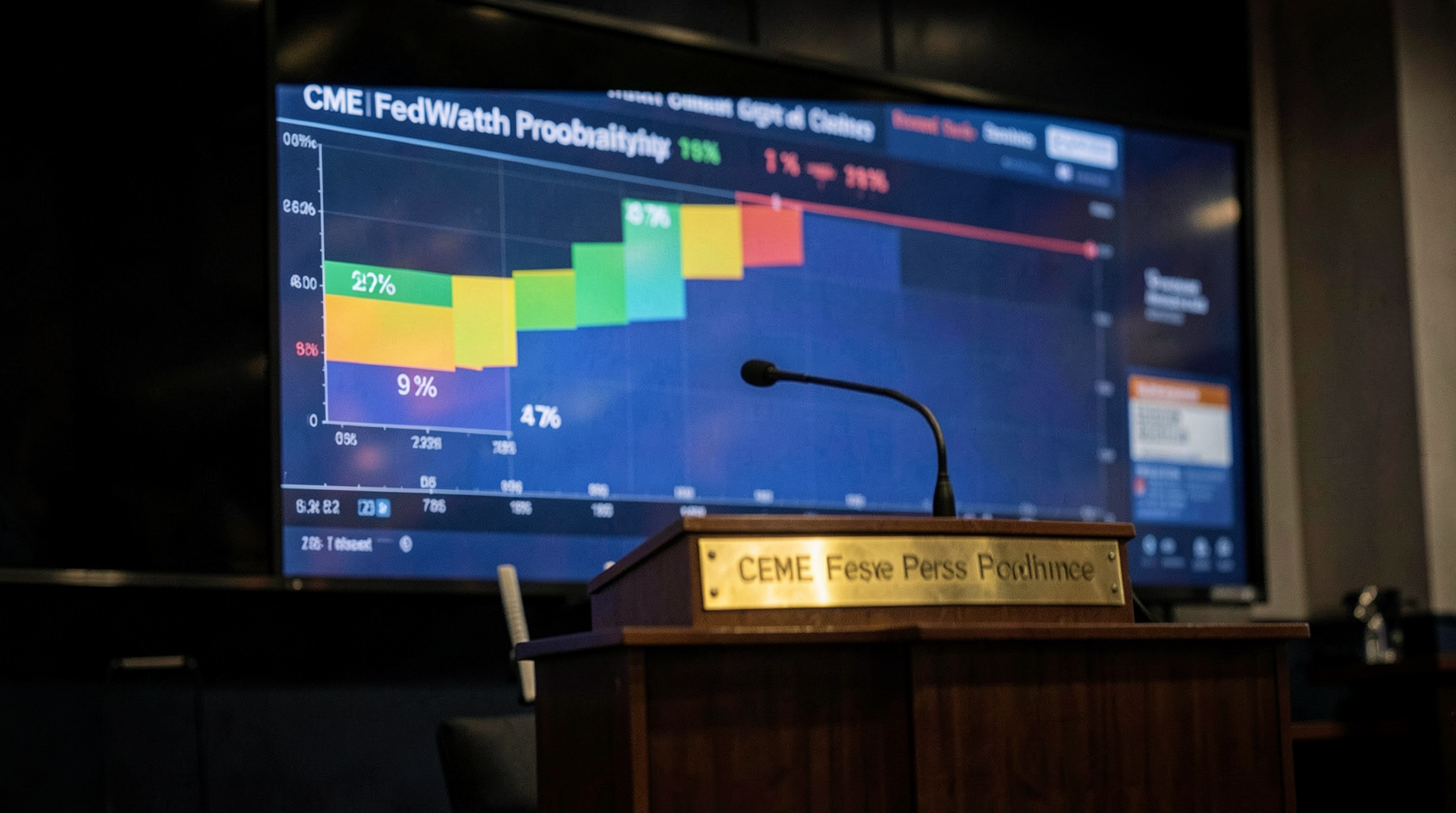
Kevin Warsh became the seventeenth chair of the Federal Reserve on Friday. By the end of the same trading day, the CME FedWatch tool was pricing a December rate hike at 40 percent, up from 13.6 percent a week ago. Top economic forecasters were projecting Q2 CPI at 6 percent. The 10-year Treasury yield touched its highest level since May 2025. Wall Street snapped a six-week Nasdaq winning streak. [1][2][3]
The paper's May 15 feature argued that Warsh's first day starts with Powell still in the room — that the transition would be governed by Board arithmetic rather than chair biography, and that the June 16-17 FOMC would be a live committee event rather than a ceremonial debut. Saturday's market data ratifies the prediction. The committee Warsh inherits is now operating against a market that is pricing his first meeting as a Trump-Warsh collision rather than a handshake.
The headline number is the CME FedWatch shift. December hike odds were 13.6 percent a week ago. They were 40 percent at Friday's close. [1] That is a roughly threefold move in seven trading days, against the same dot-plot and the same set of committee voters. The catalyst is the Q2 CPI forecast: CNBC reported that "top economic forecasters" now project Q2 CPI at 6 percent, driven primarily by the Iran-war energy premium. [1] Brent settled at $109.26 Friday, up 7.84 percent on the week. WTI gained 10.48 percent. [4][3]
The transmission is not subtle. An energy shock of that scale, sustained through Q2, pushes headline CPI into territory that ordinarily forces FOMC tightening rather than the cuts Trump's appointment of Warsh was designed to deliver. The market is now pricing that collision in week one. The institutional fact is that Powell remains a voting Board governor through the end of his term. The May 15 piece's central operational point — that Warsh chairs a committee, not a court — now lives inside a market context that did not exist Friday morning.
Wall Street's Friday session reflected the pricing. Dow -1.07%, S&P -1.24%, Nasdaq -1.54%. [3] The Business Times in Singapore attributed the move to "mounting inflation worries" — language that does the work of saying the market is no longer pricing the Trump-Warsh narrative. Babypips's pre-Warsh primer described the FOMC's structural constraint plainly: the Fed must respond to data, and the data this week pointed in the wrong direction for the political pressure that produced the appointment. [5] The Straits Times' parallel desk note carried the same Brent transmission. [6]
What the institution has not said matters as much as what it has. No public Warsh statement on the rate path has been issued. No FOMC speakers' calendar for the week ahead has been published. NPR Illinois and CBS treated Friday as a procedural ceremony with side notes on inflation. [7][8] CNN's coverage from the May 13 confirmation framed Warsh's installation as a Trump policy victory. [9] Two days later, the market is treating it as a constraint problem the new chair will need to manage rather than a posture he will be free to deliver.
The Powell variable is the institutional pivot. He remains a voting Board governor through the end of his term as governor. The May 15 piece's argument was that this single fact converts the June 16-17 FOMC from a chair debut to a committee event. Friday's market action treats Powell's continued vote as a live one. If Warsh signals dovishly into a 6 percent Q2 CPI print, Powell — alongside any other inflation-vigilant member — can dissent on the record. A dissent from a former chair on the new chair's first meeting would be the institutional event that the Trump-appointment-for-cuts thesis has not priced.
The June 16-17 meeting is now structural rather than ritual. It will run against five known inputs: a 6 percent Q2 CPI projection, an Iran-war energy premium that the May 16 lead documents has no summit-produced enforcement mechanism, a 10-year Treasury yield at multi-year highs, Powell's continued governorship, and a new chair whose appointment was justified on the basis of cutting rates. The five inputs do not point in the same direction. The committee will produce a single decision.
What is open at Saturday close is whether the "top economic forecasters" CNBC cited represent a Bloomberg-consensus survey, a regional-Fed nowcast, or named-bank desk research. The CNBC dispatch does not name the survey. [1] What is also open is whether Powell appears on the public speaking calendar in the next two weeks. A speech from a sitting governor who was until Friday the chair would establish Board posture before the June meeting and set the terms of the dissent the market is now pricing the possibility of. The Trump White House has not issued a public statement on rate path post-Warsh confirmation.
The bond market is doing its own work. The 10-year yield's move to highs not seen since May 2025 is being read as inflation premium specifically, rather than as term-premium repricing on the chair's perceived political vulnerability. The distinction matters. An inflation premium argues the rate path needs to rise; a term-premium argument would imply the market is hedging political risk that the chair will keep rates inappropriately low. Both stories are circulating. The bond market is pricing the first.
The Warsh era therefore begins not with a ceremonial first day but with a Board arithmetic problem and a market that has already converted the Trump-cut narrative into a forty-percent bet that the new chair's first FOMC will need to do the opposite. The June 16-17 meeting is now the binding event of the U.S. monetary calendar. Whether the committee delivers a hike, a hold with hawkish signaling, or a cut that triggers a Powell dissent, the answer will be the audit of Friday's pricing.
What the May 15 feature said was that the transition would be governed by votes and filings rather than body language. The position holds. The filings now include a 13F, a market settle, a CPI forecast, and a 10-year yield print. The vote that will matter is on June 17.
-- THEO KAPLAN, San Francisco