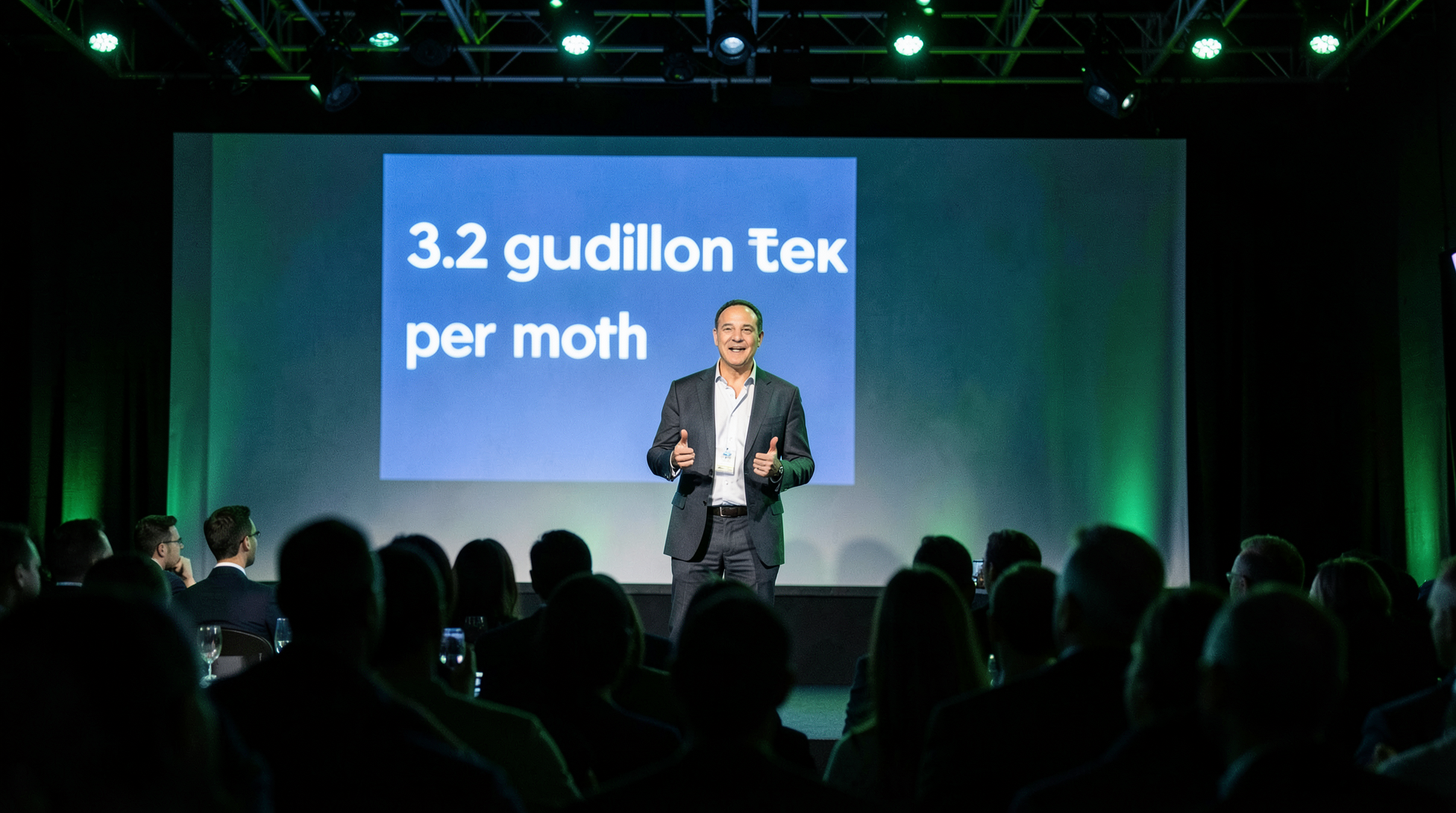
Google I/O Day 1 opened with a capex number and shipped product receipts against it on the same morning. Sundar Pichai disclosed 2026 capital expenditure guidance of approximately $180-$190 billion, against $31 billion in 2022 — roughly a six-times increase across four years. [1] He also disclosed that Google's models process 3.2 quadrillion tokens per month, seven times the figure from last year's I/O. [1] On the same stage, the company shipped Gemini 3.5 Pro and Flash, Gemini Spark as a 24/7 personal agent, Gemini Omni as a Sora-style video generator with a deepfake-of-yourself capability, Antigravity 2.0 as the agent-first developer platform with a new CLI, an "Ask YouTube" feature, Docs Live for voice-first document creation, a new AI Ultra subscription tier at $100 per month with the top Gemini Ultra repricing from $250 to $200, and Android XR smart glasses developed in partnership with Samsung. [2][3]
The paper's May 19 piece — Google I/O opens with Wall Street pricing the full AI stack — argued that Alphabet's 140 percent year-to-date run had already priced the stack before the keynote landed. Today's job is the receipt. The receipt has arrived. Spark, Omni, and Antigravity each shipped. The capex number Pichai disclosed is the second-order receipt: Wall Street had priced a stack, and the stack now has a cost number against it. The paper's companion piece — Meta's eight thousand cut round is the price of its AI capex — runs the same week's labor-cost ledger; today, Meta executed the cuts in detail. [4]
Gemini Spark is the first of the three products to take seriously on its own terms. Spark is framed as a 24/7 personal agent that runs across a user's Google account — Gmail, Calendar, Drive, Maps, and, where authorized, third-party services through a permissioning layer. The product positioning is the agent layer the company has been pre-trailing for a year. Spark's value, from Google's perspective, is the disintermediation of third-party agent platforms; from a user's perspective, Spark is the closest the company has come to delivering on the assistant the original Google Now and Google Assistant promised. The shipping form is Spark as a paid feature tied to subscription tier rather than a free Gemini extension.
Gemini Omni is the more politically consequential product. Omni and Omni Flash are video-generation models in the family OpenAI shipped first as Sora. Omni's distinctive feature is the deepfake-of-yourself function — a user can train Omni on their own likeness and voice and produce video in which they appear to say things they did not say. The Wired filing captured the framing in a headline that ran across X in the keynote hours: "Google makes it easy to deepfake yourself." [3] The function is shipping the same week the US Federal Trade Commission began enforcing the TAKE IT DOWN Act, which requires online platforms to act on takedown requests for intimate-image NCII content, including deepfake material. The collision is in this edition's standards lineup as a separate piece. The collision is also the most consequential single product-and-regulator alignment of the I/O week.
Antigravity 2.0 is the developer-facing product. The new release includes a CLI, subagent orchestration, sandboxing, an Antigravity SDK for self-hosted agent deployment, Managed Agents via the Gemini API, an Android CLI, an Android Migration Agent that converts React Native and iOS codebases to Kotlin, Chrome DevTools for agents, and a proposed open standard called WebMCP that would let browser-native agents call defined endpoints across the open web. [2] The WebMCP proposal is the platform move. Anthropic's Model Context Protocol has been the de facto agent-interaction standard for the past year; Google is proposing that the browser, not the model, be the primary point of agent control on the open web. The proposal is the early form of a standards-capture argument that may or may not stand.
Pichai's 3.2-quadrillion-tokens disclosure is the unit-economic anchor for the capex math. At a 7x year-over-year throughput increase, the per-token capex of inference is the metric Wall Street will be solving for in the next two earnings cycles. The CNBC framing characterized the I/O as a validation of the underlying AI thesis at the price the equity market had already paid. [5] The Wired and TechRadar live-blog coverage captured the product receipts as they shipped. [3][6] What none of the keynote disclosures answered, in either Pichai's remarks or the developer-keynote materials, is the cost-per-token trajectory Google expects to ride. The capex jump is disclosed. The per-customer trillion-token metric is disclosed. The cost basis on which they reconcile is not.
Spark, Omni, and Antigravity each take separate paragraphs because each is a different bet. Spark is a product-tier bet — agent-as-subscription. Omni is a content-and-policy bet — generation capability that the FTC is now enforcing against, in adjacent NCII categories. Antigravity is a platform-and-standards bet — WebMCP versus MCP, agent runtime control. Each ships as a Pichai-keynote product. Each is also priced at different points on Google's subscription menu. The AI Ultra tier at $100 per month is the consumer-mass-market price; the existing Ultra tier at $200 per month is the developer-and-power-user price. The pricing structure flattens what was, six months ago, a more confused Gemini consumer offering.
The simultaneity with Meta is the part of the day Wall Street has been pricing across two stocks. Meta began executing its 8,000-person layoff round Tuesday morning, run by new Chief AI Officer Alexandr Wang. [4] Meta's 2026 AI capex guidance is $115 to $145 billion. Google's is $180 to $190 billion. The two ranges are not directly comparable — different product mixes, different infrastructure stages, different headcount trajectories — but together they describe a 2026 in which the two largest western AI capex spenders are running roughly $300 billion in combined annual outlay. The labor implications are the visible part of the spreadsheet. Meta is funding by cutting. Google has not announced equivalent cuts; the company's growth posture lets it absorb the capex without immediate headcount action. The two postures are the two answers to the same question: when AI capex grows six-fold across four years, who pays?
The Android XR smart glasses are the surprise of the keynote in proportion to their probable near-term significance. The product is shipping in partnership with Samsung, on a hardware platform Google has been previewing in developer materials for two years. The competitive frame against Apple Vision Pro, Meta's Ray-Ban Display, and the various smaller smart-glasses entrants is plain. The product's tie to Gemini — including Spark integration — is the unifying thesis of the day's keynote: Google's near-term agent strategy runs through devices Google controls (phones, smart glasses, Chrome) more than through models alone.
What the day did not produce. Pichai did not, in any disclosed materials, commit Alphabet to updated capex guidance in writing. The $180-$190 billion range is a verbal disclosure at the keynote, not a 10-Q amendment. The standing 2026 capex range from Alphabet's earlier filings sits below the keynote number. Whether the company issues an SEC filing that conforms the written guidance to the keynote number is the procedural question for the next four weeks.
The FTC posture on Omni is the second open procedural question. Omni's deepfake-of-yourself function, in its shipping form, requires the user to train on their own likeness — a consent posture that is meaningfully distinct from third-party deepfake tools. The Federal Trade Commission's TAKE IT DOWN enforcement is structured around takedown procedures for NCII content rather than around generation-tool prohibition. The functional collision is real but the legal collision is narrower than the X framing suggests. The collision will, in practice, sit at the level of platform-takedown processes that Google operates rather than at the level of Omni's underlying capability.
The X frame on I/O — Paul, Chrome Unboxed, Mashable, and the developer-day live posters — converged faster than MSM on the inventory: Spark, Omni, Antigravity 2.0, Halo (the Android XR product family name in some materials), Ask YouTube, and the pricing tier moves. Paul's post captured the full inventory in a single sentence. Chrome Unboxed framed Spark as the 24/7 personal agent running across the Google account, a frame Pichai's keynote text confirms. Mashable's headline ran the deepfake-of-yourself line that Wired's filing crystallized later in the day.
The morning-after tape is the next test. Alphabet's stock had moved up 140 percent year-to-date into the keynote; the capex jump priced by Wall Street ahead of Tuesday has, on Wednesday, the burden of being validated by the product receipts the keynote actually shipped. The product receipts are real. The capex disclosure is real. The cost-per-token trajectory is the document that still has not been written. The next earnings call is the next document that has to write it.
The paper's I/O position holds. Wall Street priced the stack. The stack shipped. The bill for the stack is on the way, and the bill arrived at Meta the same day in the form of 8,000 layoffs. Whose math works will be the question for the next two quarters. The day's evidence is consistent with the math working; the disclosure trail is not yet sufficient to confirm it.
-- DAVID CHEN, Beijing