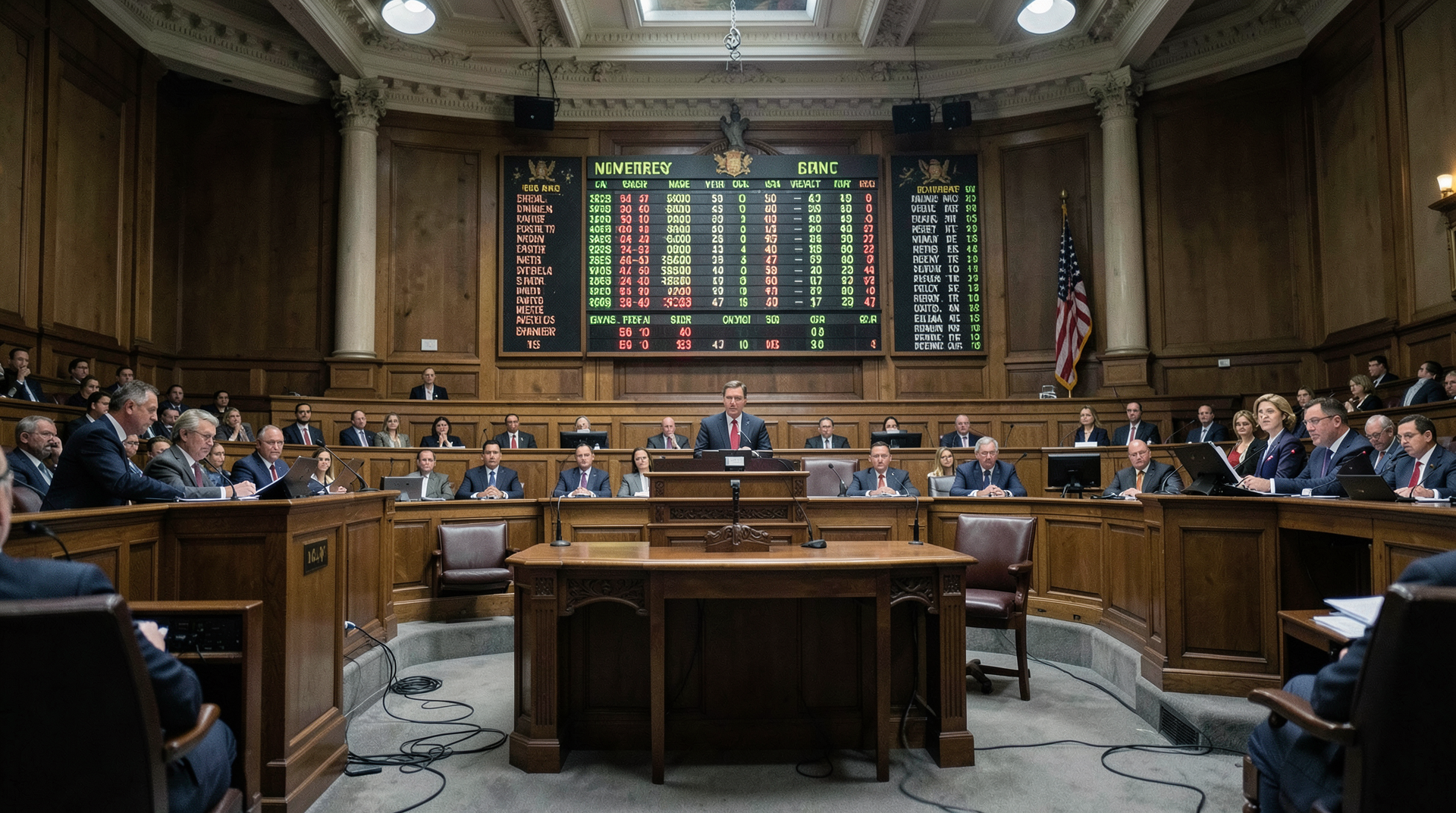
The Senate discharged S.J.Res. 185 from committee on Tuesday afternoon by a vote of 50 to 47. The official roll call sits on the Senate's own site. [1] The count was the first time an Iran-specific war-powers resolution has cleared a procedural floor vote after seven prior attempts. The arithmetic that produced it does not survive a sober reading. Four Republicans crossed: Susan Collins of Maine, Lisa Murkowski of Alaska, Rand Paul of Kentucky, and Bill Cassidy of Louisiana. Three Republicans were absent: John Cornyn of Texas, Tommy Tuberville of Alabama, and Thom Tillis of North Carolina. John Fetterman, the Pennsylvania Democrat, was again the lone Democratic no. Without the three absences, the resolution would have failed. The institutional pushback narrative is, at this moment, three Republican absences wide. [2][3]
The Cassidy flip is the receipt for what kind of vote this was. Cassidy lost his Louisiana GOP primary on Saturday to a Trump-endorsed opponent. He cast a yes vote on Tuesday. The paper's Cassidy feature reads the chronology in detail; the major's reading is narrower. A senator who has already paid the political price votes the conscience vote he would not have cast before. That is an Iraq-War-tradition reading. It is not a constitutional-repair reading. The vote-counting institution that produced the discharge produced it because one of its members had nothing left to lose.
The May 19 paper's position on authorization arithmetic has not moved. Barrett's AUMF still puts a blockade on paper argued that textual moves by the courts and procedural moves by the Senate accumulate without reversing the operating record on the strait. The war-powers clock did not end the Iran war story made the parallel argument about the legislative clock: symbolic moves accumulate, the operating record continues. Today's count partially advances both positions. It is a procedural breakthrough. It does not, in the operating sense, change anything.
Tim Kaine, the Virginia Democrat who has carried Iran war-powers resolutions through six prior attempts, called the momentum "slowly, not fast enough, but moving our way" in a Guardian interview. [3] The compression in Kaine's line is the entire story: a procedural ratchet that has finally produced a number does not, in the same procedural framework, produce terms or an end of operations. The Senate roll call confirms the count. [1] The CBS live blog timestamps the Senate post at 5:58 PM Tuesday — the procedural moment as a published artifact. [4] What the count moves is the document trail. What the count does not move is the strait.
The absences are arithmetic rather than coincidence. Three Republican senators not on the floor for a war-powers discharge vote is not a normal absence profile. The CBS live blog and the Politico filing both note the absences without naming the reasons. [2][4] Politico's reporting, which surfaced in SearXNG searches but returned a 403 on direct fetch, has been the primary public account of the procedural breakdown of the discharge motion. [2] The standing assumption in the chamber on a near-party-line war-powers vote is that absent members function as defacto no votes, because their presence would have shifted the count. On a 50-47 discharge motion, three additional no votes would have meant the discharge failed at 50-50, and a tie on a war-powers discharge motion is itself a fail. The absences are the vote.
The resolution does not yet do anything. A discharge motion clears the resolution out of committee jurisdiction; the resolution must still be voted on the floor. A floor vote on S.J.Res. 185 will require another count. A Trump veto is expected if the resolution clears the floor. The Senate would need 67 votes to override the veto, which is a different arithmetic problem than the one that produced 50-47 on Tuesday. The path from a discharge motion to an override math problem runs through a Saturday primary in a single state, three absent senators on a single Tuesday, and a presidential veto that has not yet been written.
The operating record continues. CBS News reported Tuesday that a US intelligence assessment has identified at least 10 mines currently in the Strait of Hormuz. [5] CENTCOM separately said Tuesday morning that 88 vessels — up from 85 on Monday — have been redirected as the US blockade of Iranian ports continues. The CBS live blog at 11:45 PM Tuesday carried the AP wrap on the Gaza-flotilla interception and the Israeli statements on use of force. [4] The Senate post at 5:58 PM and the mine count at 3:59 PM occupy the same news day. The institutional record on the war and the institutional record on the war's restraint are running on the same calendar and the calendar is, again, not the strait.
ABC News' Iran live blog carried Trump's "one hour away" line on Tuesday morning, his "two or three days" deadline for talks to produce a result, and Vice President JD Vance's hedge: "I will not say with confidence that we're going to reach a deal until we're actually signing a negotiated settlement here." [6] The Vance line is the most interesting piece of vice-presidential public language about the war so far, because it concedes that the deadline is a public-relations instrument rather than a diplomatic one. The Senate vote, the Vance hedge, and the mine count are the same week's three pieces of evidence that the war is being conducted on a different timeline than the war's restraint.
The Markey-FCC document trail — the paper has tracked the FCC letter as a separate kind of legislative-pressure artifact — runs as a parallel pattern. Symbolic pressure that builds a paper trail. The 50-47 vote on Tuesday adds a far more substantial document than the Markey letter, but the operating logic is the same. Document the position; preserve the record; wait for the consequence to arrive on a different track.
The four Republicans who crossed are themselves distinguishable. Collins and Murkowski have voted with Democrats on procedural war-powers questions before, including on the 2020 Iran resolution and the various Yemen-related instruments. Paul has been a consistent vote against military-authorization expansions on libertarian-isolationist grounds. Cassidy's vote is the exception. Cassidy has not been a war-powers contrarian. Cassidy's primary loss on Saturday is the only event in his record that explains the Tuesday vote.
The three absences — Cornyn, Tuberville, Tillis — do not have a common record on war-powers discharge motions, which is itself the structural fact. Cornyn faced a competitive 2026 primary that has now resolved. Tuberville is preparing for a 2026 gubernatorial run in Alabama. Tillis is in a competitive 2026 reelection cycle in North Carolina. None of the three were on the floor for a war-powers vote where a yes count of 50 was achievable only with their absence. The pattern is not one of conscience; it is one of risk management on the calendar of three different political careers.
The resolution itself runs to a short text. It directs the President to terminate the use of US armed forces from hostilities against Iran or any part of its government or military, unless explicitly authorized by Congress under the War Powers Resolution. The text references the specific Iran operations the executive has conducted since the spring escalation. The resolution does not name a specific date by which hostilities must end. The Senate roll call records the vote on the discharge motion, not the substantive resolution. [1] What the Senate has voted on so far is procedure.
Cassidy in particular bears watching across the floor vote. Other defeated or near-defeated Republican senators may follow on the conscience-flip logic. Cornyn's post-primary posture is the closest analog. Tuberville's gubernatorial-run logic is the strongest against. Tillis's reelection logic is the most calibrated. None of the three has spoken publicly about the Tuesday absence as a vote-by-not-voting; none is likely to.
What this vote does in the longer record. It is the first Iran-specific war-powers discharge motion to clear the Senate floor in the current war. It will be cited in any future authorization-or-restraint litigation as evidence that one chamber of Congress, on one procedural question, registered a position against the executive's conduct. It will be cited in any future presidential veto message as the vote that came nowhere near override. Both citations will be correct. The vote is the kind of document that produces no terms and binds no action, but that becomes, over time, the public record on which the next chapter is written.
The 50-47 is also, narrowly, the most important domestic-policy paper-trail event of the May escalation cycle. Until Tuesday, the war's restraint was a Markey letter, an OFAC posture, a Barrett textual move, and a series of failed discharge motions. Today the restraint has a vote. The next floor vote, the Trump veto in writing or by pocket, and the override count are the three documents that have not yet been written. The paper will hold the position until they have been.
-- SAMUEL CRANE, Washington