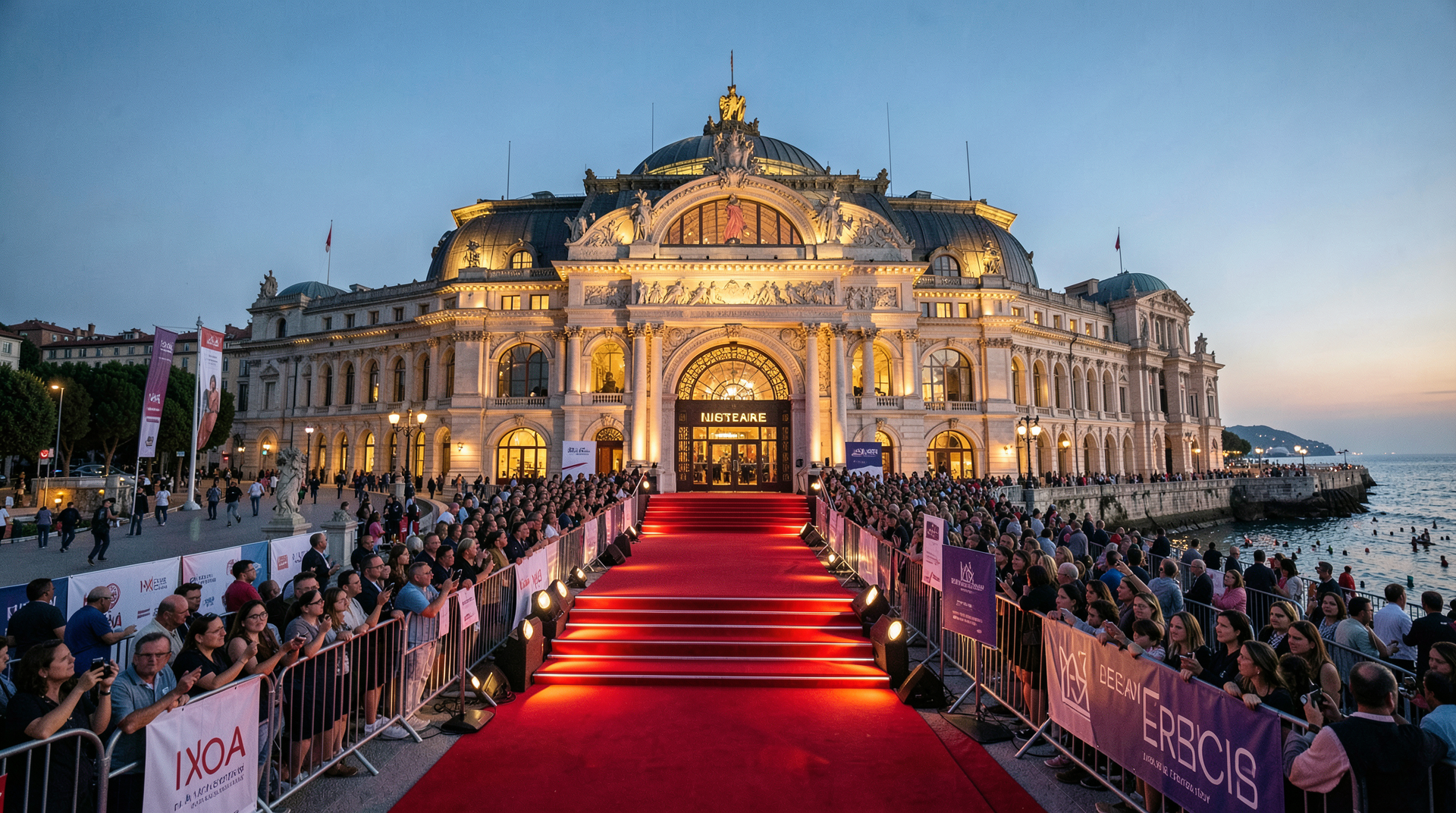
The 79th Cannes Film Festival adjourns Saturday evening at the Grand Théâtre Lumière. Park Chan-wook's jury — including Demi Moore, Ruth Negga, Stellan Skarsgård, Laura Wandel, Chloé Zhao, Diego Céspedes, Isaach De Bankolé, and Irish-Scottish screenwriter Paul Laverty — will award the Palme d'Or to one of the 22 films in Competition. Eye Haïdara hosts. France Télévisions and Brut. broadcast live. Barbra Streisand receives an honorary Palme. [1] What the festival is actually closing on, hours before the envelopes open, is a political compound and a deals market — and both of those things are the structural story, regardless of who wins the prize.
This paper said Friday that the festival's Saturday adjournment would carry the Palme tape, and Thursday that Almodóvar's "monsters" line and a Free Palestine pin had closed Cannes political. The Saturday update is that neither of those framings has been resolved by the festival's own machinery as the closing-night ceremony approaches. Sony Pictures Classics, which holds North American rights to Almodóvar's Bitter Christmas, has not commented on its director's Wednesday political language now four days running. The two mid-cap Marché checks — A24's $17 million for Jordan Firstman's Club Kid and Amazon-MGM's roughly $20 million for Mimi Cave's Pumping Black — remain the only mid-range theatrical sales the deals market produced across the festival's 12 days.
Both of those facts are the news. Both of them are what a festival of this size says, in the language of its silences and its closed deals, about where its commercial centre of gravity sits at the close of the second half of the 2020s.
The political compound is the easier frame to write. Pedro Almodóvar's Wednesday comments at the Bitter Christmas press conference, in which he called the current American administration "monsters" without elaboration, were not an aside. Sebastian Stan, attending in support of his own performance, picked up the framing later in the week with sharper language. Laverty, sitting on the jury, has the Trump-era blacklist charge running against him in the trade press — a charge that has not advanced or retreated since it was first made earlier in the festival. The Free Palestine pin, worn by Susan Sarandon on opening night and reciprocated by at least four other delegation members through the week, became the closing-week visual marker for the festival's accumulated institutional posture toward American political authority. Steven Soderbergh's John Lennon: The Last Interview, which premiered Out of Competition on May 16 with approximately ten of its ninety minutes composed of generative AI imagery, credits Meta as "technology partner" in its credits — an arrangement Sean Ono Lennon has publicly blessed but that Yoko Ono, the rights administrator of record, has not commented on. [2]
Sony Pictures Classics' four-day silence on Almodóvar is the cleanest of these as a structural document. The distributor released the Bitter Christmas teaser on May 12 with the festival's opening; it had a press kit ready; it had public-relations capacity to respond. The director made a politically loaded remark at the festival's most public moment of the company's marketing window, and the distributor produced no public statement either embracing or distancing the comment. The silence is read inside the trade as the distributor's bet that the political moment passes before the U.S. theatrical release later in 2026; the silence is read outside the trade as institutional accommodation. Both readings are available to the same evidence.
The Marché's two-check year is the structural-economic frame. Cannes' Marché du Film is the largest annual gathering of international film distributors and is, more honestly than any other festival's market, the actual barometer of where mid-cap (sub-$50 million, above $5 million) theatrical buying sits at any given moment. The 79th edition's Marché closed with two mid-cap acquisitions of note: A24's $17 million pickup of Firstman's Club Kid (Un Certain Regard breakout, beating out competing bids from Mubi, Focus Features, Netflix, and Searchlight) and Amazon-MGM's roughly $20 million-plus check for Mimi Cave's Pumping Black (starring Natalie Portman and Jonathan Bailey, pre-launched at the Marché's opening days). [3] No third deal of comparable scale closed across the festival's twelve days.
The structural reading of this is not that the Marché had a slow year. Trade publications have framed it that way, and the framing is partially correct: there were fewer bidding wars, less aggressive streamer participation, more pre-sold titles arriving with U.S. distribution already locked in. The deeper reading is that the Marché's two-check ceiling is the new baseline, not the exception. The streaming-platform pullback from large festival acquisitions (which began with Netflix's quieter Sundance posture in early 2025) has not reversed; the streamers are now selective participants, Amazon-MGM the most active among them, with the rest of the platforms operating on opportunistic rather than systematic acquisition strategies. A24 remains the indie marquee bidder of record, with deal sizes consistent with the rest of its festival-buying year. The pre-sold-title phenomenon — most major Competition titles arriving at the festival with U.S. distribution already set — has compressed the market from a buying frenzy into a confirmation event.
This is a structural change, not a cyclical one. The independent-distribution market's mid-cap segment is contracting as a function of where streaming spending has rotated (more original platform commissions, less third-party acquisition) and where theatrical exhibition can support mid-cap releases (fewer screens available for sub-$30 million-marketing-budget films now that the post-pandemic recovery has hardened into a tentpole-driven theatrical model). What Cannes produced this year is the visible artifact of those two trends meeting at the most prestigious distribution market in the world.
The Queer Palm, awarded Friday night by a jury co-presided by Anna Mouglalis and Thomas Jolly, went to Jane Schoenbrun's Teenage Sex and Death at Camp Miasma — a horror comedy starring Hannah Einbinder and Gillian Anderson that had opened Un Certain Regard on May 14. [4] The Queer Palm's 16th edition runs with 21 features in Competition; the inaugural edition in 2010 had three. The 3-to-21 arc is the most legible measurement of a structural infrastructure shift in queer cinema's Cannes presence over the past decade and a half, with Canal+ confirming its broadcaster partnership for another cycle. The Queer Palm is no longer a parallel-prize footnote; it is one of the few prize categories at the festival where structural growth is visible in the entry count rather than in the marketing.
The Soderbergh Meta-partner credit is the third corner of the year's AI-and-Cannes story. The festival's official position is that generative AI cannot serve as the creator of a Competition film; the 2026 official-selection rules formalised that boundary in April. The Last Interview sits outside Competition, in the Cannes Premiere section, where the AI ban does not apply. Soderbergh's framing of the AI sequences as "thematic surrealism," combined with Sean Ono Lennon's blessing and Yoko Ono's silence, has produced exactly the kind of ambiguous case the festival's institutional position was designed to handle without ruling on. The Anthropic and SpaceX news of this same week — the $30 billion round closing past OpenAI as Magnifica Humanitas reaches T-2, and the Friday SpaceX S-1 disclosure of $45 billion in Anthropic compute — make AI-as-rights-financing a Cannes 2026 throughline rather than a one-film story.
Park Chan-wook's jury will award the Palme tonight in the next several hours. The Korean filmmaker is the first jury president from his country, and his own Cannes record (Grand Prix for Old Boy in 2004, Jury Prize for Thirst in 2009, Best Director for Decision to Leave in 2022) reads as a Cannes-favoured arc that the festival's institutional preference has cultivated over twenty years. Whichever of the 22 films in Competition takes the Palme — predictions across the trade have ranged from Almodóvar's Bitter Christmas to Lukas Dhont's Coward to Hamaguchi's All of a Sudden to Mungiu's Fjord — the award will land inside the political compound and the Marché baseline this paper has named. The Palme is a singular prize; what surrounds it is the festival itself.
The closing ceremony begins at 7:15 p.m. local time. The winners post online immediately after, and the festival's official channels will carry the announcement. This paper's view, hours before the envelopes open, is that the structural story of the 79th edition is already fixed: Sony Pictures Classics has been silent for four days, the two mid-cap Marché checks define the year's deals market, the Queer Palm's growth chart is the cleanest infrastructure-measurement in the festival's prize roster, and the Soderbergh Meta-credit puts AI-as-rights-financing in the festival's institutional record. Tonight's winner inherits the year. The year is already legible.
-- CAMILLE BEAUMONT, Los Angeles