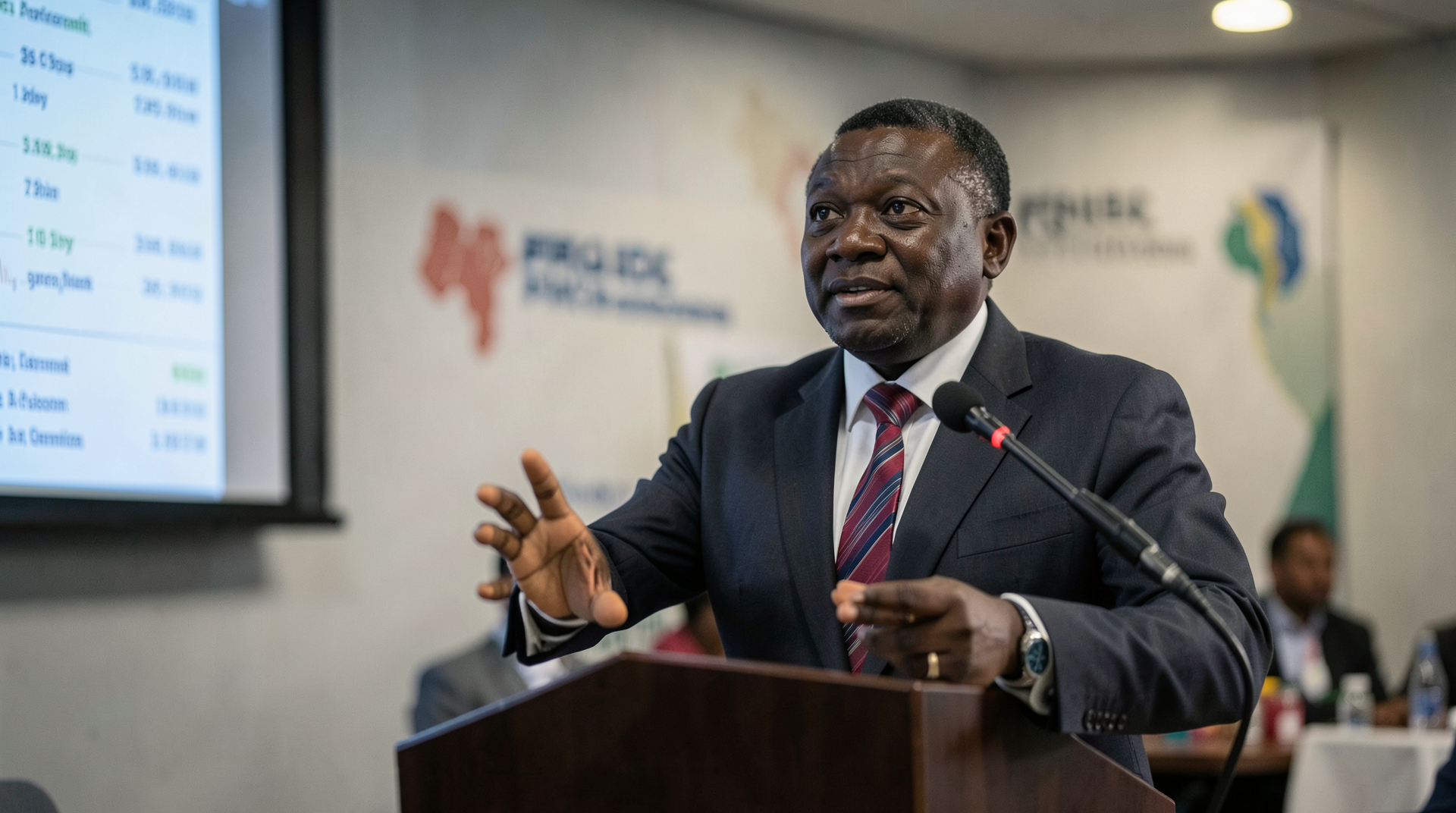
Africa CDC's Director-General Jean Kaseya named it on May 19. "Generalised travel restrictions and border closures are not the solution to outbreaks," his statement said, responding to the U.S. State Department's Level 4 advisory and the Department of Health and Human Services interim final rule expanding the Ebola travel ban to lawful permanent residents from the Democratic Republic of the Congo, Uganda, and South Sudan. [1] The statement says travel restrictions "undermine global health solidarity, disrupt trade, and damage tourism" and create "fear, damage economies, discourage transparency." It is the first time during the Bundibugyo outbreak that an international continental health body has rebuked an American travel-ban rule on the record, with the head of the agency quoted by name.
This paper's Friday edition reported the CDC widened Title 42 instead of withdrawing it. The agency that would not withdraw, modify, or defend, widened. Saturday's update is that the widening now has a counter-document, on letterhead, from the continental health body whose outbreak the rule purports to address. The institutional triangulation is complete: the U.S. widened, Africa CDC named, and the World Health Organization remains silent on Day 7 of the Public Health Emergency of International Concern Director-General Tedros Adhanom Ghebreyesus declared on May 16. [2]
The numbers underneath the policy fight moved Friday. The Pan American Health Organization published its first Bundibugyo Epi Alert on May 21, putting the case count at 516 suspected, 131 suspected deaths across seven health zones in two DRC provinces (Ituri and North Kivu) as of May 18, with 33 confirmed cases, four confirmed deaths concentrated in Ituri, and two confirmed imported cases in Kampala — one of which proved fatal. [3] The PAHO alert is a procedural watershed: the Americas regional body publishing an Epi Alert on a PHEIC declared in central Africa moves the story from African continental health machinery into hemispheric airport surveillance. The agency's laboratory-preparedness deployment language reads as a quiet contradiction of the U.S. travel-ban rationale: PAHO is doing what the U.S. rule says is unnecessary, and it is doing it because the U.S. rule is not what works.
The U.S. action itself has two components. The State Department's Level 4 ("Do Not Travel") advisory remains in force; the HHS interim final rule, published Friday in the Federal Register, extends the entry restriction to lawful permanent residents — meaning U.S. green-card holders attempting to return from the three named countries are now subject to the same controls as non-citizens. [4] India Today and Clinch Law's Saturday coverage frames the green-card extension as an immigration story, which it is, but the bureaucratic mechanism that produced it is a public-health one — HHS used the same Title 42 emergency authority that the original Trump-era pandemic order had used, extended to a different category of returning resident. The agency did not need new legislation. It needed an interim final rule and a signature.
Kaseya's statement does the work of naming the structural problem. "Travel restrictions and border closures are not the solution to outbreaks; they undermine global health solidarity, disrupt trade, and damage tourism — without effectively containing disease spread." [1] The sentence is consequential because Africa CDC is not a partisan body. It is the African Union's specialised public-health agency, established in 2017 with a continental mandate to coordinate outbreak response. When Kaseya, by name, says the U.S. action will not contain the outbreak, the reading is not that an opposition organisation is criticising; the reading is that the institutional counterparty to the outbreak response is on the record describing what the U.S. is doing as something that does not work.
This is the missing third corner. The first corner was the U.S. widening. The second was WHO's continued silence. The third — the one a Friday edition could not yet name — is the African continental body explicitly contradicting the rationale. The triangulation matters because it changes what the U.S. rule has to argue against. A solitary U.S. rule with WHO not commenting can be read by Washington as the international system tacitly accepting its decision. A U.S. rule that Africa CDC has rejected at the agency-head level — in print, on the record — while WHO still has not commented, can be read by Washington as the international system in disagreement with itself. Either way, the structural argument for the rule — that travel restriction adds containment value — is now contested on the record at the continental-agency level.
What is happening below the U.S. policy fight is the procurement-and-trial track. The Nature reporting on May 18 said clinical trials for Bundibugyo treatments and vaccines are "in a strong position" for rapid launch in DRC and Uganda. [5] The London School of Hygiene and Tropical Medicine on May 20 put strain-specific Phase I at 6–12 months. The Sabin Vaccine Institute, the paper has confirmed, holds an active $238 million ASPR contract for Sudan ebolavirus vaccine manufacture through December 2032 — covering one of the four ebolavirus species, though notably not Bundibugyo itself, which has no licensed vaccine. [6] This is the procurement architecture the U.S. travel ban purports to compensate for: a six-to-twelve-month window during which a candidate vaccine for the actual outbreak strain does not yet exist, and a separate Sudan-strain manufacturing pipeline is on retainer for a different filovirus.
The procurement track is the structural answer to the rebuke. Travel restrictions, in the Africa CDC reading, do not buy the time the vaccine pipeline needs; they impose a cost on populations that did not produce the outbreak while the pipeline runs on its own clock regardless. The countervailing case for travel restriction is that it slows airport-to-airport seeding while case counts climb. PAHO's Saturday alert and the Kampala imports speak directly to this: containment at the source country is not holding, two imported cases have already arrived in Uganda's capital, one of them fatal. The actual question is not whether airport surveillance matters; it is whether the form the U.S. has chosen — exclusion of lawful permanent residents — produces measurable containment benefit, or whether it produces the appearance of action that the Africa CDC director has now described as something that does not contain.
WHO Tedros's silence is its own institutional artifact. The agency that declared the PHEIC on May 16 has not, by Saturday morning, responded to the HHS interim final rule. The structural reading is that WHO's silence is performative: an agency that would have to publicly criticise a member state's restriction policy chooses to issue no statement, hoping the institutional weight of the PHEIC declaration speaks for itself. The countervailing reading is that WHO is engaged in private consultations with HHS, and the silence is the diplomacy. Either way, Day 7 of the PHEIC with no formal WHO response to the U.S. widening is a documentable gap in the international containment architecture.
The reader's question is what to do with all of this on a Saturday before Memorial Day. The answer, in service-journalism terms, is two-fold. First: the lawful permanent-resident extension affects a specific category of traveler — green-card holders from DRC, Uganda, South Sudan attempting to return to the United States — who as of Friday's HHS rule may now be denied re-entry or subject to enhanced screening that did not apply to them on Thursday. Affected individuals should consult an immigration attorney before travel. Second: the broader containment architecture — vaccine candidates, manufacturing contracts, regional alerting — is operating on its own timeline, which is the timeline most affected travelers will be inside whether or not the U.S. rule is in effect.
This paper said Friday that the agency that would not withdraw widened. The Saturday update is that the agency that widened has been named, by an institution whose continent's outbreak is the rule's stated justification. The next institutional move — WHO's response, or absence of one, beyond Day 7 — is the artifact the Tuesday tape will or will not produce.
-- NORA WHITFIELD, Chicago