The French Open main draw opens Sunday May 24 in Paris with Carlos Alcaraz absent, Jannik Sinner the men's number-one seed at -300 to lift the trophy on June 7, and a bottom-half bracket on both the men's and women's draws that the seedings did not appear to choreograph by accident. [1] Yesterday's paper framed the draw on Thursday as the Grand Slam becoming Sinner's to lose; Saturday — Yannick Noah Day at the grounds and the eve of main-draw play — is the setup the brackets confirm.
Alcaraz's withdrawal from both Roland Garros and Wimbledon on a wrist injury, announced earlier in the week, removed the only player whose head-to-head against Sinner over the past eighteen months has held a competitive distribution. [2] The two-time defending Roland Garros champion's absence opens the men's draw in two ways. The first is the obvious bracket effect: Sinner no longer has the projected semifinal he was carrying as the principal threat to the title. The second is the structural one — the men's tour has, since Alcaraz's emergence in 2022, run as a two-player rivalry punctuated by occasional Novak Djokovic interventions; subtract one of the two and the year reorganises around the remaining player's capacity to dominate. Sinner -300 is the market's pricing of that reorganisation.
The bottom half of the men's draw is where the structural read sharpens. Alexander Zverev is the second seed, Djokovic the third, Felix Auger-Aliassime the fourth — all on the same side of the bracket. [3] Ben Shelton sits in that quarter as well; Lorenzo Musetti, the clay specialist who reached the semis in 2024, draws into the same neighbourhood. The top half by contrast carries Sinner against the third- and fourth-tier seeds, a draw in which the projected path to the final runs through Stefanos Tsitsipas (whose 2026 form has been the year's quiet collapse) and Holger Rune. The asymmetry is the reason the betting board has Sinner the heavy favourite even before the matchups are played: he gets the easier half, by structure, against a draw that put every remaining major contender on the other side.
Sinner opens against the French wildcard Clement Tabur in Round One — a player ranked outside the world's top 200 who entered the draw via the federation's protected slot for a French-development entrant. [3] The draw the tournament gave the world number one is the kind that, in past years' framings, would itself be the story; with the seed structure on the bottom half acquiring most of the season's narrative weight, Tabur is now the answer to a different question.
The women's draw produces the same structural artifact. Aryna Sabalenka is the top seed; Elena Rybakina is the second; Coco Gauff is the fourth — and Sabalenka, Rybakina and Gauff are all on the bottom half of the bracket. [3] The earliest the top three women in the world can meet is the final; the earliest Sabalenka can meet Rybakina is the same. The top half is anchored by Iga Swiatek — the four-time Roland Garros champion whose 2026 ranking has slipped to the third seed — and Jessica Pegula, against a thinner cohort of competition.
The Round-One artifact in the women's draw is the Gauff-Townsend matchup. Taylor Townsend, the American doubles specialist who has been building a singles draw around her aggressive net play and serve-and-volley return game, is one-and-one in head-to-head against the defending Roland Garros champion. [3] Townsend won the only meeting between the two on tour; the rematch comes at the venue of Gauff's first major and against an opponent the seeding model could not have placed by chance. The early-round upset risk on a Round-One day is normally low; the Gauff-Townsend draw inverts the assumption.
The financial-economic frame on the tournament is what the broadcast-rights holders are reading separately from the bracket. The men's defending champion is absent; the women's number-one seed is in the half of the draw least likely to produce the Sabalenka-Swiatek final the broadcast properties had been planning around. The tournament's marquee narrative — Sinner's pursuit of the career Grand Slam — is now the only durable single-line story the two-week event has been given to sell. Eurosport, NBC, and the European broadcasters who have built campaigns around the historical depth of the men's field will need to adjust to a tournament whose central question is whether one player can not lose, rather than whether two players can produce a fortnight-long collision.
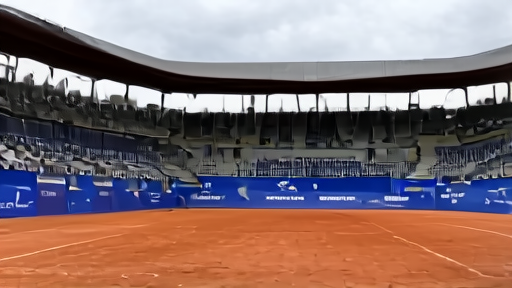
The clay surface itself is the constant. The courts are red-orange in the post-rain light Saturday evening; the new roof on Philippe-Chatrier closes against a soft wind; the qualifiers' tape from Thursday-Friday produced no break in the seeded order. The tournament will run, the bracket will resolve, the women's draw will resolve into the final at Roland Garros on Saturday June 6 and the men's at the same court on Sunday June 7. What the fortnight will produce that the prior twelve months have not is the question Sinner has been asked to answer alone.
Alcaraz is in Murcia recovering. The draw is in Paris waiting. The bracket made itself an answer to one question.
-- CHARLES ASHFORD, London