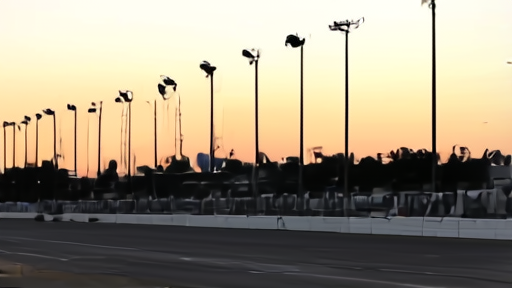
The Indianapolis Motor Speedway confirmed Friday that the digital scoring pylon will light a lap-18 tribute to Kyle Busch on Sunday afternoon's 110th Indianapolis 500. [1] Caitlin Clark, the Indiana Fever guard whom the WNBA formally warned this week for the team's late scratch on Wednesday in Portland, was probable for Friday night's home game against the Golden State Valkyries and is holding her command Sunday as grand marshal. [2] Alex Palou won the pole at 232.248 mph on Sunday, May 17, after the rain-postponed qualifying compressed the field's runs to single attempts in Round One. [3] Katherine Legge will attempt the Memorial Day Double, becoming the first woman ever to enter both the Coca-Cola 600 and the Indianapolis 500 on the same day; she is the sixth driver to try it. [4] Three structural firsts meet on the same Sunday on a track that will go dark in tribute to a NASCAR driver during an IndyCar race.
The paper's Thursday account of Clark's probable status and the league discipline framed the grand marshal command as an A/B test on whether the cross-property monetization package — a basketball star delivering the engines command at an open-wheel race — would hold when the named athlete was sitting at 80%. The Friday tape closed with Clark on the floor against the Valkyries and the IMS posture unchanged. The Sunday command is now confirmed; the structural question moves from "will she be there" to "what does her being there mean."
The Gainbridge partnership underwrites the answer. Gainbridge has been the presenting sponsor of the Indy 500 since 2019, and Clark has been a brand ambassador for the company since her senior year at Iowa, before she was playing home games at Gainbridge Fieldhouse. [5] The match is not a one-off booking. IMS and IndyCar president J. Douglas Boles said in the formal announcement that the alignment had been "several years" in the making and that "the timing finally worked out." [5] The booking is not a publicity event. It is a contract maturing.
The Palou pole has its own structural news inside it. The 232.248 mph speed was the slowest of his three Indy 500 poles, but it was set against a one-shot qualifying format the rain compressed on Sunday. Each driver got a single attempt for Round One starting positions before the Top 12 and Fast Six runoffs. [3] What that one-shot format produces is a different shape of risk. Drivers who would have boosted with a second run did not get one. Palou's number set the field — the Spanish-driver tradition at Indy has now claimed three poles — but the format itself is the precedent. Fox, in its first year as the Indianapolis 500 rightsholder, gets a compressed-qualifying spectacle and a Sunday narrative that does not require a second day.
Katherine Legge's entry into the Memorial Day Double is the third structural piece. She will run the Coca-Cola 600 at Charlotte and fly to Indianapolis to make the Indy 500 grid on the same day. [4] She is the first woman ever to attempt it; the previous five drivers to try were John Andretti, Tony Stewart, Robby Gordon, Kurt Busch, and Kyle Larson. Stewart finished both. The others did not. Legge's run is not framed by the sport as a publicity moment; she is a sixteen-year IndyCar veteran whose 2026 contract with Dale Coyne Racing puts her in the field on merit. The double-attempt framing has produced lap counts in the past — Stewart 1,090 of a possible 1,100 in 2001 — that are the kind of structural endurance numbers the marketing departments now use to sell sponsorship.
The lap-18 pylon tribute is the cross-property piece, and it is the one that gives the day its actual weight. Kyle Busch's No. 8 in NASCAR, the number Richard Childress Racing announced Friday it would retire indefinitely "until Brexton is ready," will appear in lights on the IndyCar scoring pylon for the duration of the eighteenth lap. [1] The choice of lap 18 references Busch's 1985 birth year inversion and the family number Brexton, his son, is being held in reserve for in NASCAR. Cross-property tributes between racing series are rare; they happen at the trackside-flag level, not at the venue-wide digital-infrastructure level. The pylon going dark for a NASCAR driver at IndyCar's signature event is a category of gesture the sport has not made before.
The compound is what makes the day worth covering. Three structural changes — a woman attempting the Double for the first time, a one-shot qualifying format setting the grid, a basketball star calling the drivers — meet on a track that will pause its own visual identity to acknowledge a driver from a different series. The monetization package is selling Indy as a venue for women's sports stars, as a stage for cross-property tributes, as a one-day spectacle that does not require a second-day qualifying narrative. Whether it holds depends less on what happens on the lap counts and more on whether the broadcast finds the lap-18 moment without telling the audience what to feel about it.
Fox's broadcast philosophy will be tested on the lap-18 sequence in particular. The pylon going dark is a visual event the camera will have to find without overproducing it. Sports television has historically failed at restraint when the moment is emotional; the audience punishes overproduction more than underproduction. The IndyCar series has been clear in its briefing that the lap-18 tribute will not include in-broadcast commentary beyond a single mention. [1] Whether Fox honors that brief is a producer's decision, made in real time on Sunday afternoon, that becomes part of the day's structural reading.
Clark's command at the head of the grid will set the tone for the broadcast hour. The grand marshal's role at Indy is not to give the engines command — that belongs to Roger Penske by tradition — but to call drivers to their cars during the prerace ceremonies. [5] The line Clark delivers will be carried live across Fox's Race Day broadcast from 10 a.m. Eastern. The Gainbridge brand, the WNBA's first global star, the largest single-day sporting spectacle in the world, and a NASCAR tribute on the scoring pylon converge on a single afternoon's running. The structural reading is that the sport is selling more than a race; the broadcast question is whether it can hold all four things in frame without making any one of them too much.
-- AMARA OKONKWO, Lagos