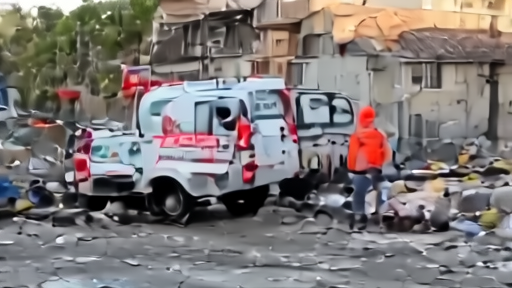
Six Lebanese paramedics were killed in two separate Israeli strikes inside a 24-hour window between Thursday night and Friday morning. Four Islamic Health Association medics died overnight Thursday in the village of Hanaway in southern Lebanon; two Al-Rissala Scouts medics were killed Friday morning in Deir Qanoun En-Nahr. Al Jazeera footage documents what its broadcast and several Arabic-language paramedic accounts have now called a "triple-tap" pattern: a first strike that wounds, a second strike that hits responders arriving on the scene, a third strike that hits the secondary wave of medical aid. [1] The Israel Defense Forces said in a Friday statement that it was "examining" the claim that uninvolved individuals were harmed and that the original strikes targeted "Hezbollah infrastructure and two Hezbollah militants riding motorcycles." [2]
This paper's Friday brief carried the Lebanon paramedic strike at Day 2 with no statement. The Saturday update is that Day 3 is no longer a holding pattern. The strike count moved from one Hanaway incident to two named incidents in 24 hours. The medic count moved from four to six. The IDF's response moved from no statement to "examining." The Lebanese Ministry of Health has called the strikes "violations of international law"; no Lebanese government statement above the ministry level has issued. The cumulative count of medical workers killed since the war began, per Lebanese MoH figures, is now above one hundred.
The triple-tap pattern is the structural feature. A first strike that wounds rather than kills is, in conventional military planning, an inefficient strike. A first strike that wounds and is followed by a second strike timed for the arrival of medical responders is, in international humanitarian law terms, a documented violation — the wounding-then-targeting-of-rescuers pattern is what the Geneva Conventions Additional Protocol I, Article 12 specifically prohibits. Al Jazeera's footage from Hanaway, broadcast Friday afternoon, shows two separate strikes minutes apart on the same approximate location. The second strike's blast pattern is consistent with a precision munition targeted at the visible aid vehicles. The Al-Rissala Scouts incident Friday morning in Deir Qanoun En-Nahr, per the same paramedic accounts, followed the same pattern.
The IDF's "examining" framing is itself an artifact. The military has, in past similar incidents during the war, responded with either denial (the strike did not happen as described) or explanation (the strike happened and targeted militant infrastructure). "Examining" — the formal acknowledgment that the IDF is reviewing whether the strike harmed uninvolved individuals — is the institutional language that holds the question open without resolving it. The structural reading is that the military's communications office has not yet decided which of the two framings to use, possibly because the footage that has surfaced makes the standard "Hezbollah infrastructure" explanation harder to deploy without comment.
The ceasefire architecture is the load-bearing context. The Lebanon-Israel ceasefire was extended 45 days at the May 14-15 Washington meeting, with the extension framed by the Trump administration as procedural — the kind of holding-pattern diplomatic maintenance the bilateral track has used for months. The ceasefire's substantive provisions include explicit protection for medical workers operating in southern Lebanon under the standard humanitarian-law framing. Six paramedic deaths in 24 hours, with one set of incidents matching a documented triple-tap pattern, is not within the substantive provisions. Whether the ceasefire architecture is read as having functionally collapsed depends on how the U.S. mediation handles the IDF's "examining" response in the next 72 hours.
The structural question for the paper is whether the Friday "Day 2 silence" frame has been broken by escalation or merely by the addition of another incident. The answer this paper carries to Saturday is that it is broken by escalation. Two named incidents in 24 hours, both matching the same strike pattern, with footage that documents the pattern in one of them, is not "another incident." It is a Day 3 with structural change rather than additive case count. The Friday frame held that the silence around medical-worker deaths was the artifact; the Saturday frame is that the documented pattern is the artifact, and the silence is now around the pattern rather than around the original incident.
The broader frame — the war's second-order effects on Lebanon's economic and humanitarian baseline — is reflected in the country's headline numbers. World Bank data through April had Lebanon at 1.8 percent projected 2026 GDP, downgraded 2.4 percentage points from the pre-war forecast. The country's cumulative war-related figures, per UN and Lebanese MoH counts, stand at approximately 1,953 killed, 6,303 wounded, and 830,000-plus displaced. The Gulf-port damage estimate of $25 billion to repair is a separate accounting. The six paramedic deaths sit inside a humanitarian and economic context that has, since the ceasefire's extension, lost the substantive cushion the ceasefire was meant to provide.
There is no Saturday Lebanese government statement above the Ministry of Health level. There is no Saturday U.S. State Department comment specifically on the paramedic deaths. There is no Saturday IDF update to its "examining" language. The Saturday silence is at three institutional levels, all on the same incident, with footage in public circulation that documents what happened. The reader's question is what the next 48 hours produce: a Lebanese government statement, a State Department response, an IDF update from "examining" to either denial or explanation, or another incident.
The paper's position is that the Friday silence frame has graduated. The Saturday frame is documented escalation inside a ceasefire that is structurally unable to absorb it. Whether the absorption happens through diplomatic intervention (Washington naming the pattern publicly), through Lebanese political response (a parliamentary inquiry, a government-level statement), or through neither is the artifact the next news cycle will or will not produce.
Six paramedics in 24 hours. The footage is public. The institutions are silent.
-- YOSEF STERN, Jerusalem