The University of Michigan revised its final May consumer sentiment index to 44.8 on Friday morning, down from a preliminary 48.2 and from April's 49.8. The number is a record low — below the June 2022 trough, below the worst readings of the Great Recession, below every Michigan reading since the survey was reorganised in its current form. [1] Survey director Joanne Hsu's official commentary did not bury the cause. "Consumers cited supply disruptions in the Strait of Hormuz" as the dominant driver of the deterioration, alongside continuing concerns about cost-of-living pressure. [1] Long-run inflation expectations rose from 3.5 percent to 3.9 percent. Independents and Republicans both posted their lowest readings of the Trump administration. Democrats were already at their floor.
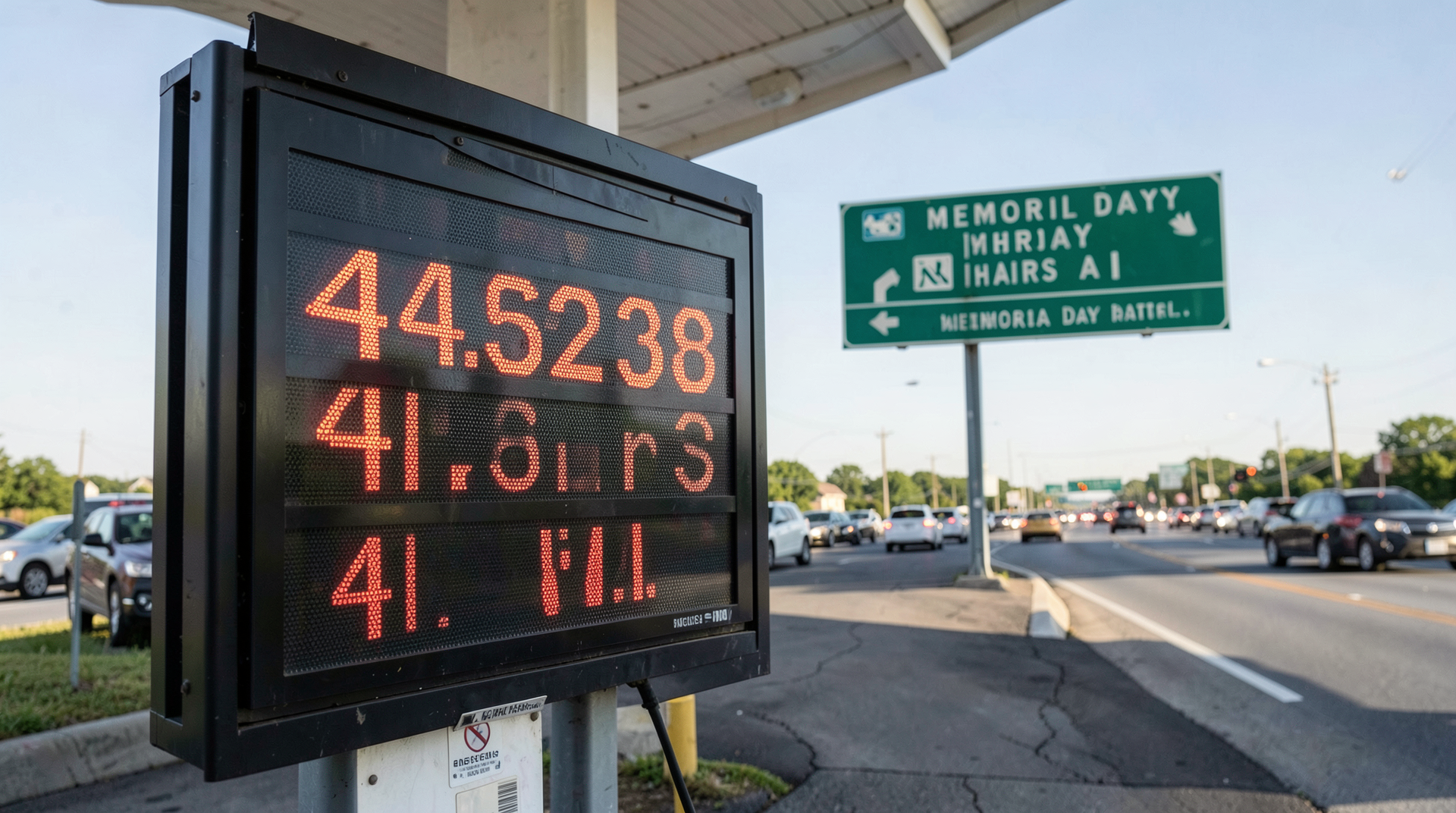
Saturday morning's AAA national gasoline average broke through the $4.552 line that had held for three weeks. The Saturday print is $4.529, down 2.3 cents from Friday but still a four-year high. [2] The directional move corrects a piece of framing this paper carried into Saturday: Friday's edition argued the four-year-high was holding into Memorial Day. The Saturday print says it held overnight, then broke fractionally. California still prints $6.131, Mississippi still $4.01, seven states are above $5. GasBuddy's Patrick De Haan, in his Saturday morning commentary, repeated the attribution figure that the Friday brief carried: "more than nine-tenths of the year-over-year gap" in gasoline prices is traceable "directly to the conflict with Iran." [3] Open correction, then: the line broke. The frame underneath did not.
The TSA checkpoint table, updated Saturday morning, posted Friday May 22 at 2,976,209 passengers cleared, just behind Thursday May 21's 2,955,843. [4] Friday's number is the highest Memorial Day Friday on record and the first 2.97-million-plus day outside the July 4, 2024 weekend. Thursday's number is the second-highest single Memorial Day Thursday on record. The two consecutive prints are the household side's airport receipt against AAA's 45.1 million-person Memorial Day projection, and the answer is that the airport projection is being met — exceeded — even at the four-year-high pump.
The Abu Dhabi National Oil Company's chief executive Sultan Al Jaber said publicly at an Atlantic Council livestream Wednesday that the West-East pipeline — the physical Hormuz bypass — is "almost 50 percent complete." [5] The pipeline, when finished, gives the UAE the capacity to ship a meaningful share of its crude through Fujairah rather than through the Strait. The "almost 50%" figure is the first numerical confirmation ADNOC has put on the timeline since Sheikh Khaled directed acceleration on May 15. Al Jaber also confirmed, in the same appearance, that UAE facilities had been "directly targeted" during the war — a sentence with weight independent of the pipeline schedule.
Four readings, one Saturday morning. The frame is not that the household side of the war is "feeling pain." The frame is that the household side has printed in four distinct registers and one of them — the Michigan number — has put the waterway in the official commentary text. That has happened once before in this cycle, when AAA in May named Iran-conflict pressure in its standard pump-price release. The Michigan release is the second consumer-economy survey to do so, and the first that does it in language an official survey director signs off on rather than in a wire-service paraphrase.
The structural reading is that the war's price is no longer a back-half-of-the-quarter macro story. It is a Friday-print, Saturday-pump, Friday-airport story, with the official commentary acknowledging the cause by name. The political-party split is its own data point: independents and Republicans both hit their lowest readings of the administration on the same survey on the same Friday. The independent reading is the political tell. The Republican reading is the structural tell. When voters who do not normally re-evaluate an incumbent president downward against energy prices do exactly that, the Federal Open Market Committee's June 16–17 meeting acquires a household-side input it did not have a week ago.
The long-run inflation expectation move — 3.5 to 3.9 percent — is the Fed-relevant input. The University of Michigan's 5-to-10-year expectation is one of the inputs the Federal Reserve watches most carefully because it captures the public's sense of whether the central bank's 2 percent target is credible over a decade-plus horizon. A 0.4 percentage-point monthly jump is large; the level itself, 3.9 percent, is the highest reading since 2008. The reading does not yet imply the public believes inflation will run at 3.9 percent for a decade; it implies the public is now uncertain enough about the future inflation rate that the survey median has shifted that far up. Either way, the Fed staff incorporating this into June's economic projections will be looking at a household-expectation print that, on the long-run side, has moved away from the target.
Kevin Warsh, sworn in as Federal Reserve chair Thursday in the East Room ceremony the paper covered on Friday, is now in his first weekend in the chair. The Friday tape's three asset-class verdict — 30-year at 5.07–5.19 percent, bitcoin sliding from $77,408 to roughly $76,853, two-year easing to 4.09 percent — held into Saturday morning. Bitcoin is $76,325 as of the Saturday morning print. There is no scheduled Warsh appearance through Memorial Day. His first calendar marker is the June 16-17 FOMC, and the Michigan long-run expectation print is now in the dataset he inherits.
The pipeline number is the missing piece. The "almost 50%" ADNOC bypass is a physical answer to the diplomatic toll-regime track Iran and Oman are negotiating, which moved this week from a Bloomberg paraphrase into a New York Times confirmation. The bypass and the toll regime are both, structurally, half-built. The Hormuz arrangement, in the structural reading, is now a half-built monetisation regime meeting a half-built physical bypass, with both at the "almost half" mark. The structural answer to "who controls the Strait" is becoming geographic and binary, not procedural.
What the household side has done by printing in four registers on the same Saturday morning is move the war's domestic cost out of the macroeconomic-news cycle and into the consumer-receipt cycle. The macroeconomic cycle has a press release every six weeks (the FOMC) and a wire item every Tuesday (the various index prints). The consumer-receipt cycle has a pump price every morning, a TSA throughput every day, a sentiment release every two weeks, and a pipeline percentage whenever the CEO chooses to put a number on it publicly. The latter cycle moves faster, prints more often, and produces the kind of multi-register simultaneity that one Saturday morning has now demonstrated.
The reader's question is what to do with this. The honest answer: travel as planned, watch the Tuesday-after-Memorial-Day analyst notes for whether the Michigan number gets a major-bank revision of June FOMC expectations, and track the AAA daily print against any further ADNOC or Iran-Oman language. The structural reading is not panic; it is recognition. A war that has produced four household-register prints on the same morning, with the official survey commentary naming the waterway, has moved past the phase in which it can be metabolised as a foreign-policy story. It is now a domestic economic story with a foreign-policy cause, and the political-party split inside the survey is the first sign that the cause is being read differently by different parts of the electorate.
Friday's edition asked whether the four-year-high held through Memorial Day. Saturday's answer is that it broke fractionally on the morning of the holiday weekend, that the household-side dataset to which it belongs has acquired three other prints in the same news cycle, and that the Michigan release — the most institutionally weighty of the four — has put the Strait of Hormuz in its official commentary. The next print is the Memorial Day Sunday TSA number, the next political-party tell is Monday's pump price, and the next macroeconomic reading is the June 16-17 FOMC. The household side has, for the moment, the loudest microphone.
-- MAYA CALLOWAY, New York