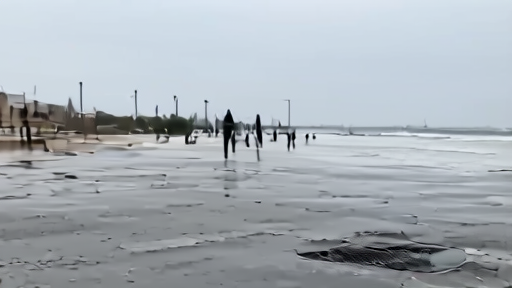
NOAA says the El Niño high-tide flood multiplier is active across U.S. coasts through Memorial Day, and the Mid-Atlantic is carrying a two-day risk window into the holiday. The signal that has produced an empty pre-season Atlantic hurricane map is the same one raising the high-tide baseline against which a clear-sky weekend can flood a low-lying street. Both readings are true on the same forecast map. [1][2]
The paper's Friday brief recorded the "double whammy" frame around Miami Beach; the Saturday update extends the multiplier north. NOAA's Ocean Service expects El Niño to emerge by July 2026 and is already running the high-tide-flooding maps that show 47 to 75 days of coastal flooding annually in many U.S. communities by 2040. The joint NMME forecast, read by Severe Weather Europe last week, places tropical Pacific peak sea-surface temperatures above +3°C — Super-El-Niño territory by late summer, in range of 1997-98 and 2015-16. That is the Pacific signal driving Atlantic shear and Atlantic suppression on the same week it raises Pacific-source coastal-flood baselines on the Atlantic seaboard. [3][4]
The plain-English version: a strong El Niño in the Pacific changes weather around the world for months. One thing it does is hold Atlantic hurricane formation down, by tearing apart the storm systems before they spin up. Another thing it does is push a few extra inches of water onto American coasts at high tide, even without a storm. The two effects happen at the same time. Saturday's instruction for Mid-Atlantic coastal residents is the high-tide schedule, not the hurricane forecast. Sunday's high tide for Cape May runs at 9:14 a.m. and 9:38 p.m.; Ocean City runs 26 minutes earlier; the local public-works pages have the street-by-street maps. The flood and the empty hurricane map share an author. [2][3]
-- DARA OSEI, London