Iran's Foreign Ministry declared on June 9 that the United States is "seeking no ceasefire or dialogue," collapsing the last remaining diplomatic frame around a conflict that has now entered its 102nd day without a binding agreement. [1]
The statement, carried by Iranian state media, confirmed what shipping data and military posture had already demonstrated: the ceasefire that took effect in early April has ceased to function as a restraint on either side. Israel struck Beirut's southern suburbs on June 8. Iran's Revolutionary Guard Corps targeted a US base in retaliation. Kuwait reported intercepting hostile missiles and drones. [2]
Tehran's declaration reframes the conflict. The question is no longer whether a ceasefire will hold — it is whether any diplomatic framework exists at all. The answer, for now, is no.
The Post-Collapse Regime
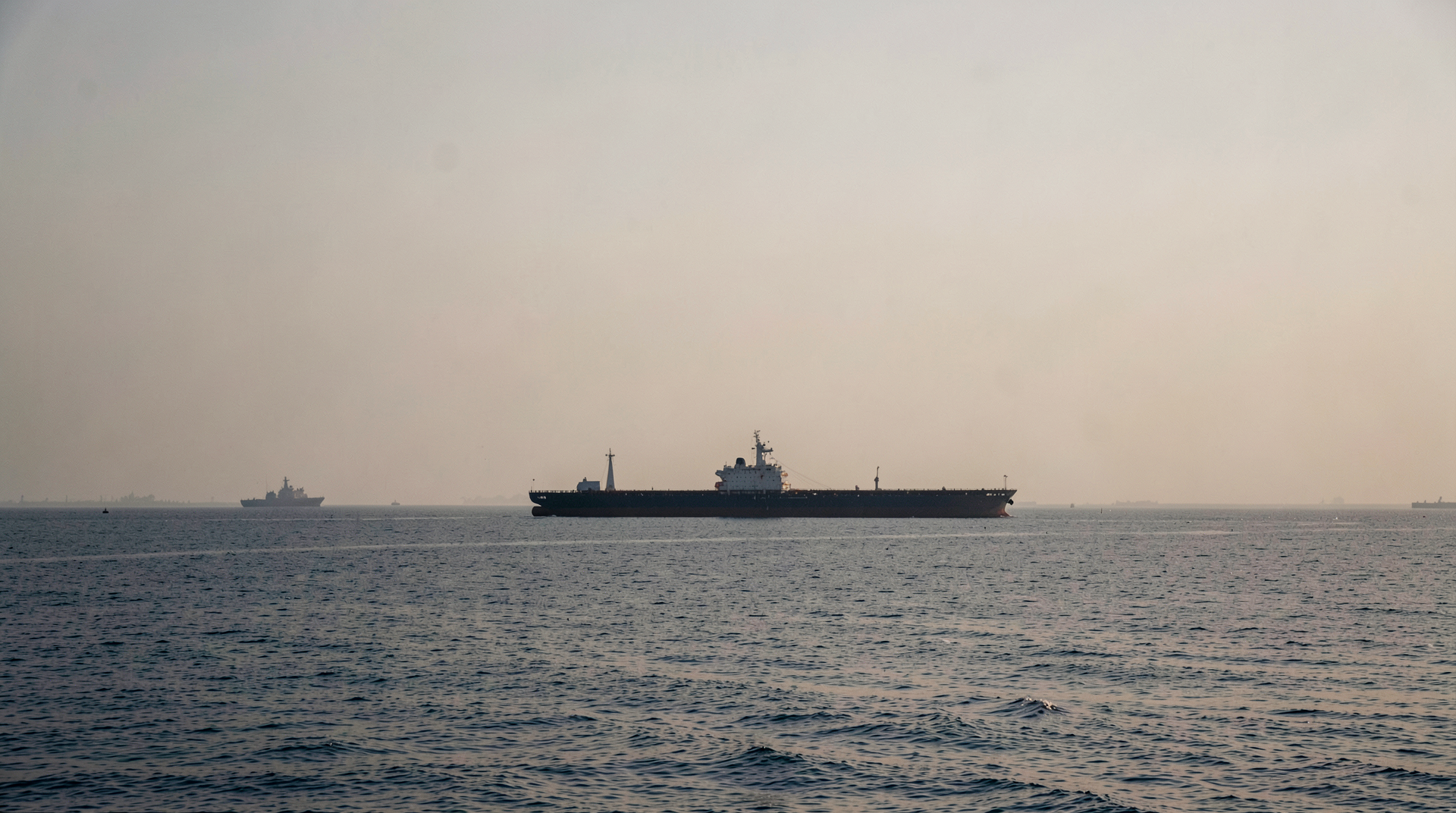
The ceasefire expired not as a single event but as a gradual erosion. Marine traffic through the Strait of Hormuz collapsed from roughly 120-138 commercial vessels per day to just 4-6 ships in the initial weeks of the crisis — an 80-95% drop in volume. [3] Iran selectively allowed "friendly" vessels from Russia, China, and India unimpeded passage, while other cargo required transit tolls processed in Chinese yuan or UAE dirhams. [3]
That toll system, once inferred from shipping behavior and insurance signals, received its first named confirmation on June 9 when Iran's envoy to Moscow, Kazem Jalali, told Izvestia that the strait "will be open but with transit fees" under conditions set jointly by Iran and Oman. [4] The fees are framed as payment for services — not tariffs, not sanctions, not a blockade. A governance structure has emerged where none was authorized. The paper's companion coverage follows the envoy's Moscow announcement and the Fujairah bypass acceleration it triggered; this piece is about what the fee regime does to the war's legal architecture.
The paper's prior frame — that every exit ramp leads to deeper commitment — is now confirmed by the absence of any ramp at all. Trump's warning to Netanyahu on June 8, which MSM treated as a pivot toward restraint, was one actor in an escalation dynamic, not a policy shift. [5]
The Price of a Fee Regime
A transit fee is not just an annoyance at sea. It reprices every barrel that moves, because insurers, charterers and traders build the toll into freight math the day it becomes predictable. When Iran selectively allowed "friendly" vessels from Russia, China and India through while charging others in yuan or dirhams, it created a two-tier market inside the world's most important oil chokepoint: a discounted corridor for the aligned and a taxed route for everyone else. [3] That split does something sanctions never quite accomplished — it puts a neutral commercial actor, the insurance market, in the position of pricing Iranian authority into every voyage as a routine cost of doing business.
The precedent compounds quietly. Oman's co-stewardship gives the arrangement a veneer of regional legitimacy; the fee's framing as payment for services gives it a veneer of commerce; the absence of any signed agreement gives both sides deniability. None of these veneers changes the substance: a state collects revenue from traffic through international waters because it demonstrated, over 100 days, that it could. MSM covers the strait as a price story and moves on when prices stabilize. The stabilization is itself the story — markets have accepted the fee regime as background conditions, which means they have accepted the war's new map.
What the US Said vs. What Happened
Vice President JD Vance met Iranian and Pakistani representatives in Islamabad on April 12. The talks ended without a deal. Trump said the outcome "makes no difference." [6] Iran described the talks as "intensive" and urged the US to avoid "excessive demands." Oil jumped 8.5% the next morning. WTI hit $104.80 per barrel. [6]
Since then, the US has maintained a naval presence in the Gulf while Iran has maintained its de facto control of shipping lanes through selective enforcement. CENTCOM guided 70 ships with 20,000 seafarers stranded on June 8. [4] Neither side has acknowledged the other's authority over the strait.
The structural reality: Iran collects transit fees. The US patrols. Insurers price risk. Shippers choose routes. A fee regime operates without a treaty, without a signed agreement, and without either government's formal acknowledgment of the other's role.
Notice what has not happened either: no convoy has been escorted through at the point of a gun, and no Gulf state has publicly endorsed the fee schedule. Both governments prefer ambiguity to the test that would break it. Ambiguity is cheaper than escalation for Tehran and cheaper than concession for Washington, which is why it persists even as each side's public language hardens. The strait's daily traffic tells the truth both capitals avoid: the toll system works, therefore it will be treated as permanent by everyone whose cargo depends on it. [4]
The Authorization Gap
The ceasefire collapse makes the Senate's inaction on war authorization urgent. Senator Tim Kaine demanded a legal justification as the Senate clock ticks — the paper covered this on June 8 — but no floor vote exists. [7] The House passed a war-powers measure 215-208, but without Senate follow-through it remains evidence of a gap, not a resolution. Our expanded coverage of the authorization gap details where the constitutional question now sits.
The Senate proved it can act when politically aligned: it passed a $69.5 billion immigration enforcement bill on June 5 after an 18-hour vote-a-rama. [8] War authorization remains the constitutional test the chamber is choosing to fail.
The contrast is more damning than gridlock would be. Gridlock suggests disagreement about ends. What the Senate demonstrated instead is agreement about means paired with avoidance of the one vote that would attach lawmakers' names to them. A fee regime operating in international waters, enforced by a foreign military against commercial traffic the Navy simultaneously patrols, is precisely the fact pattern the 1973 War Powers Resolution was written to force Congress to confront. The confrontation keeps being scheduled and keeps being cancelled. Meanwhile the executive branch negotiates nothing, the legislature votes nothing, and the operational reality accumulates precedents neither branch authorized.
Without Senate action, war powers remain unresolved while the operational reality creates new facts daily. The ceasefire's collapse into a post-collapse regime — where both sides operate under new rules without diplomatic cover — is precisely the scenario the Constitution's framers designed war-powers provisions to address.
The Governance Question
Who sets the transit fee? Who collects it? Who enforces it? These are not abstract questions. Iran's envoy named the fee structure publicly. The Fujairah pipeline — the only Hormuz bypass — is being accelerated because bypass infrastructure is now permanent, not contingency. [4] Aramco's CEO said normalization won't happen before 2027. [4]
The pattern is not a negotiation breakdown. It is the emergence of a parallel governance system in the world's most important oil chokepoint. MSM covers the strait as a price story. X compresses it into gas-price anxiety. The paper treats it as the construction of infrastructure that will outlast any ceasefire agreement — because it was built to survive one.
The historical analogy worth carrying is not blockade but customs union: institutions that begin as wartime improvisation and survive peacetime because every commercial actor has already reorganized around them. The Suez closures of 1956 and 1967 ended; the routing habits, insurance products and pipeline investments they triggered did not. Hormuz's toll regime is following the same arc at compressed speed, which is why "the war ends" is no longer synonymous with "the system unwinds." [4]
What Comes Next
The ceasefire collapse has moved from event to condition. Both sides are testing new engagement rules without a diplomatic framework. Tehran's statement forecloses the possibility of a near-term deal. Trump's warning to Netanyahu does not alter the structural dynamics.
Three indicators will tell the reader more than any press conference this week. First, whether the fee schedule stays quiet — a toll that stops being contested in public has stopped being negotiable in private. Second, whether Fujairah and other bypass capacity attracts long-term contracts rather than spot rerouting; infrastructure financed on ten-year assumptions is a statement about what shippers expect from the next decade. [4] Third, whether the Senate schedules the vote it owes the Constitution before another operational fact arrives that makes the question academic. The paper's lead coverage of Trump's warning to Netanyahu captured the day's drama; the drama is not where the story lives.
Can anyone name a ceasefire agreement that Trump is warning Netanyahu about? The answer is no — and that absence is the story. A war without a framework does not end when the fighting pauses. It ends when someone dismantles the systems the fighting built. Nothing on either side of the strait suggests dismantling has begun.
-- YOSEF STERN, Jerusalem