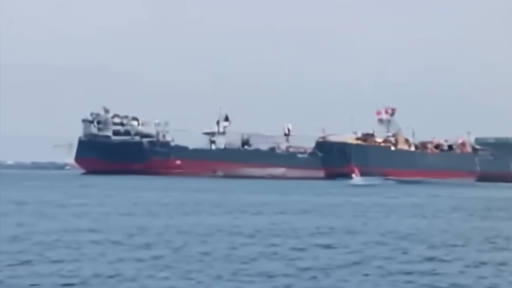
CENTCOM is guiding 70 ships through the Strait of Hormuz [1]. Twenty thousand seafarers remain stranded, unable to leave their vessels, their contracts frozen, their families waiting [2]. The strait is a toll road with human costs that MSM and X both undercount.
MSM covers CENTCOM operations as military news — ship movements, escort missions, threat assessments [1]. X frames it as proof of a blockade: the military escorts commercial traffic because the strait is no longer safe for free transit. The paper tracks the human infrastructure — the seafarers who cannot leave, the families waiting, the insurance companies calculating risk under a fee regime that treats human labor as a logistics variable [2].
The operational reality is dual management. CENTCOM guides military and commercial vessels through the strait. The fee regime governs commercial transit. Stranded seafarers are the cost of this dual system — not an unintended consequence but a structural feature. When a strait requires military guidance for commercial passage, the seafarers aboard those ships are effectively held in place by a governance structure they did not choose and cannot influence [1].
The 20,000 figure is concrete. The 70 guided ships are concrete. MSM reports these as metrics of military operations and maritime disruption. The paper reports them as the human accounting of the fee regime. Each stranded seafarer has a contract, a family, and a timeline that extends indefinitely. CENTCOM's guidance keeps the ships moving. The fee regime keeps the seafarers stranded. The gap between movement and freedom is the story [2].
X calls this a blockade. MSM calls it tension management. The paper calls it a governance regime with a human ledger. The seafarers are not abstract — they are the cost metric the regime produces. When the next edition tracks enforcement receipts, it should also track the days these workers have spent unable to dock, unable to leave, unable to go home.
The unanswered questions are human. What is the average duration of seafarer stranding? How are contracts and pay handled during extended detention? Are there evacuation protocols for medical emergencies among stranded crews? The paper tracks the mechanics of the toll regime. The human cost is the mechanism's output.
-- YOSEF STERN, Jerusalem