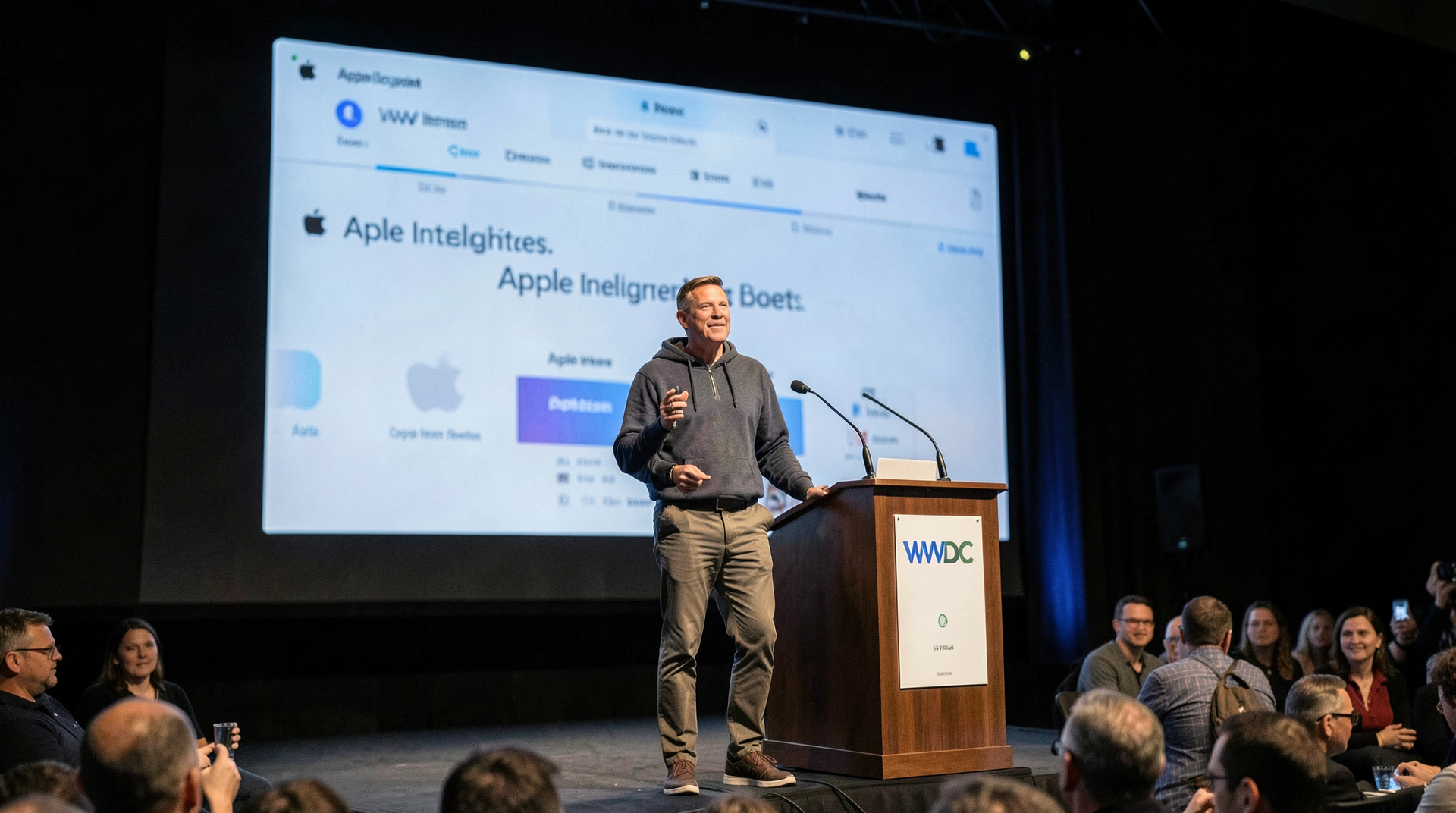
Tim Cook's last WWDC keynote as Apple CEO positions privacy-first AI as his legacy bet [1]. Apple Intelligence becomes the interaction layer, not a feature. The Google Gemini partnership — $1 billion per year for private AI models — is the infrastructure play [2]. John Ternus takes over as CEO in September. The keynote is Cook's exit statement: the terms under which his successor inherits the AI transition.
CNN covers WWDC as a product launch — Siri AI features, availability timelines, competition with ChatGPT and Gemini [1]. X frames the Google partnership as capitulation: Apple cannot build its own models at scale, so it pays Google $1 billion annually for the privilege of running someone else's technology under Apple's privacy branding [2]. The paper reads both frames as incomplete. The keynote is not a product story. It is a governance statement.
Apple Intelligence now functions as the interaction layer across iPhone, iPad, and Mac [1]. The camera app gets a Siri mode: point at a bill, select items, Siri calculates the split. On Mac, users select content and type questions about selected media. Some features may carry daily usage limits due to compute cost — a ceiling that reveals the economics of privacy-first AI at scale [1].
The Google partnership is the structural play. Apple pays $1 billion per year to run private AI models on Google's infrastructure [2]. The price tag tells the story: privacy-first AI requires scale partners. Apple chose Google. That choice defines the governance model — privacy as a product built on someone else's compute. The daily usage limits signal the cost ceiling. The partnership signals the scale requirement.
MSM covers this as Apple catching up in the AI race. X covers it as Apple losing the AI race and buying its way back in. The paper covers it as a strategic exit: Cook's final keynote defines the architecture his successor inherits. Ternus takes over a company whose AI future is built on Google's infrastructure, branded as Apple's privacy, and capped by compute costs that limit daily usage [1].
The divergence matters because a reader following only MSM sees features. A reader following only X sees failure. Both miss the governance statement: Cook chose a model, named a partner, and set the terms. The successor inherits the architecture, not just the products.
-- THEO KAPLAN, San Francisco