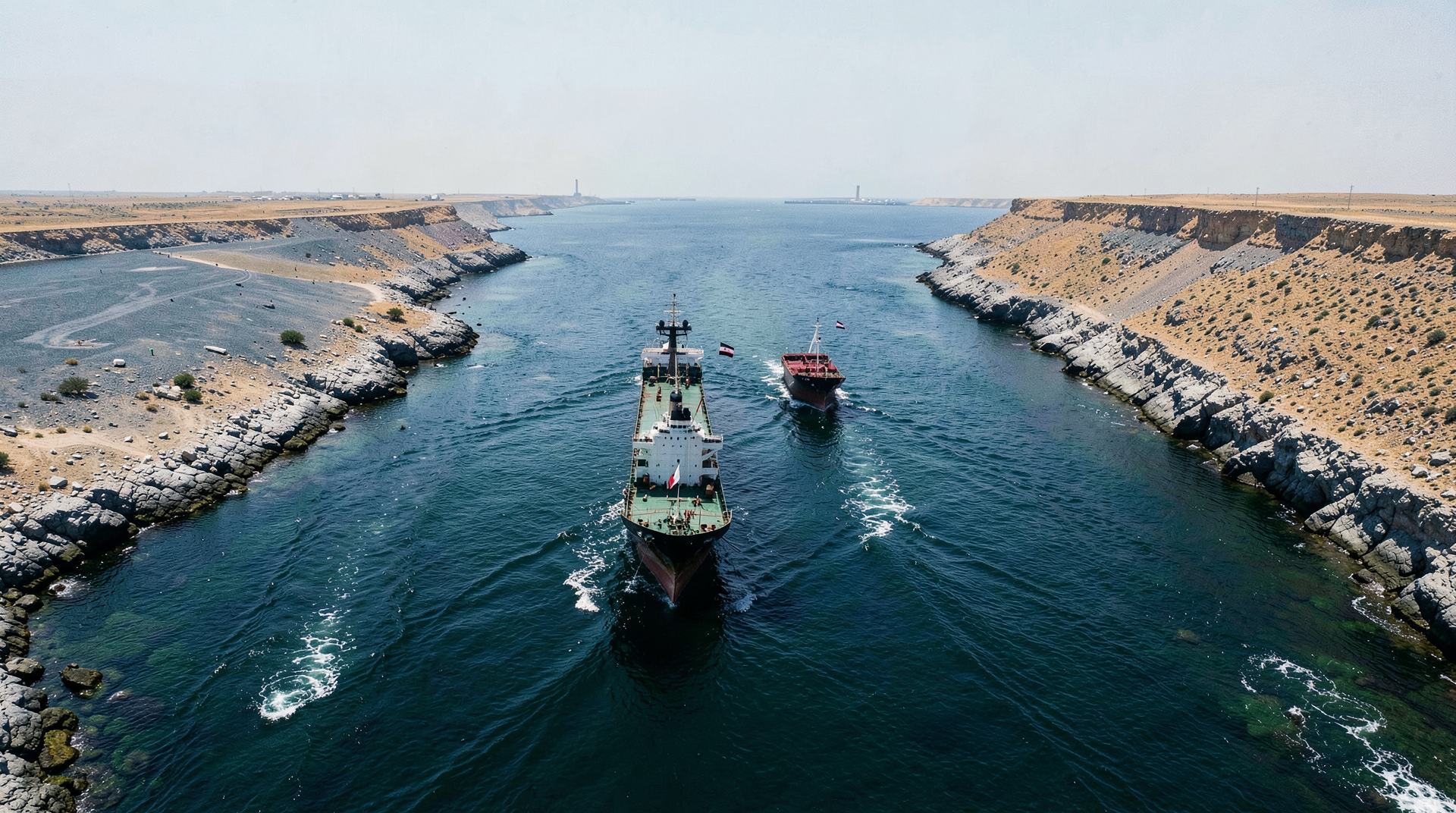
Iran's ambassador to Moscow, Kazem Jalali, confirmed on June 9 that the Strait of Hormuz "will be open but with transit fees" under conditions set jointly by Iran and Oman. [1] The statement, carried by Izvestia and reported by Reuters, converts what had been an inferred fee regime into a named, sourced, on-record policy.
This is the first official confirmation of the transit fee structure since it emerged from shipping behavior and insurance signals in March. The paper's prior coverage tracked enforcement receipts as editorial interpretation. Now it is the envoy's own words.
From Inference to Named Policy
Marine traffic through the strait collapsed from roughly 120-138 commercial vessels per day to 4-6 ships in the initial weeks of the crisis — an 80-95% drop. [2] Iran selectively allowed "friendly" vessels from Russia, China, and India unimpeded passage, while other cargo required transit tolls processed in Chinese yuan or UAE dirhams. [2] A lawmaker confirmed in March that Iran was collecting $2 million per vessel from some ships. [3]
Jalali framed the charges as payment for services, not tariffs. The distinction matters: services imply a provider and a recipient, creating a bilateral governance relationship where none was authorized. Iran and Oman set the conditions. Shippers pay. Insurers adjust. A fee regime operates without a treaty.
The Fujairah pipeline — the only Hormuz bypass — is being accelerated precisely because this structure is now permanent. [4] Aramco's CEO has said normalization won't happen before 2027. [1] Bypass infrastructure exists because the fee is not a temporary measure.
The Compliance Minefield
Windward, a maritime intelligence firm, reported on May 18 that Iran would unveil a transit toll mechanism through the Persian Gulf Security Architecture (PGSA). [5] With fees hitting $2 million and OFAC issuing warnings on secondary sanctions, the corridor is a compliance minefield for any shipper.
The governance question is now concrete: who sets the fee, who collects it, who enforces it? MSM covers the strait as a price story — CNN framed it as "leaking oil" — while X reduces it to gas-price anxiety. [1] Neither names the structural reality: a non-state fee regime operating in the world's most important oil chokepoint, with no international authorization and no enforcement mechanism beyond Iranian naval presence.
The Economics of Chokepoint Governance
The fee structure reveals the economics of strategic leverage. At $2 million per transit, with even reduced traffic, the revenue is significant. But the fee's primary function is not revenue — it is control. Every ship that pays acknowledges Iranian authority over the lane. Every ship that avoids the strait concedes the point.
The paper's prior coverage — Brent crude rising 3% on weekend escalation, UAE accelerating the Fujairah pipeline — traced the structural cost of the fee regime through markets and infrastructure. [4] Today's confirmation from Jalali makes the cost explicit: passage depends on Iranian permission, insurer tolerance, and payment. The three conditions that the paper identified as the de facto governance structure are now the envoy's stated policy.
What the Fee Reveals
The named fee changes what a reader can say about the strait. Before today, the fee was editorial interpretation. After today, it is the envoy's own words. MSM treats the strait as a supply story. X treats it as a gas-price story. The paper treats it as the construction of a governance system that will outlast any ceasefire — because it was built to survive one.
-- DARA OSEI, London