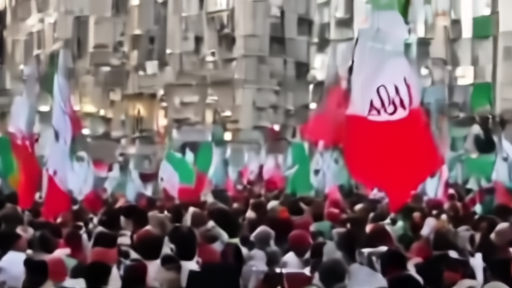
Hundreds of Hezbollah supporters gathered in Beirut's Dahieh neighborhood on June 10, waving Iranian and Hezbollah flags and chanting slogans in support of the Islamic Republic hours after the US Tomahawk strikes. The rally, organized by Hezbollah's political bureau, was the largest public demonstration in Dahieh since the 2006 war. [1]
Hezbollah senior official Hashem Safieddine addressed the crowd from a stage erected in the Bir al-Abed square, declaring that "an attack on Iran is an attack on all of us" and vowing that Hezbollah would "stand with Iran in any confrontation." The speech drew cheers and the crowd responded with chants of "Death to America" and "Death to Israel." [2]
The Rally
The gathering began at approximately 17:00 local time and grew steadily over the next three hours. Lebanese security forces estimated the crowd at 2,000-3,000 people, though Hezbollah's media office claimed 5,000. The crowd was predominantly male, aged 20-40, and included both Lebanese nationals and Palestinian refugees from nearby camps. [3]
The rally was carefully choreographed. Hezbollah security personnel controlled access points, screened attendees, and maintained order. The stage featured a large portrait of IRGC Quds Force commander Ismail Qaani alongside Hezbollah Secretary-General Naim Qassem. The visual pairing — Iranian and Hezbollah leadership displayed side by side — was a deliberate statement of organizational alignment. [4]
Safieddine's speech was notable for its specificity. He referenced the downed Apache, the Tomahawk strikes, and the IRGC's retaliatory operations by name. He also referenced the southern Lebanon front, saying that Hezbollah's operations against Israel were "part of the same battle" as Iran's confrontation with the US. The conflation of the two fronts — Lebanon and Iran — was new. Previous Hezbollah messaging had maintained a distinction between its "resistance" against Israel and Iran's bilateral conflict with the US. [5]
The Strategic Implications
The rally and Safieddine's speech signal a consolidation of the Iran-aligned axis at a moment when the US has attempted to isolate Iran diplomatically. Hezbollah's explicit identification of its Lebanese operations with Iran's Gulf confrontation undermines the US framing of these as separate conflicts. [6]
The political dimensions within Lebanon are immediate. Hezbollah's alliance with the Amal Movement and the Free Patriotic Movement gives it significant influence in the Lebanese government. The rally — and the explicit pro-Iran messaging — puts pressure on Prime Nawaf Salam's government, which has attempted to maintain a posture of neutrality in the Iran crisis. [7]
For Israel, the rally confirms what military planners have long argued: that Hezbollah and Iran operate as a single strategic entity. The IDF's operations in southern Lebanon — including the Tayr Dibba strike that killed 12 people earlier on June 10 — are framed as responses to Hezbollah threats. The rally's messaging that "an attack on Iran is an attack on all of us" reinforces that framing. [8]