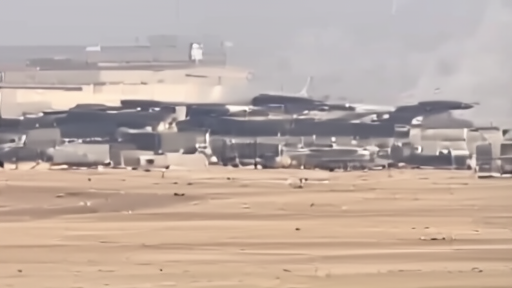
The Islamic Revolutionary Guard Corps claimed on June 10 that it struck 21 US military targets across three countries, destroying four of them, in retaliatory strikes following the American Tomahawk barrage. The Pentagon confirmed damage to facilities at Isa Air Base in Bahrain and Ali Al-Salem in Kuwait but disputed the scope of Iran's claims, setting up the familiar wartime contest over facts. [1]
IRGC spokesperson Brigadier General Ali Mohammad Naini said in a televised statement that the strikes hit "21 American military targets in Bahrain, Kuwait, and Jordan, destroying four of them completely and causing significant damage to the remainder." He listed targets including "a Patriot battery at Ali Al-Salem, a logistics center at Isa Air Base, a flight operations facility at Muwaffaq Salti, and an F-35 hangar at Isa." [2]
The Claims
The F-35 hangar claim drew the most attention. The IRGC released video footage purporting to show a Shahab-3 missile striking a large hangar at Isa Air Base, followed by a secondary explosion. The footage, broadcast on Iranian state television, appeared to show at least one aircraft in the hangar at the moment of impact. [3]
Satellite imagery published by Maxar Technologies within hours of the strike appeared to corroborate part of the claim. The imagery showed significant damage to a hangar complex at Isa, with structural collapse visible in at least one bay. A subsequent image, released by the open-source intelligence account OSINTdefender, showed what appeared to be the tail section of an F-35A Lightning II visible in the debris. [4]
The Pentagon's initial assessment, released at 14:00 local time, said "two facilities at Isa Air Base sustained damage from Iranian missile strikes" and that "no aircraft were destroyed." A later update, issued at 18:00, revised the assessment to acknowledge "damage to aircraft parking areas" but maintained that "no F-35 aircraft were destroyed." The statement did not address the satellite imagery. [5]
The discrepancy between the Pentagon's assessment and the satellite evidence is not unusual in wartime. The US military has historically been conservative in acknowledging damage during the early hours of a conflict, releasing revised assessments as information becomes available. The IRGC, conversely, has an incentive to夸大 the effectiveness of its strikes for domestic audiences. [6]
The Target List
Beyond the F-35 claim, the IRGC's target list included infrastructure at all three bases struck. At Ali Al-Salem in Kuwait, the IRGC claimed to have destroyed a Patriot battery — the Pentagon confirmed "damage to an air defense installation" but said the battery was "degraded, not destroyed." At Muwaffaq Salti in Jordan, the IRGC claimed to have hit a flight operations center; the Pentagon said the base sustained "minor damage from drone debris after air defenses intercepted the incoming volley." [7]
The IRGC also claimed strikes on two additional targets that the Pentagon did not acknowledge: a communications relay station in southern Iraq and a forward operating position in eastern Saudi Arabia. No satellite imagery has surfaced to confirm these claims, and military analysts on X noted that the IRGC may be inflating the target list to create an impression of broader capability. [8]
The discrepancy in casualty figures was smaller but notable. The IRGC claimed "dozens of American dead and wounded." The Pentagon's count stood at three dead and seventeen wounded across all three bases. The gap — between "dozens" and twenty — is consistent with historical patterns of Iranian overstatement and American understatement during conflict. [9]
The Verification Challenge
The contest over strike accuracy is not merely academic. It shapes public perception, political will, and the calculus of escalation. If the IRGC destroyed an F-35 — the most advanced fighter in the US inventory, valued at approximately $80 million — it would represent a significant degradation of American air capability in the region. If the Pentagon's assessment holds, the damage is significant but not strategically decisive. [10]
OSINT analysts on X spent the afternoon parsing satellite imagery, flight tracking data, and IRGC video footage. The consensus, by evening, was that the F-35 claim was "partially confirmed" — at least one F-35 was likely damaged, possibly destroyed, but the hangar's full contents were unknown. The Patriot battery claim was "unconfirmed" — satellite imagery showed damage to an air defense position but not the distinctive launchers of a Patriot system. [11]
The wartime truth gap — exaggerated claims on one side, conservative assessments on the other — is as old as conflict itself. In the age of satellite imagery and social media, the gap is narrower but not eliminated. Both sides have access to the same images; they interpret them through different lenses. The IRGC sees a destroyed F-35 hangar. The Pentagon sees damaged aircraft parking areas. The satellite sees concrete and metal. [12]
What is not in dispute is that Iran struck US bases with ballistic missiles and that people died. The target counts and damage assessments are arguments over magnitude, not over the fact of the strikes themselves. The exchange happened. The question now is what comes next. [13]
-- YOSEF STERN, Jerusalem