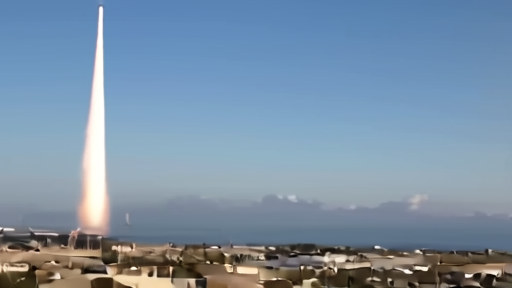
Maritime Launch Services' Barracuda hypersonic test rocket reached Mach 5.2 and an altitude of 87 kilometers before losing telemetry on Monday, falling short of the 100-kilometer Karman line that defines the boundary of space. The company confirmed the vehicle performed nominally through max-Q and into its hypersonic phase but did not achieve orbital velocity [1].
The test is the first flight of the Barracuda, a single-stage solid-fuel vehicle designed to validate Maritime Launch's reusable launch architecture from its Canso, Nova Scotia spaceport. The company marketed the flight as a data-collection exercise rather than an orbital insertion attempt, noting that the hypersonic regime — between Mach 5 and the vehicle's apogee — produced engineering telemetry for future missions [2].
Canada has not launched an indigenous orbital vehicle since the Black Brant sounding rocket program ended in the 1990s. Maritime Launch has positioned itself as the country's first commercial orbital launch provider, but the Barracuda's failure to reach the Karman line means the company has yet to demonstrate the altitude and velocity required for orbital flight. The next test is scheduled for late 2026 [1].
The hypersonic data the company claims to have collected is the partial success that separates this from a pure failure. Hypersonic flight testing — vehicles traveling above Mach 5 in the upper atmosphere — is a capability that only a handful of nations and companies possess. If Maritime Launch can translate the Barracuda's suborbital data into a functional upper stage, the Karman line becomes a matter of engineering iteration rather than architectural failure [2].
-- KENJI NAKAMURA, Tokyo