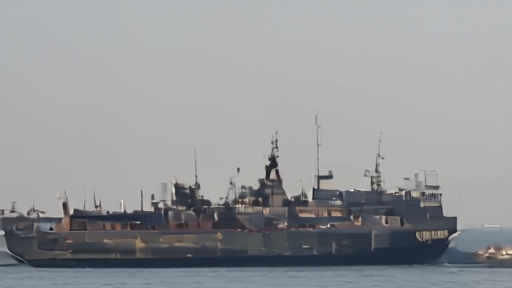
US Navy forces disabled a Panama-flagged oil tanker in the Gulf of Oman on Monday after the vessel "refused to comply with multiple identification demands" during a period of heightened maritime security, CENTCOM said in a statement [1]. The tanker's 23 crew members — from India, Pakistan, and the Philippines — were rescued by US Navy personnel and transported to a nearby naval vessel. No casualties were reported.
The incident occurred approximately 30 nautical miles south of the Strait of Hormuz, in international waters outside Iran's declared exclusion zone. CENTCOM described the tanker as "suspicious" and said it was operating without a transponder signal. The vessel's Greek operating company, Andromeda Shipping, said the transponder malfunctioned and the crew was following standard commercial shipping protocols [1].
X's frame treats the disabling as the conflict's expansion from Iranian waters to international shipping lanes. The Gulf of Oman is not a war zone. It is international waters where commercial shipping operates under freedom of navigation principles. A US Navy vessel disabling a commercial tanker in international waters — regardless of the stated justification — sets a precedent that other naval powers will cite. China's operations in the South China Sea, Russia's actions in the Black Sea, and Iran's Hormuz closure all find legal cover in the precedent [2].
The Identification Question
The "refused to comply with identification demands" framing raises operational questions. Commercial tankers in the Gulf of Oman receive identification requests from naval vessels regularly. The standard response is to transmit AIS data, display the vessel's name and flag, and communicate via marine radio. Andromeda Shipping said the crew attempted all three protocols. CENTCOM said the vessel did not respond [3].
The discrepancy is the story. Either the tanker's crew failed to respond to identification demands — which would be unusual for a commercial vessel with nothing to hide — or the identification demands were delivered in a format or timeline that the crew could not process. The 14 hours between the disabling and the crew's rescue by Indian Navy forces suggests that the "suspicious" designation was applied quickly and the consequences followed immediately [1].
MSM frames the incident as a security operation. X frames it as a rules-of-engagement escalation. The difference matters because every commercial tanker in the Gulf of Oman is now operating under rules where "refusing identification demands" — even if the refusal is a transponder malfunction — can result in military force. The tanker disabling is not about one vessel. It is about the new rules for commercial shipping in a war zone [2].