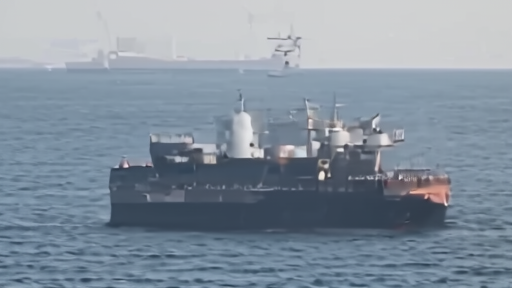
A US Navy destroyer disabled the Indian-flagged crude tanker MV Dhwaj Maritime with naval gunfire early on June 10, killing two crew members and leaving a third missing and presumed dead. The ship, carrying 85,000 tons of Iranian crude oil, was struck approximately 40 nautical miles south of Bandar Abbas while transiting the Strait of Hormuz. [1]
India's Ministry of External Affairs issued a statement within hours, calling the attack "an unacceptable violation of international maritime law" and demanding "immediate accountability from the United States." The statement was remarkable for its tone — India has historically avoided direct criticism of US military operations, even when its interests were affected. The language of "strongest terms" and the demand for accountability marked a significant diplomatic escalation. [2]
The Incident
The Dhwaj Maritime, operated by Mumbai-based Dhwaj Shipping Lines, was en route from Bandar Abbas to Mundra port in Gujarat when it was intercepted by the USS Gridley, an Arleigh Burke-class destroyer operating as part of the US Fifth Fleet's blockade enforcement patrol. [3]
According to CENTCOM, the destroyer issued multiple warnings to the vessel over a two-hour period, demanding it alter course and submit to inspection. The Dhwaj Maritime's captain responded that the ship was carrying a legal cargo under Indian law and that it would not submit to a US boarding without authorization from the Indian government. [4]
The Gridley fired warning shots across the bow before striking the ship's bridge and engine room with precision-guided munitions. The attack killed Chief Engineer Rajesh Patel and Second Officer Vikram Singh. Third Officer Arjun Mehta is missing and presumed dead — his body has not been recovered. Six other crew members sustained injuries. [5]
The ship lost power and began listing to port. A nearby Indian Navy patrol vessel, INS Sumitra, responded to the Dhwaj Maritime's distress call and assisted in evacuating the surviving crew. The Indian Navy footage, shared widely on social media, showed sailors being lifted from the listing tanker by helicopter. [6]
India's Response
Prime Minister Narendra Modi convened an emergency Cabinet Committee on Security meeting at 7:00 AM local time. The meeting lasted three hours — an unusually long session for what is typically a 30-minute briefing — and produced a statement that went beyond what many analysts expected. [7]
"We are shocked and deeply saddened by the attack on MV Dhwaj Maritime," the statement read. "The loss of Indian lives in what appears to be an unprovoked act of aggression against a commercial vessel operating in international waters is utterly unacceptable. India demands an immediate explanation from the United States and reserves the right to take all necessary measures to protect its citizens and its shipping." [8]
The language was the strongest India has used against a US military action in decades. Analysts noted that the statement's phrasing — "unprovoked act of aggression" and "reserves the right to take all necessary measures" — echoed the kind of language typically reserved for Pakistan after cross-border terrorist attacks. [9]
The political dimensions were immediate. Modi faces a general election in 2027, and his opposition Congress party seized on the incident. Rahul Gandhi called the attack "a national humiliation" and demanded that Modi "stand up to Washington instead of bowing to it." The BJP's response was more measured but notably firm, with External Affairs Minister S. Jaishankar summoning the US Ambassador for an explanation. [10]
The Blockade's Civilian Toll
The Dhwaj Maritime incident is not the first civilian casualty of the US naval blockade of Iranian oil exports, but it is the most diplomatically consequential. Since the blockade began in March, at least four commercial vessels have been fired upon or disabled for refusing to submit to US inspection. [11]
The blockade enforcement rules, issued by CENTCOM in April, require all vessels transiting the Strait of Hormuz to submit to boarding and cargo inspection by US Navy personnel. Ships carrying Iranian crude are turned back or, if they refuse inspection, engaged with "proportionate force." The Dhwaj Maritime was the first vessel to be struck with lethal force. [12]
Maritime law experts questioned the legality of the blockade under international law. The UN Convention on the Law of the Sea permits blockade during armed conflict but requires that commercial vessels be given safe passage after surrender. The US has not declared a formal state of war with Iran, relying instead on the 2001 Authorization for Use of Military Force and executive authority. [13]
"The US is attempting to enforce a blockade without the legal framework that makes a blockade lawful," said Dr. James Kraska, a professor of international law at the US Naval War College. "You cannot have it both ways — either you are in a state of armed conflict and can impose a blockade, or you are not and must rely on sanctions enforcement through legal channels." [14]
The Strategic Stakes
India imports approximately 1.8 million barrels of Iranian crude per month — roughly 15% of its total oil imports. The Dhwaj Maritime was carrying a cargo valued at approximately $85 million. But the financial cost pales beside the diplomatic damage: India has been a key US partner in the Quad security dialogue, and Modi has cultivated a personal relationship with Trump. [15]
The incident forced India into an impossible position. Continuing to import Iranian oil risks US secondary sanctions — Washington has already imposed penalties on Indian companies that violate its Iran restrictions. But acquiescing to the blockade enforcement would be politically devastating for Modi, who has built his brand on India's strategic autonomy and refusal to be dictated to by any power. [16]
Indian shipping companies have already begun rerouting around the Cape of Good Hope, adding 15-20 days to transit times and significantly increasing costs. The Indian Oil Corporation confirmed it was seeking alternative suppliers from Saudi Arabia and Iraq, but the spot market for crude has tightened dramatically since the Hormuz closure, with premiums of $8-12 per barrel above benchmark prices. [17]
For the US, the attack on the Dhwaj Maritime risks fracturing the coalition it has painstakingly built around the Iran pressure campaign. The Gulf states have already issued tepid statements. India's condemnation is sharper. If the blockade continues to produce civilian casualties, the diplomatic cost may outweigh the strategic benefit. [18]
-- PRIYA SHARMA, Delhi