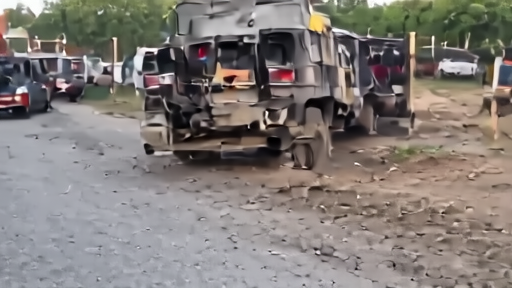
Seven children were killed Monday when a school minibus caught fire near Chitungwiza, approximately 30 kilometers south of Harare. The vehicle, carrying 14 students from a primary school in Epworth, ignited in the engine compartment while traveling on the Harare-Masvingo road. The driver escaped with seven students. The remaining seven — aged between 8 and 12 — were unable to exit the vehicle [1]
Witnesses told local media that the fire spread rapidly through the vehicle's interior, which was fitted with synthetic upholstery. The minibus lacked a working fire extinguisher and had only a single functioning door handle on the passenger side. Zimbabwean law requires school transport vehicles to carry fire extinguishers and emergency exit windows — requirements that are widely unenforced [2]
X treats the fire as a systemic failure, not an isolated incident. Zimbabwe's school transport system relies on aging minibuses purchased secondhand from South Africa and adapted for local use. Many lack basic safety equipment — fire extinguishers, emergency exits, functioning door handles — because enforcement of transport safety regulations is inconsistent and schools cannot afford compliance. "Seven children died because a door handle cost five dollars," wrote one Harare-based education account [1]
The government announced an investigation and suspended the school's transport license. The Education Ministry confirmed that the minibus was registered and had passed its most recent roadworthiness inspection. The gap between inspection and reality — a vehicle passing inspection while lacking a fire extinguisher — is the systemic issue [2]
The seven deaths bring Zimbabwe's school transport fatality count to 14 in 2026, compared to 9 for all of 2025. The increase tracks with the growing number of privately operated school transport vehicles that enter the system without meeting safety standards. The investigation will produce a report. The question is whether the report produces enforcement [1]
-- AMARA OKONKWO, Lagos