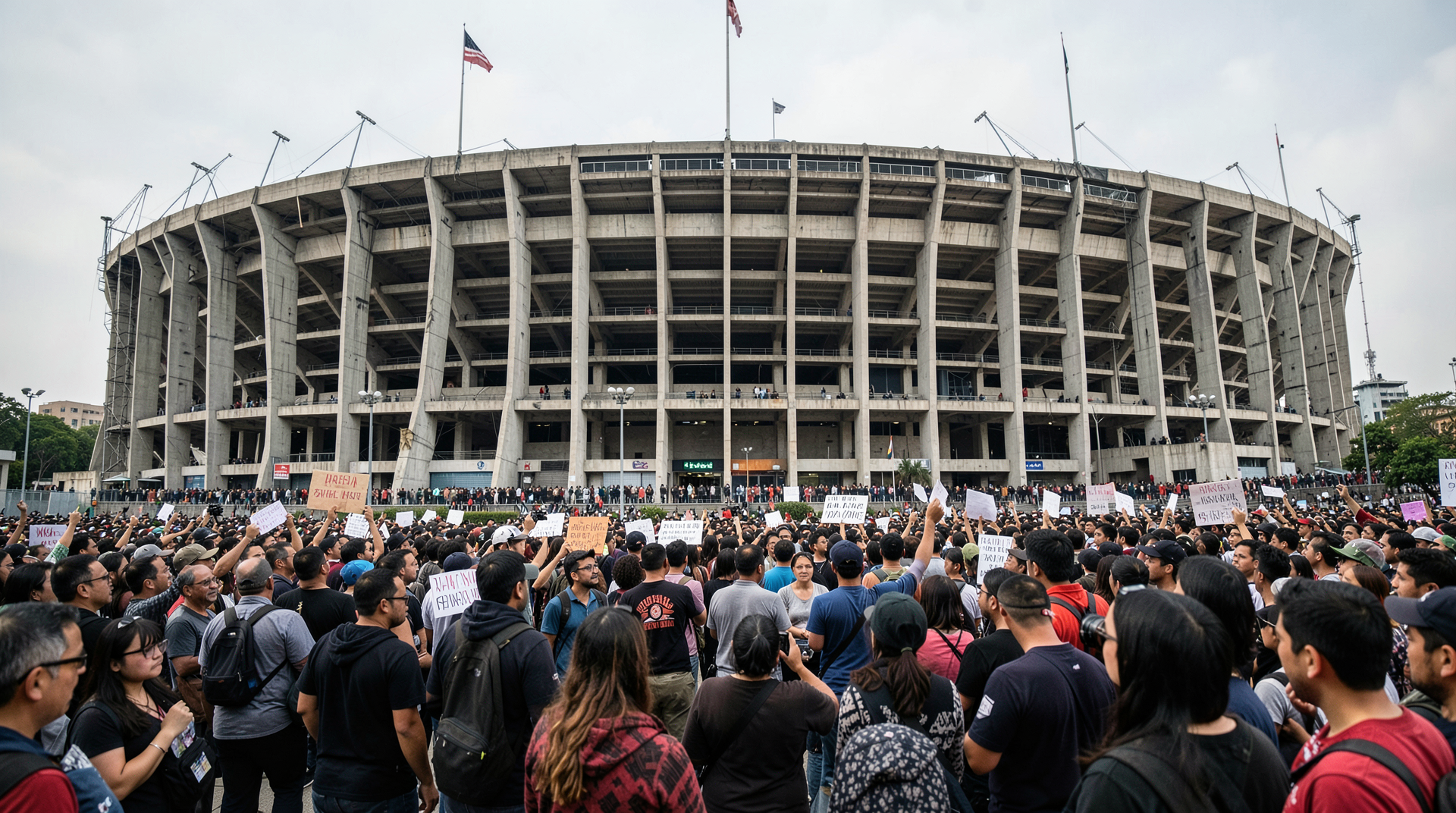
The 2026 FIFA World Cup opened at Estadio Azteca on June 11 with Mexico facing South Africa in the tournament's first match [1]. Outside the stadium, thousands of protesters blocked the avenue leading to the venue. The immediate disconnect between celebration and enforcement is the story of day one.
The paper's prior account of ICE enforcement around World Cup venues documented the tensions between the tournament's celebration and the enforcement apparatus surrounding it. Day one confirmed the thesis completely: Azteca — the spiritual home of Mexican football, which hosted Pelé and Maradona — became a political stage.
ICE agents were confirmed present near the stadium by the Department of Homeland Security [1]. The civil rights group Move On Civic Action had gathered over 13,000 signatures on a petition demanding FIFA stand firm against ICE presence at World Cup venues [2]. FIFA did not respond to the petition before the opening kickoff. The silence was interpreted by protesters as complicity with the enforcement presence.
AFP reported that "thousands of protesters blocked an avenue leading to Mexico City's Azteca Stadium, just days before the 2026 World Cup kicks off at the venue" [3]. The timing was deliberate and calculated: the protest was designed to coincide with the opening ceremony, ensuring maximum international visibility.
Al Majalla noted that "concerns grow ahead of the 2026 World Cup" with the tournament beginning at Mexico City's Estadio Azteca [2]. The MSM framing treats the protests as separate from the tournament. X treats them as inseparable — the enforcement and the celebration are part of the same story.
Mexico won the opening match 2-0. Inside the stadium, the celebration was genuine. Outside, the clashes between police and protesters continued [3]. The political dimension of the World Cup is immediate and visible.
The tournament was awarded to the United States, Mexico, and Canada jointly — but the enforcement presence is concentrated in the Mexican venues exclusively. The optics of ICE agents patrolling near a stadium where Mexican fans are celebrating their national team is the kind of contradiction that X amplifies and MSM contextualizes.
FIFA's response to the protests will shape the tournament's narrative. If the organization ignores the demonstrations, it signals that commercial interests outweigh human rights concerns. If it acknowledges them, it risks antagonizing the US government — which controls the majority of the tournament's venues and revenue. The tension between FIFA's commercial interests and its stated commitment to human rights is the structural conflict that the opening day has made visible.
The 48-team tournament will span sixteen cities across three countries over the next month. If the protests in Mexico City are any indication, every match will carry a political dimension that FIFA would prefer to ignore. The opening day at Azteca has set the template: celebration inside, confrontation outside, and a governing body caught between the two.
The protests were not spontaneous. Organizers had been planning them for weeks, coordinating with immigrant rights groups across the United States. The message was deliberate: the World Cup cannot be separated from the political context in which it is being held. Mexico, which co-hosts the tournament, has been at the center of the immigration debate — and the presence of ICE agents at Mexican venues has turned the tournament into a symbol of that broader political struggle.
FIFA's commercial interests are enormous. The organization has sold broadcasting rights worth more than $3 billion for the 2026 tournament alone. Sponsors including Coca-Cola, Adidas, and McDonald's have invested heavily in the event. The financial stakes make it unlikely that FIFA will take a strong stance on the protests — but the optics of ignoring them carry their own significant cost. The opening day at Azteca has created a tension that will persist throughout the tournament.
The contrast between the celebration inside the stadium and the confrontation outside it is the defining image of the World Cup's opening day. The tournament that was supposed to unite the continent through football has instead become a mirror of its political divisions. The protests will continue. The matches will continue. And the tension between them will define the narrative of the 2026 World Cup for as long as it lasts.
-- AMARA OKONKWO, Lagos