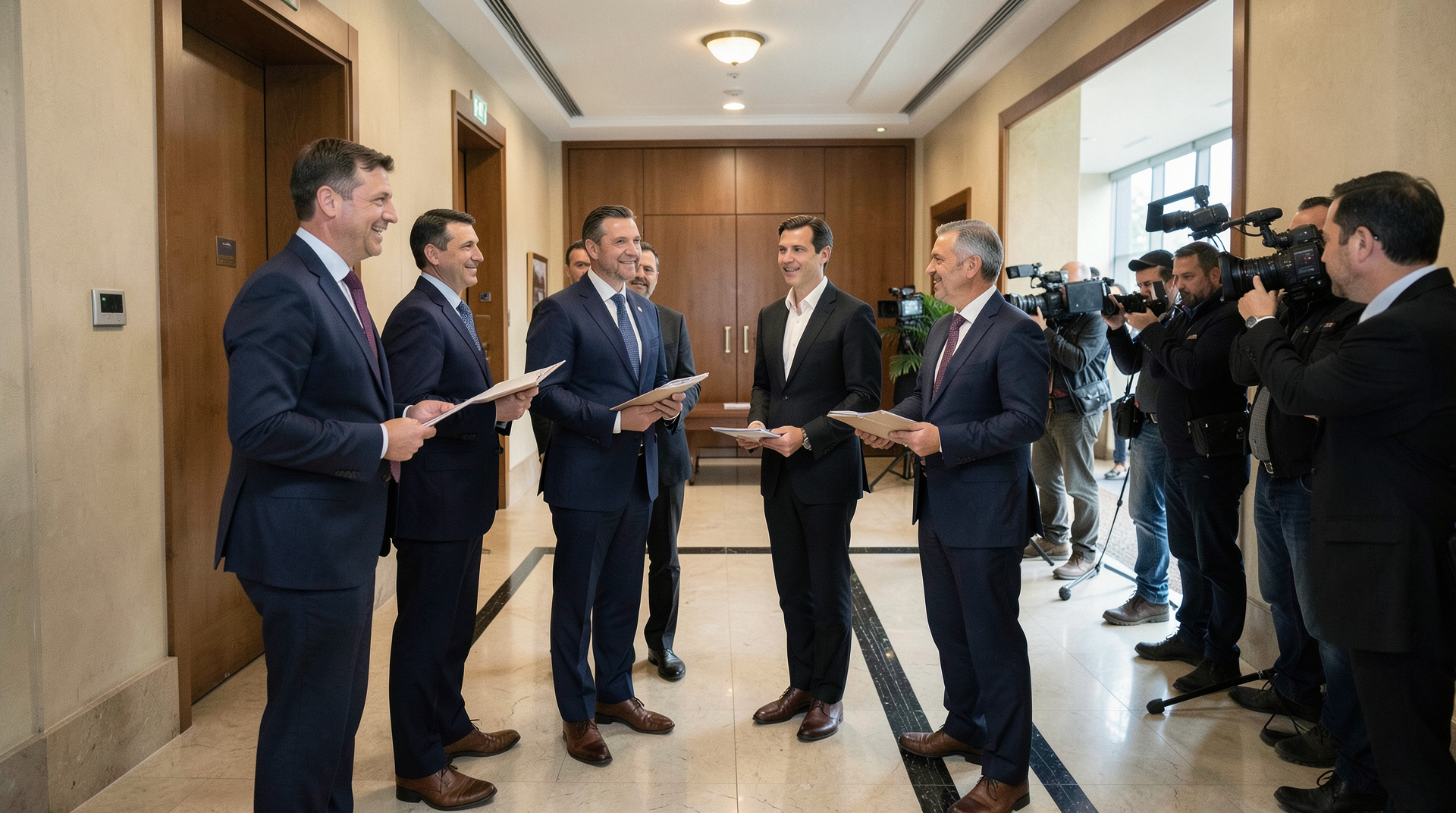
Iran deal claims split before text appears because Washington, Tehran, and Pakistan are now describing a signing window before the public has one common document to inspect. The paper's June 12 lead argued that movement was real but settlement was not, because the record had paper with rival owners rather than a common public text. Saturday sharpens that warning. AP now reports Pakistani expectation of a U.S.-Iran deal within 24 hours and a possible electronic signing, while Al Jazeera reports Trump saying the agreement would be signed Sunday and Iranian officials saying no such official terms or Sunday signing exist. [1] [2]
The first fact is the timing split. AP's account places the diplomacy near enough to the finish line for Pakistan to speak of a deal within a day, and it ties the expected settlement to reopening the Strait of Hormuz. [1] Al Jazeera's account gives the contradiction its plain form: Trump told reporters that Iran would sign tomorrow, while Iranian Foreign Ministry spokesman Esmaeil Baghaei said reports of a Sunday signing were not accurate and that no terms had been officially released. [2] The live Al Jazeera record kept the same distinction through the day, treating peace as within reach but not signed. [3]
The second fact is the missing text. A settlement that changes nuclear limits, sanctions relief, frozen funds, shipping rules, Lebanon, and inspection authority should be legible enough for the parties to name the same document. Instead, the public sees a series of claims: a Pakistani expectation, a presidential signing window, Iranian denial of official terms, and liveblog caveats that the agreement remains unsigned. [1] [2] [3]
The social-media frame is brutal and partly earned. X turns the gap into fake peace, betrayal, or another presidential declaration that outran the settlement. That frame can flatten diplomacy into suspicion. But it notices the failure that official phrasing can soften. If the deal is ready for signature, the text should not be harder to find than the congratulatory posts about it.
The mainstream frame is more disciplined but still incomplete. AP and Al Jazeera preserve the sequence of public claims and denials, which is essential. [1] [2] Yet the reader who stops at a headline about possible signing may miss the operating question: what exactly changes for a vessel entering Hormuz, an inspector entering an Iranian facility, an Israeli planner reading a Lebanon clause, or a family waiting for an account of killed sailors?
Diplomacy often moves through ambiguity. That is not the same as asking the public to call ambiguity a settlement. A negotiated text can be initialed privately before release. Sanctions schedules can require classified annexes. Verification can take days to describe. But each of those explanations depends on institutional receipts that have not appeared in public: a signatory list, a timetable, a verification method, a sanctions mechanism, and a shipping rule.
The Hormuz promise is the cleanest test because it turns language into ship movement. AP connects the expected deal to claims that the strait would reopen. [1] The paper has treated that promise as a harder question than diplomacy because insurers, ports, crews, navies, and commodity buyers do not operate on atmosphere. They need channels, warnings, escorts, premiums, and liability rules. A statement that the water is open is not the same thing as safe passage.
The nuclear file carries the same problem. Al Jazeera's reporting says Iranian officials disputed the signing claim and said terms had not been officially released. [2] That leaves the public unable to compare the nuclear language Trump describes with the nuclear language Tehran accepts. It also leaves Congress unable to tell whether conditions and verification demands have been met or merely postponed.
Lebanon is another unresolved edge. A settlement that speaks of regional fronts but binds only some parties would not end the operational file. It would move the war from one register to another. The public text must say whether Lebanon is a ceasefire provision, a monitoring mechanism, a proxy commitment, or a sentence in a diplomatic summary that Israel can ignore. Until then, the clause is rhetoric, not control.
The Pakistani role deserves equal caution. Pakistan may have real diplomatic visibility. It may also be describing expectation rather than a document. AP's account makes Islamabad part of the public timing chain. [1] That matters because third-party optimism can move markets and audiences while still being one step removed from the parties that have to sign and implement the deal.
Iran's denial does not prove the process is fake. It proves the process is not public enough for the reader to audit. Al Jazeera's live record described U.S. and Iranian signals that peace was within reach while noting that it had not been signed. [3] That is a useful sentence precisely because it refuses to collapse movement into settlement. The distinction has been the paper's whole Iran file.
The practical test is now a list, not a mood. Is there a shared document? Who signs it, electronically or in person? Does it name uranium enrichment, inspectors, frozen funds, sanctions, military withdrawals, proxy obligations, and Hormuz safety? Does it say what happens if a ship is hit during implementation? Does it explain how Israel, Lebanon, Pakistan, and Gulf states fit into a U.S.-Iran text?
Inspection is the first place where vague optimism should fail. If nuclear language exists, the public does not need every classified annex to know whether the deal restricts enrichment, restores inspectors, creates a timetable, or postpones those questions to later talks. Al Jazeera's report that Iranian officials denied official terms had been released means the public cannot yet compare Trump's nuclear claims with Tehran's accepted obligations. [2]
Sanctions relief is the second place. A deal that lifts oil sanctions, releases frozen funds, or changes banking channels would leave receipts outside the foreign ministries: Treasury language, bank notices, shipping insurance, oil-company behavior, and escrow instructions. None of those has the glamour of a signing ceremony. All of them are more reliable than an adjective about closeness. AP's record of Pakistan's expectation is meaningful, but it is not a sanctions schedule. [1]
Verification is the third place. A private understanding can open talks. It cannot ask families, crews, and markets to behave as if the conflict has ended unless someone can say who checks compliance. The Al Jazeera live record kept saying peace was within reach but not signed. [3] That is not pedantry. A settlement without a monitor is a promise to argue later.
The family's version of the same problem is less diplomatic. If ships have been struck and sailors killed, a Monday morning text must tell third countries what changed. Does passage resume under escort? Do prior incidents get investigated? Are claims waived, compensated, or ignored? The missing text is not merely a reporter's complaint. It is the difference between a government telling its citizens that a route is safe and telling them to infer safety from a press conference.
Even the idea of an electronic signature needs scrutiny. Electronic signing can be perfectly valid. It can also become the phrase used when nobody wants to show where the signature happened, who witnessed it, and what paper received it. If Sunday produces a signed document, the evidence should be mundane: names, time, text, and publication. The threshold is not high. It is just higher than atmosphere.
The same standard applies to Pakistan's role. A mediator or friendly capital can preview a real outcome before principals publish it, and AP's account makes that expectation newsworthy. [1] But an expectation is not the executed instrument. If Islamabad has seen the same document Washington and Tehran intend to sign, the follow-up should say so. If it is reading diplomatic temperature, the public should not confuse that with law.
This is why the lead belongs above the war's ordinary noise. The dispute is not a side argument about public relations. It is a test of whether peace in this conflict means institutions changing their behavior or leaders racing to occupy the headline before the other side writes the terms. The first produces enforceable quiet. The second produces another weekend of claims.
Markets and political accounts will want a cleaner story. A signing headline rewards hope. A fraud headline rewards suspicion. Neither headline gets a sailor through Hormuz, an inspector into a facility, or a legislator to a condition. The reader needs the ugly middle: the place where each claim is matched to an operating receipt.
That is why Saturday's story is not a peace story yet. It is a claims story. The claims are closer to settlement than yesterday's silence, and they may turn into a real agreement. But the public record still has too many speakers and too little common text.
There is movement. There is no published settlement. There is a signing window. There is an Iranian denial. There is social-media celebration and social-media contempt. What there is not, as of Saturday's public file, is one text that tells ships, inspectors, markets, lawmakers, and families what changes on Monday morning. That absence is the lead.
-- YOSEF STERN, Jerusalem