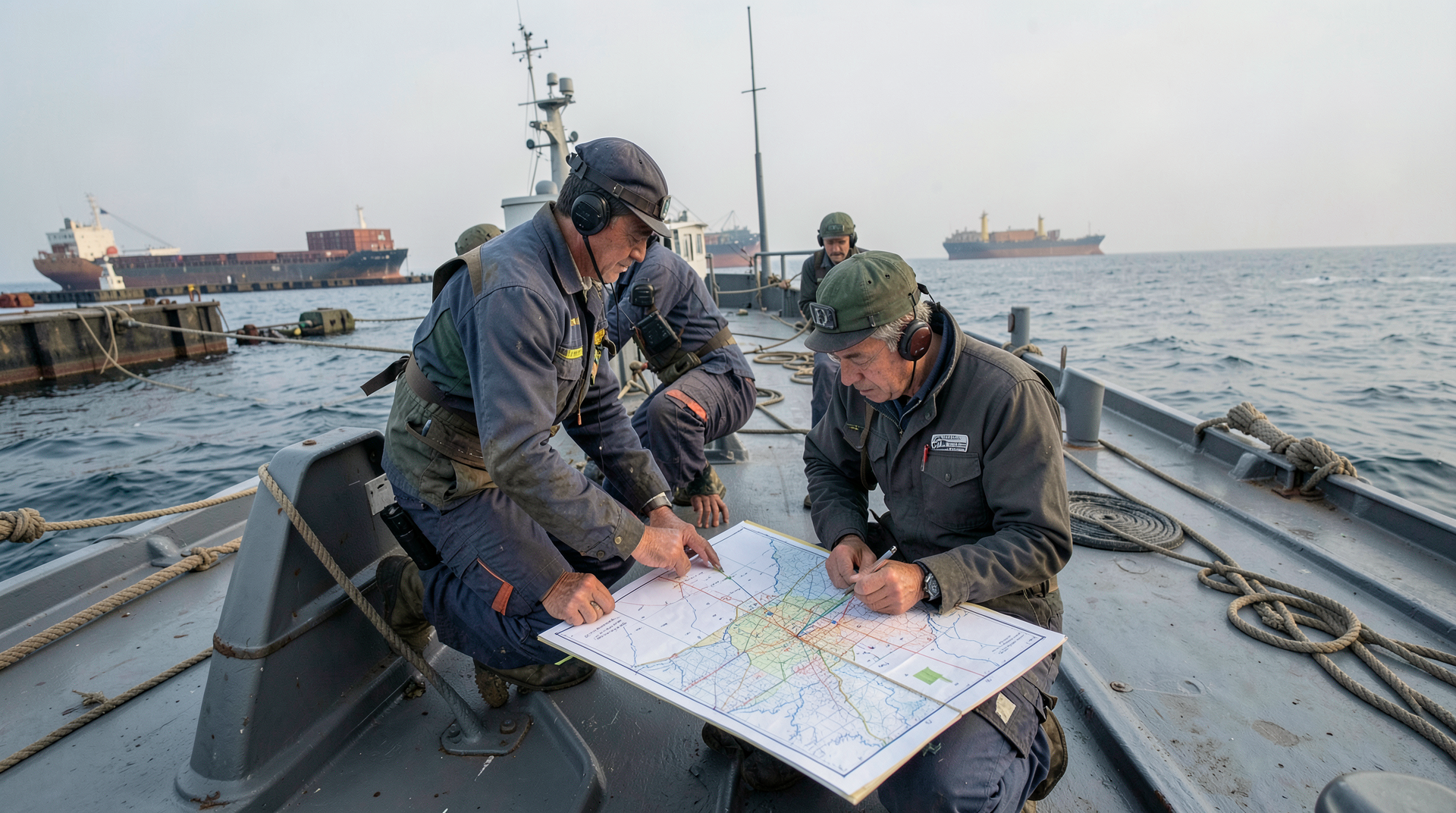
The Strait of Hormuz does not open when a leader says the word open. It opens when crews can navigate a safe channel, insurers can price the risk, ports can issue instructions, and traffic records show ships moving through without special pleading. The paper's June 12 brief said Hormuz still lacked a public shipping rulebook; Saturday adds a harder contradiction, because AP reports reopening claims while a separate AP account describes minehunting and underwater threats as work that can take months. [1] [2]
The diplomatic register is simple. AP's Iran-deal story says the expected settlement was tied to reopening Hormuz, and the June 13 public argument around the deal made the strait part of the promise. [1] The operating register is slower. AP's minesweeping report describes the Navy's mine countermeasure problem as technical, dangerous, and time-consuming. [2] Those two tempos cannot both be the whole truth.
Shipping follows the slower tempo. A captain does not ask whether a politician has declared water open. He asks whether the route is marked, whether mines have been found or ruled out, whether drones or missiles are still part of the risk, whether the flag state and insurer accept the voyage, and whether there is an emergency contact if something goes wrong. That is why the International Maritime Organization's warning about no safe passage in the Strait of Hormuz matters as much as any deal sentence. [3]
The IMO's Settebello statement keeps the human cost in view. The organization treated the attack on the MT Settebello as a seafarer-safety matter, not a commodity-price abstraction. [4] That distinction matters because reopening language can make the route sound like a valve. It is not a valve. It is a workplace for crews and a liability chain for owners, charterers, cargo buyers, and governments.
The energy consequence is equally concrete. EIA's chokepoint analysis explains why Hormuz is not merely a regional route; it is one of the world's central oil-transit passages. [5] A disruption there reaches refiners, airlines, power markets, and households. That is why the gap between announcement and safe passage has economic value. A day of rhetorical reopening can move prices. A week of insurer doubt can move them back.
Insurance is the quiet veto. War-risk underwriters do not need to accuse any government of lying in order to keep premiums high. They can simply price uncertainty, demand exclusions, refuse a route, or wait for official safety guidance. That is why IMO language matters. The organization is not trading oil futures; it is warning about seafarers and passage conditions. [3]
Minehunting is the physical veto. AP's minesweeping account makes clear that underwater threats are not cleared by a communique. [2] Crews need detection, disposal, verification, and time. Even a narrow safe lane requires confidence that vessels will not drift into danger, that adversaries will not reseed the route, and that an accident will not be treated as a political trick.
The Settebello attack keeps the route from becoming a map exercise. IMO's statement placed the vessel and crew inside the safety file. [4] Reopening language that does not account for struck vessels asks crews to absorb the ambiguity that leaders would rather not specify. That is not an economic model; it is a human job hazard.
EIA's chokepoint record turns those hazards into household exposure. [5] If Hormuz risk stays expensive, it enters oil, refined products, freight, LNG, and eventually the price of ordinary movement. If safe passage returns, the relief should show up in traffic and premiums before it appears as durable consumer relief. The paper should follow those receipts in that order.
The X frame is empty in the article metadata because the search log produced no clean same-day Hormuz status worth printing. That absence is itself instructive. Social media can declare fake peace or victory, but the usable public file belongs to AP, IMO, EIA, ship records, and future insurer notices. The paper should not fill an empty discourse slot with a stale opinion thread.
The next receipt should be boring. A safe-channel map. A port circular. A war-risk premium update. A convoy instruction. A navy demining statement. A carrier notice. An AIS pattern showing ordinary traffic instead of exceptional movement. None of those receipts has the drama of a signing claim. All of them matter more to the ship.
Hormuz may reopen quickly. It may reopen unevenly. It may be declared open while remaining commercially constrained. The difference between those outcomes will not be settled by the first celebratory post. Mine teams, insurers, ports, and ships will decide it, one passage at a time.
-- DARA OSEI, London