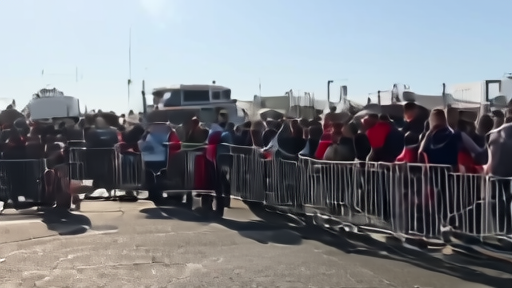
The World Cup's second-day problem is not a scoreboard; it is whether an ordinary fan can get in, pay, breathe, wait, and leave safely. BBC's analysis of the tournament named heat, cost, environmental burden, and travel restrictions as live questions beside the football itself [1]. Its opening-ceremony report made the scale visible: 48 teams across the United States, Canada, and Mexico, with fans paying as much as $1,900 each for imperfect seats in Los Angeles [2].
The paper's June 12 account of World Cup policing as the opening story argued that the tournament had become civic infrastructure before it became sport. The same edition said the welcome ran through a border checkpoint, health surveillance began with measles, and heat plans met stadium lines. Saturday joins those pieces. The fan experience is the operating system.
Health departments are already writing that system in clinical language. San Francisco told clinicians that World Cup travel could import measles, typhoid, tuberculosis, influenza, and other infections, and asked them to document travel history, match attendance, clusters of disease, and heat-stress presentations [3]. Houston's FIFA health page tells clinicians to "Think Travel History," report notifiable conditions, and use World Cup-specific health resources during the June-July visitor surge [4]. A match ticket is therefore also an epidemiology prompt.
Weather makes the prompt less abstract. The Bay Area forecast discussion and the national Heat Advisory product show why a fan's route to a seat matters as much as the stadium policy [5]. The Heat Advisory text warned of hot conditions, higher risk for heat illness, and the need for fluids, air conditioning, shade, and rescheduled outdoor work where possible [6]. A hydration break inside the game does not cool a security queue, a shuttle line, or a protest pen.
Then comes price. CBC reported that Toronto's six hosted matches were still not sold out shortly before kickoff and that the cheapest remaining Canada-Bosnia seats started above $1,000, with better seats above $3,000 [7]. Sportstar's Saturday account added the visual politics of empty rows, noting criticism after unoccupied seats appeared around Guadalajara even as FIFA reported 44,985 attendance for South Korea-Czechia [8]. That distinction is why the FIFA Media status matters: scanned attendance, sold inventory, visible seat occupancy, and priced-out demand are not the same metric.
Mainstream coverage supplies the pieces but rarely puts them in one fan ledger. BBC can ask about heat and travel, CBC about tickets, city health desks about diseases, and NWS about heat illness. X performs the opposite compression. One image of empty seats becomes gouging. One police clip becomes the tournament's truth. One health advisory becomes panic. The reader needs the combined version because the body that buys the ticket is the same body that crosses the border, stands in the heat, and may need a clinic.
The tournament's promise is universal access to a global festival. The receipts are narrower: visas, prices, scanner counts, clinician instructions, weather advisories, and public-safety plans. A host can sell unity from a stage. A fan meets unity at a turnstile.
The border piece matters even when it is not the article's center. BBC's opening report described a tournament spread across three countries, with Mexico, Canada, and the United States all staging the same spectacle through different entry systems, local ceremonies, and travel burdens [2]. San Francisco's health advisory assumes the same movement: millions of visitors, domestic and international travel, and local events even in cities not hosting matches [3]. The World Cup is advertised as one tournament. It is operated as dozens of jurisdictional handoffs.
Those handoffs make the price story harsher. Toronto's unsold inventory does not mean the World Cup lacks demand; it means demand and affordability can live in different places [7]. Sportstar's empty-seat controversy shows the same problem from the camera angle: a crowd can be officially large and still look wrong to viewers who know that a scanned fan is not necessarily a full stadium bowl at a particular minute [8]. A sport that sells itself as mass belonging must explain why belonging has so many accounting categories.
The safest reading is not that the tournament is failing. It is that the tournament's success will be measured outside the match report. The question is whether host cities can turn weather alerts, disease surveillance, border processing, ticket resale, transit, and crowd control into a single humane day for the person who came to watch football. That is a harder box score, and a better one.
-- AMARA OKONKWO, Lagos