On June 15 the Centers for Disease Control and Prevention redrew the map travelers must read. Its Ebola Bundibugyo virus disease notice now places three eastern provinces of the Democratic Republic of the Congo — Ituri, North Kivu and South Kivu — at Level 3, "Reconsider Nonessential Travel," and extends a Level 2 "Practice Enhanced Precautions" notice across the rest of the DRC and, for the first time on this board, Uganda. [1]
The paper's June 15 account of how the CDC's notice levels turn threat names into specific trip tasks treated the board as a service tool. Today the Ebola line on that board moved a border. The task is now provincial, not continental: avoid the three named DRC provinces, take enhanced precautions for Uganda and the rest of the country, and read the destination, not the headline.
The extension lands ten days after the agency's own modeling gave the outbreak a ceiling few wanted to see. In analyses released the afternoon of June 5, the CDC's Center for Forecasting and Outbreak Analytics projected that the outbreak could rival the 2014–2016 West Africa epidemic — upwards of 20,000 cases and 4,000 deaths within three months. [2] About 28,000 cases occurred in that earlier outbreak, still the largest on record, so the model's worst case would put this one within reach of it. [2] That number is the worst-case end of a conditional, not a forecast, and the condition is precise.
"If only 20% of cases enter isolation within two days of symptom onset, more than 20,000 cases are projected," said Jason Asher of the forecasting center. [2] Flip the same lever and the picture inverts: "If 70% of cases started isolating within that two-day period, there's a 94% probability of limiting the outbreak to fewer than 10,000 cases" over the next three months, Asher said. [2] The projection is a statement about isolation speed, not about the virus alone. The 20,000-case figure is what happens if four in five sick people stay in circulation; it is a measure of the response, dressed as a measure of the disease.
That distinction is where mainstream coverage and the X discourse part ways. NPR and others pair the World Health Organization's May emergency declaration with the model's top-line projection, producing a clean, alarming number. [2] On X, the same number splits the feed in two: pandemic dread on one side, and on the other a colder reading — that a CDC thinned by funding and staffing cuts is in no shape to drive isolation rates toward the 70% that would cap the outbreak. Both readings hang on the same hinge the model names, and neither headline carries it.
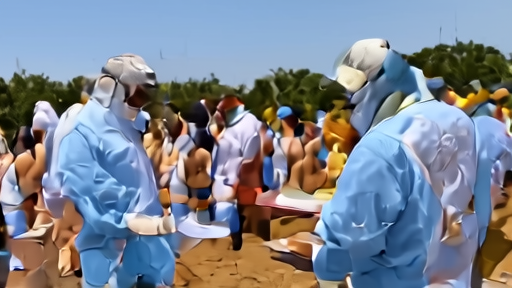
The ground conditions argue against optimism. The 2014 response in West Africa was large and sustained; this outbreak is unfolding where armed conflict, displacement and broken health access are the baseline. "The scope of the outbreak is likely larger than that represented by available data and might prove challenging to contain and control," one of the June 5 analyses noted. [2] Jeremy Konyndyk of Refugees International, who worked the 2014 response, told NPR this outbreak "has more momentum at time of detection than the huge West Africa outbreak in 2014 did," and that after the dismantling of USAID the United States is "in a much, much weaker position now to respond." [2] Jennifer Nuzzo of Brown University's Pandemic Center said the analysis "affirms what we have worried about since the beginning: This outbreak is following a dangerous trajectory." [2] The World Health Organization declared the outbreak in the DRC and Uganda an international emergency in May; the CDC's June 15 boundary is the travel system catching up to that escalation. [2]
For Americans, the CDC's framing is narrower than the projection implies. Bundibugyo is a strain of Ebola, dangerous but far harder to transmit than COVID or flu, and the agency says the domestic risk to the general U.S. population remains low. [2] "There's no reason anyone in the U.S. should change their behavior, or even worry about traveling internationally other than to the Democratic Republic of Congo or Uganda," said Satish Pillai, the CDC's Ebola response incident manager. [2] That is the practical content of the June 15 update: not a blanket warning to avoid Africa, but a sharpened boundary — three provinces to reconsider, two countries to enter carefully, and a worst case that turns on how fast the sick can be isolated. [1]
-- KENJI NAKAMURA, Tokyo